Are there heritage or conservation
restrictions?
Are heritage or conservation rules shackling your Milton property? Read this before you buy, sell, renovate, or demolish.
Quick answer up front
Yes — heritage and conservation restrictions exist in Milton, Ontario. They come from three places: the Ontario Heritage Act (municipal designations and heritage districts), Conservation Halton (environmental regulation), and the Niagara Escarpment Plan where it applies. Each one can limit what you do with a property. Know which applies before you sign anything.
Why this matters — straight talk
You can buy a house in Milton and think you own the freedom to change it. Not always true. If a property is listed or designated under the Town of Milton’s Municipal Heritage Register, or lies in a Conservation Halton regulated area, you may need permits, heritage approvals, or face fines for unauthorized changes. That impacts resale value, renovation costs, insurance, and timelines.
The three rules that control properties in Milton
-
Ontario Heritage Act (municipal level)
-
What it is: Province-wide law that lets municipalities list, designate, and protect buildings or areas with cultural heritage value.
-
How Milton uses it: Town Council can place properties on the Municipal Heritage Register, issue Part IV designations for individual properties, and create Part V Heritage Conservation Districts (HCDs).
-
Effect on owners: Designated property owners usually need a Heritage Permit for alterations, additions, and demolition. Demolition can be delayed by council review.
-
Conservation Halton (environmental regulation)
-
What it is: The regional conservation authority that regulates development in floodplains, wetlands, valleylands, watercourses and hazard areas.
-
How Milton uses it: Many Milton properties fall within Conservation Halton’s regulated areas. If you’re in a regulated area, you must get permission from Conservation Halton before development, grading, shoreline work, or certain tree removals.
-
Effect on owners: Permits, engineering studies, setback requirements, and sometimes redesign or denial of proposals.
-
Niagara Escarpment Plan & Commission (where applicable)
-
What it is: A provincial land-use plan protecting the Niagara Escarpment’s environmental and scenic values. Some parts of Milton sit within the Niagara Escarpment Plan area.
-
Effect on owners: Development permit system, stricter controls on lot creation, land use, and changes to heritage or natural features in the Escarpment area.

How to check if a Milton property is affected — step-by-step
- Search the Town of Milton Municipal Heritage Register
- This is the authoritative list of properties on the radar. If a property is on the Register, it may be designated now or later.
- Check Town of Milton planning & heritage staff
- Contact Milton’s Planning or Heritage staff. Ask if the property is designated, in an HCD, or has heritage status pending.
- Title search and local by-laws
- A title search will reveal official designations or conservation easements registered on title. Your lawyer must do this before closing.
- Contact Conservation Halton
- Use their interactive maps or call them to confirm regulated area status. Ask if the property sits in a floodplain, wetland, valleyland, or watercourse buffer.
- Check the Niagara Escarpment mapping
- If the property is in the Escarpment Plan area, you’ll face the NEC development permit process.
- Ask for existing permits and site plans
- Review past permits, approvals, and compliance letters. Those documents show what was approved and any conditions that still apply.
Common scenarios and what they mean for you
-
Buying a designated heritage home
-
You can own it. You may need municipal approval to alter character-defining elements. Expect application fees, longer timelines, and restrictions on demolition.
-
Renovating a heritage building
-
Work that affects the exterior or character-defining features will likely need a Heritage Permit and a conservation-minded contractor. Interiors are often less restricted unless the designation specifically lists interior features.
-
Building in a Conservation Halton regulated area
-
You’ll likely need a permit and technical reports (e.g., flood report, environmental impact). Expect set-back rules and potential project redesign.
-
Property inside the Niagara Escarpment Plan area
-
The NEC may require a development permit. This can add time and conditions to a transaction or project.
Real consequences — numbers and outcomes
- Delayed closings: If a property needs a heritage or conservation approval and the buyer didn’t check, closing can be delayed weeks or months.
- Unexpected costs: Heritage conservation work is typically more expensive. Conservation authority conditions often require engineering or mitigation work that adds tens of thousands of dollars.
- Denials and redesigns: Conservation Halton or NEC can require design changes or deny development in sensitive areas. That can kill a deal.
Benefits — yes, there are upsides
- Value premium: Some heritage properties command higher prices because of history and character.
- Grants and incentives: Milton and provincial programs sometimes offer grants or tax relief for conservation work.
- Protection of neighbourhood character: Heritage districts can protect long-term value by keeping developments in character.

How a smart buyer or owner handles this (exact playbook)
- Start early. Check the Heritage Register and Conservation Halton maps before an offer.
- Add conditions. Make your offer conditional on a heritage status review and Conservation Halton confirmation.
- Hire specialists. Use a heritage consultant when dealing with designated properties. Use a civil engineer for Conservation Halton issues.
- Talk to planning staff. Call the Town of Milton planning and Conservation Halton to get informal guidance before committing.
- Budget appropriately. Add contingency for heritage-sensitive restoration and permit conditions.
- Use an informed realtor. Work with someone who knows Milton’s processes and fights for clean approvals and realistic timelines.
Practical example (common Milton case)
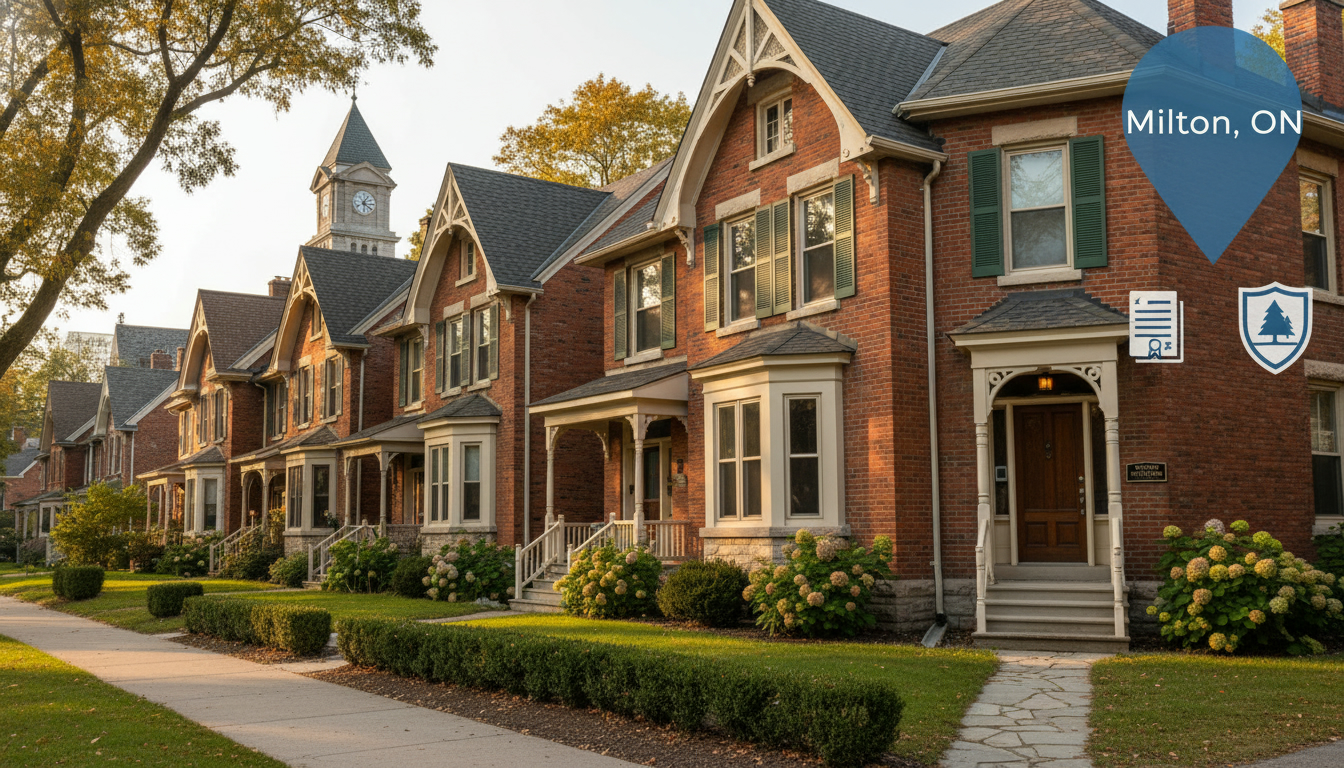
A buyer finds a 120-year-old brick home near downtown Milton. The house is attractive but partly in a Conservation Halton regulated valleyland, and it’s on the Municipal Heritage Register. The buyer follows the playbook: checks the Register, talks to Milton planning staff, and contacts Conservation Halton. They learn a Heritage Permit is needed for new windows and an engineered flood mitigation plan is required for a basement addition. The buyer includes contingencies in the offer. The seller agrees to a price and the buyer budgets for the extra work. The result: a successful purchase with a realistic renovation plan and no legal surprises.
Local laws and policy references (where to read)
- Ontario Heritage Act (Provincial law) — sets out designation powers and protections.
- Town of Milton Municipal Heritage Register — available on the Town of Milton website.
- Town of Milton Official Plan — heritage and cultural policies.
- Conservation Halton regulations and mapping — for floodplains, wetlands, valleylands, etc.
- Niagara Escarpment Plan and NEC Development Permit System — if applicable to property.
Access these documents online or ask Town staff for links and advice.
How I help as your Milton property expert
I’m Tony Sousa — Milton-based realtor focused on Legal & Documentation for property deals in Milton, ON. I guide buyers and sellers through heritage and conservation checks. I explain which approvals apply, coordinate specialists, and keep transactions moving. Call or email for a free property-status check before you buy or list.
Contact: tony@sousasells.ca | 416-477-2620 | https://www.sousasells.ca
FAQ — quick, clear answers to what owners ask most
Q: What’s the difference between being on the Municipal Heritage Register and being designated?
A: The Register lists properties with potential heritage value. Designation (under Part IV or V of the Ontario Heritage Act) gives legal protection. A property on the Register can be designated later; designation typically brings permit requirements.
Q: Can the Town stop me from demolishing my house?
A: If the property is designated, demolition often requires council approval and a Heritage Permit. The Town can delay demolition while it considers designation. If it’s not designated and not in an HCD, demolition is usually governed by other municipal rules.
Q: Who enforces conservation restrictions like floodplain rules?
A: Conservation Halton enforces environmental regulations. They issue permits and can stop unauthorized work in regulated areas.
Q: Does being in a heritage district mean I can’t renovate inside?
A: Most heritage protections focus on exterior and character-defining elements. Interior work is usually less restricted, but check the specific designation by-law.
Q: Are there financial supports for heritage property owners?
A: Sometimes. Towns and provinces may offer grants, tax relief, or conservation incentives. Check with Town of Milton heritage staff and provincial programs.
Q: How do I confirm a property’s status before making an offer?
A: Perform a title search, check the Municipal Heritage Register, contact Town planning staff, consult Conservation Halton, and add conditional clauses in your offer.
Q: What if my property has both heritage and conservation restrictions?
A: You’ll need to satisfy both sets of rules. That often means dual applications (Heritage Permit + Conservation Halton permit) and coordination of specialists.
Q: Can designations be removed?
A: Rarely and only through a Council process or provincial order. Removing a designation is not simple and can be politically sensitive.
Final straight advice
Don’t assume nothing applies. Check. Ask. Budget. Use contingencies. And use a Milton expert who knows the Town of Milton register, Conservation Halton rules, and the Niagara Escarpment process. I offer a no-cost property status check so you can move fast and avoid costly surprises.
Contact: tony@sousasells.ca | 416-477-2620 | https://www.sousasells.ca
This article is for general information. For legal advice, consult a qualified lawyer or heritage consultant.