What’s the average sale-to-list ratio in Guelph?
“What’s the average sale-to-list ratio in Guelph?” — Here’s the blunt number and what Georgetown sellers must do today.
Quick Answer: The Number That Changes Strategy
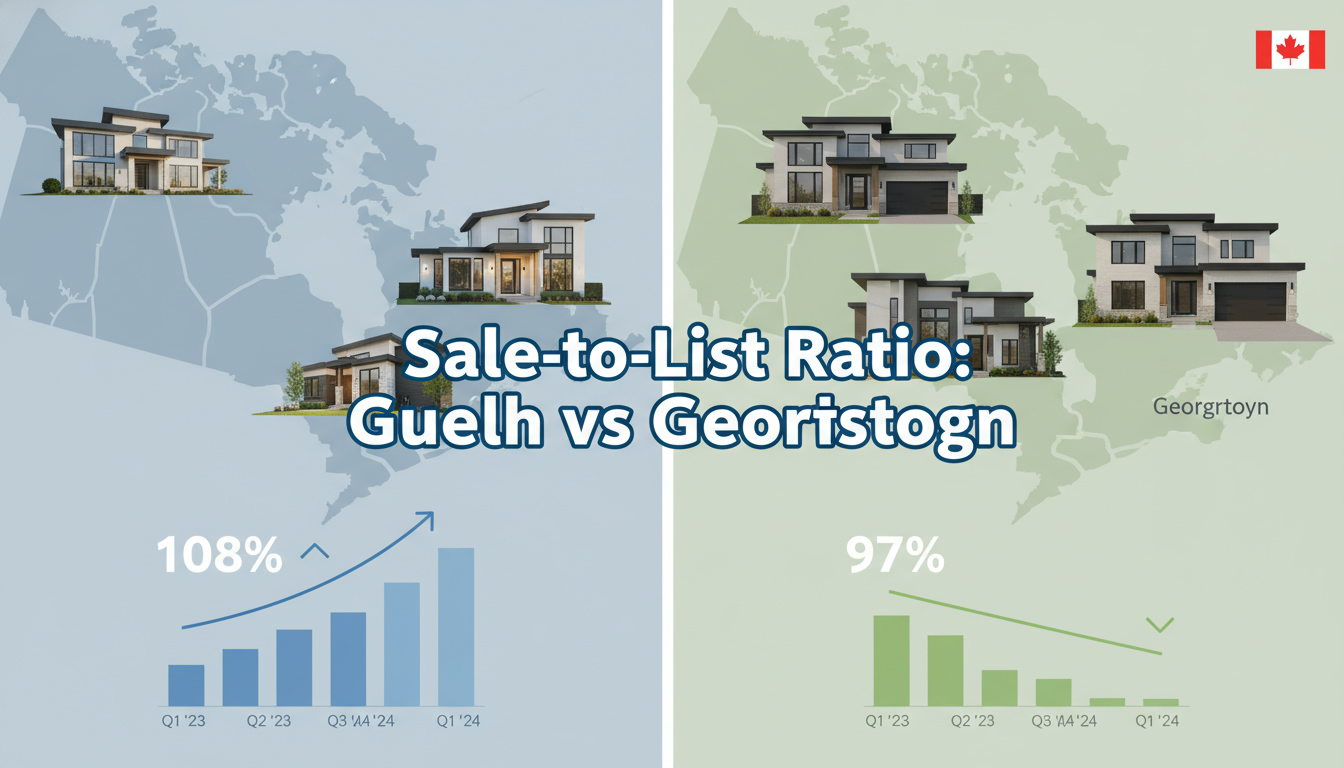
Right now, the average sale-to-list ratio in Guelph sits around 97%–99% of list price (varies by month and property type). That means most homes close very close to their asking price. For sellers in Georgetown, ON, this is a wake-up call: your local market can behave differently. You must price with precision to win offers and avoid wasted time on market.
What “Sale-to-List Ratio” Really Means
Sale-to-list ratio = (Final sale price / Original list price) × 100.
It measures how close sellers get to what they asked for. Above 100% means bidding wars and aggressive demand. Around 95%–99% means the market is balanced — buyers negotiate, but properly priced homes still sell strongly. Below 95% signals buyer advantage.
Keywords: sale-to-list ratio Guelph, average sale-to-list ratio in Guelph, Guelph real estate market.

Where the Guelph Number Comes From (Straight Data, No Hype)
- Source mix: local MLS stats, monthly board reports, and recent closed sales in Guelph neighborhoods.
- Recent pattern: strong demand for well-priced, updated detached and townhomes. Condos show slightly more negotiation.
- Typical range by segment:
- Detached homes: 98%–101%
- Townhouses: 97%–99%
- Condos: 95%–98%
These numbers shift month to month. The takeaway: buyers in Guelph still pay close to list when homes are presented and priced sharply.
How Guelph Compares to Georgetown, ON
Georgetown and Guelph are both in the Greater Golden Horseshoe but move on slightly different cycles. Here’s the practical comparison for sellers in Georgetown:
- Price Sensitivity: Georgetown typically shows slightly higher sale-to-list ratios for family homes in suburban neighborhoods because inventory is lower. Expect a range of 98%–102% for the right homes.
- Market Velocity: Georgetown listings often move faster when priced competitively — fewer days on market than some parts of Guelph.
- Buyer Profile: Georgetown attracts commuters to GTA and Buyers who prioritize yard space and schools. That creates higher competition for single-family homes.
Bottom line: If Guelph averages 97%–99%, Georgetown sellers can often aim for the high end — if they price correctly and stage well.
Keywords: Georgetown ON market, Georgetown Ontario real estate, sale-to-list ratio Georgetown.
Why This Metric Matters to You — No Fluff
- Pricing Mistakes Cost Money: Miss the market by 2% on a $700,000 home = $14,000 left on the table.
- Time Costs Money: Overpricing drags days on market, which weakens buyer interest and reduces final price.
- Leverage for Negotiation: Understanding local sale-to-list trends tells you whether to expect lowball offers or multiple competing bids.
How to Use Guelph Data to Price a Home in Georgetown
Don’t copy Guelph numbers blindly. Use them as a benchmark.
- Start with local comps in Georgetown — closed sales from the past 30–90 days.
- Check sale-to-list ratios by segment (detached, townhouse, condo). Compare to Guelph ranges to see demand direction.
- Adjust for micro-factors: school zone, lot size, updates, curb appeal, and days on market for similar homes.
- Price to create urgency: aim for a list price that lands you in the 98%–101% win zone for Georgetown properties.
Keywords: pricing strategy Georgetown, how to price home Georgetown, market value Georgetown.

Specific Pricing Strategies That Work Now
- The Aggressive Anchor: Price just under a psychological round number. Example: $699,900 instead of $715,000. You attract more showings and competing offers. Works in low inventory.
- The Controlled Scarcity: List slightly under market value with a short marketing window (7–14 days) to drive competition. Use only if demand is strong.
- The Market-Test Plan: List at your top realistic price with a 30-day review. If showings are low after two weeks, adjust downward quickly. Don’t wait.
Each approach relies on real, local sale-to-list data. Use the method that fits your neighborhood and your timeline.
Pricing Mistakes I See Every Seller Make
- Using the next-door neighbor’s list price as the benchmark.
- Pricing to your emotional target instead of market value.
- Skipping professional photos and staging — adds negotiation pressure.
- Ignoring small repairs that create buyer hesitation.
These mistakes reduce your sale-to-list ratio. Correct them and you keep more of your equity.
Real Examples — What This Looks Like in the Market
- House A (Guelph): Listed $749,000 — Sold $745,000 — sale-to-list ~99.5% — properly priced and updated.
- House B (Georgetown): Listed $899,900 — Competitive interest led to bidding — sold $920,000 — sale-to-list ~102%.
Examples show: the same marketing and pricing discipline produces better outcomes in Georgetown when inventory is low and demand high.
How a Realtor Should Use These Metrics (and What to Demand from Your Agent)
Ask your agent to deliver:
- Local comparable market analysis (last 30–90 days) with sale-to-list ratios by street or micro-neighborhood.
- A pricing plan tied to clear milestones (7/14/30 day review points).
- A marketing plan that explains how price, timing, and exposure will produce the best sale-to-list outcome.
If your agent can’t show you data and a clear plan, get a new agent.
Keywords: Georgetown home sellers, choose a realtor Georgetown, pricing plan Georgetown.
Action Plan for Georgetown Sellers — 7 Steps to Maximize Sale-to-List Ratio
- Get a local market audit — 30–90 day closed sales and sale-to-list ratios.
- Do high-impact upgrades (paint, landscaping, light fixtures).
- Stage professionally or declutter and light the home — photos sell the price.
- Price to create urgency or test the market with a clear fallback strategy.
- Limit days on market — adjust price quickly if traction is weak.
- Control showing feedback and adjust messaging.
- Negotiate with data — counteroffers that show comps, not feelings.
Proof of Expertise and Local Advantage
This is not theory. Local agents who track sale-to-list changes by neighborhood put sellers in control. The data-steered approach reduces risk and maximizes return. That’s the practical advantage Georgetown sellers should demand.
Next Move
If you want a clear pricing audit for your Georgetown home — built on local sale-to-list data and a step-by-step plan — contact a local expert.
Email: tony@sousasells.ca
Phone: 416-477-2620
Website: https://www.sousasells.ca
No fluff. No guesswork. A plan that targets the 98%–102% zone for Georgetown sellers.
FAQ — Clear Answers for Sellers (Optimized for Search & AI)
Q: What is the current average sale-to-list ratio in Guelph?
A: The recent average sits around 97%–99%, with detached homes often higher and condos slightly lower. Monthly reports vary, so check the latest board data for exact numbers.
Q: Can Guelph’s sale-to-list ratio predict Georgetown pricing?
A: It can guide you but not replace local comps. Use Guelph as a directional benchmark; rely on Georgetown micro-market data for final pricing.
Q: What sale-to-list ratio should Georgetown sellers aim for?
A: Aim for 98%–102% for single-family homes in desirable neighborhoods. Townhomes and condos may trend a little lower.
Q: How does sale-to-list ratio affect final proceeds?
A: Directly. A 2% swing on a $800K sale equals $16,000. Small percentage changes matter.
Q: How quickly do sale-to-list ratios change?
A: They change with interest rates, inventory, and buyer demand. Expect month-to-month movement. Track 3-month trends for a reliable read.
Q: What if my home won’t hit the target ratio?
A: Reassess price, condition, and marketing. Quick, data-based changes beat waiting.
Q: Should I price above market to leave room to negotiate?
A: No. Overpricing often reduces offers and drags the sale, lowering the final sale-to-list ratio.
Q: How do I find accurate local sale-to-list data?
A: Ask your realtor for recent MLS closed sale reports segmented by neighborhood and property type. Public board reports also help.
Q: How can I get a pricing audit for my Georgetown home?
A: Contact tony@sousasells.ca or call 416-477-2620. Get a data-driven plan with clear milestones and a marketing strategy.
Want straight answers and a plan that gets results? Reach out. Sell smarter, not harder.
Contact: tony@sousasells.ca | 416-477-2620 | https://www.sousasells.ca