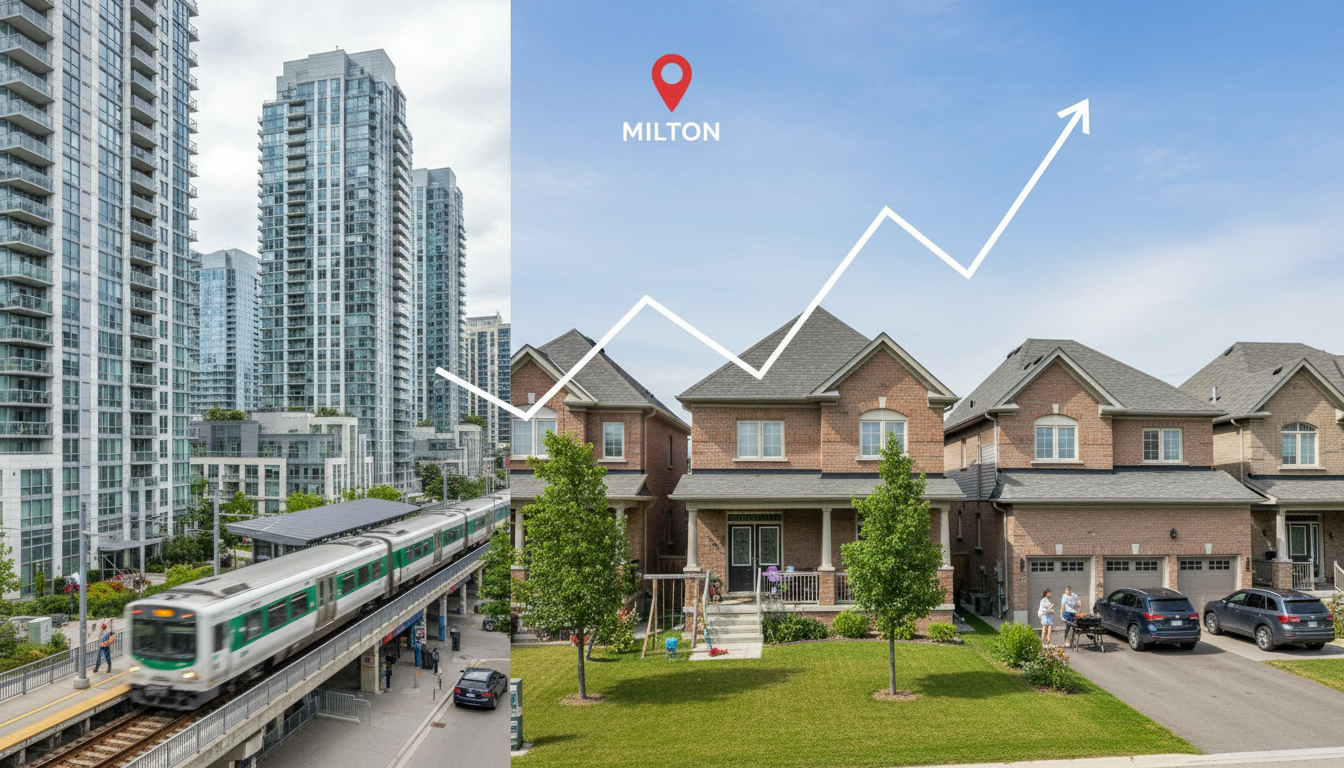
Are condos or houses better for investment?
Are condos or houses better for investment? Read this quick, raw answer before you buy property in Milton — it will save you money and time.
Why this question matters now
Milton isn’t Toronto. It’s faster-growing, family-focused, and fed by commuters. That mix changes what wins as an investment. Pick the wrong asset type and you’ll underperform for years. Choose the right one, and you compound income and equity faster than your peers.
This post gives one thing you can use immediately: a decision framework based on cash flow, appreciation, tenant demand, costs, and exit strategy — all tuned for Milton, Ontario.
Milton market snapshot (what every investor must know)
- Milton ranks among the fastest-growing communities in the Greater Toronto Area. Growth is driven by young families moving for space, commute access via the Milton GO line, and new housing supply.
- Demographics tilt younger and family-oriented. That means higher demand for multi-bedroom housing, larger living spaces, and proximity to schools and parks.
- Commuter infrastructure (Milton GO, Highway 401 access) keeps buyer demand strong. Transit-driven appreciation matters in Milton more than in non-commuter towns.
- Local incomes and household formation rates have been above provincial averages, supporting solid mortgage capacity.
Data sources: municipal growth reports, TRREB and CREA market summaries, and Statistics Canada demographic profiles. These trends make Milton a market where both condos and houses can work — but for different reasons.
Core investment comparison: Houses vs. Condos (Milton lens)
I’ll be blunt. There is no universal winner. The right asset depends on your objective. Below I break down the variables you must weigh — with Milton-specific context.
1) Appreciation potential
- Houses: In suburban growth nodes like Milton, detached and semi-detached homes historically outpace condos on price appreciation. Why? Limited land, high family demand, and zoning that favors low-rise subdivisions push buyer competition onto detached inventory.
- Condos: Appreciation is possible in transit-oriented or infill pockets, but condos face more supply risk (new mid-rise projects) and slower per-unit land-value gains.
Milton takeaway: If your goal is long-term capital growth (10+ years), detached houses typically win in Milton because families pay premiums for space, yards, and school catchments.
2) Cash flow and rental yield
- Houses: Larger mortgages, higher taxes, and maintenance costs. But they often command higher rents per unit and attract long-term family tenants, reducing vacancy and wear.
- Condos: Lower entry price and property taxes can produce better initial gross yields. However, condo fees and condo rules reduce net yield and flexibility.
Milton takeaway: For short-term positive cash flow, a well-priced condo can be attractive. For stable, predictable rental income and lower tenant turnover, houses perform better.
3) Liquidity and resale speed
- Houses: In a seller’s market, detached homes in Milton sell fast because inventory is limited and buyer demand is family-driven.
- Condos: Resale depends on supply and developer activity. In flood years of condo construction, resale can slow. But condos near Milton GO or new town centres can flip faster.
Milton takeaway: If you need fast resale, prioritize quality location over asset type: schools, transit, and established neighbourhoods convert to liquidity.
4) Risk: fees, maintenance, and rules
- Houses: You own the land and structure. Maintenance is your responsibility. Risk is mostly cash-in-pocket for repairs and capital projects.
- Condos: Monthly condo fees cover many items (roof, amenities, some utilities). Fees can spike after special assessments. Condo boards and restrictions can limit rentals and renovations.
Milton takeaway: Expect developer-built condo projects to come with attractive amenities but also rising fees over time. For passive investors who dislike surprises, condos can be smoother — until the board calls a special assessment.
5) Tenant profile and stability
- Houses: Attract families and long-term renters. In Milton, that’s a major advantage: stable tenants, fewer turnover costs, and less wear than student or transient renters.
- Condos: Attract singles, couples, young professionals, and sometimes investors listing short-term. Turnover can be higher.
Milton takeaway: With Milton’s family skew, houses typically have stronger tenancy profiles and lower vacancy risk.
Practical decision framework — how to choose (three simple paths)
Use this like a checklist. Answer honestly and follow the recommended asset type.
1) You want long-term appreciation and low tenant turnover: Buy a detached/semi in an established Milton neighbourhood near schools and transit.
2) You want lower entry price, quicker cash flow potential, and hands-off management: Buy a well-located condo near Milton GO or the town centre — but only after stress-testing condo fees and reserve fund health.
3) You want a hybrid: Buy a townhouse or stacked townhouse. It often blends house-like appreciation with lower maintenance than detached homes. In Milton, townhouses have become a sweet spot for investors.
Numbers that matter — what to run before you buy
- Net yield: Calculate rental income minus mortgage, taxes, insurance, maintenance, vacancy, and (if condo) condo fees.
- Price per bedroom: Milton buyers pay a premium per bedroom for houses. Compare price-per-bedroom across property types to see value.
- Days on market in target micro-neighbourhood: A property that sells 10–20 days faster than town average signals higher liquidity.
- New supply pipeline: Check municipal planning for condo/midrise approvals in your submarket. New supply depresses condo price gains.
Run sensitivity scenarios: 3x scenarios (base, downside -10% price, upside +10%). If your investment survives downside and returns in base, you can buy with confidence.
Typical Milton investor profiles and the right asset
- The long-term wealth builder (10+ years): Detached or semi-detached houses in family neighbourhoods. Outcome: capital appreciation + lower turnover.
- The cash-flow seeker (5+ years): Carefully selected condos near GO station or core town centres, or townhouses with solid rent history.
- The hybrid operator (value-add): Small multifamily or split-level homes that can be renovated and re-rented. Townhouses also fit if you can add value.

Common mistakes Milton investors make
- Buying the cheapest option without testing real net yield (ignores condo fees and special assessments).
- Ignoring micro-location: not all Milton neighbourhoods perform the same. Proximity to GO, schools, and main arteries matters.
- Underestimating maintenance on older houses. Deferred maintenance kills returns.
- Betting solely on short-term appreciation during market peaks. Milton’s long-term growth is strong, but timing matters.
How to reduce risk right now (actionable steps)
- Get the condo status certificate and review reserve fund and recent special assessments.
- Ask for neighbourhood days-on-market and sale-to-list ratios for the last 12 months at the property level.
- Model five-year cash flow under three rent-achievement scenarios: conservative (-10%), base (current market), optimistic (+10%).
- Speak with local property managers on typical vacancy, tenant quality, and maintenance costs for the building or street.
- If buying a house, do a detailed inspection and factor in immediate capital costs (roof, furnace, windows).
Bottom line: Which is better for investment in Milton?
- If your priority is long-term capital growth and stable tenancy: houses (detached, semi, or well-located townhouses) edge out condos in Milton.
- If your priority is lower entry cost and near-term cash flow with less hands-on property work: a carefully chosen condo near transit or town core can deliver.
- For most conservative wealth builders in Milton, townhouses are the best compromise: stronger appreciation than condos, lower maintenance than detached homes.
This is not theory. It’s a market reality driven by Milton’s demographics: family growth, commuter reliance, and limited land for detached infill.
Proven next move (do this if you want to act)
- Pick one micro-neighbourhood in Milton and compare three active listings: a condo, a townhouse, a detached home.
- Calculate net yield and 10-year projected appreciation using historic averages and developer pipeline checks.
- Choose the asset that meets your risk profile and has the best downside protection (low vacancy risk, strong micro-location).
Want help with that analysis? I provide free, no-pressure neighborhood audits for Milton investors. I’ll run the numbers, show you the downside scenarios, and outline the fastest path to profitable ownership.
Contact: tony@sousasells.ca | 416-477-2620 | https://www.sousasells.ca
FAQ — Milton condos vs houses (what smart investors ask)
Q: Do condos ever outperform houses in Milton?
A: Yes. A well-located condo with limited new supply, strong transit access, and low condo fees can outperform in the short to medium term. But over multi-decade horizons, detached homes usually lead in Milton.
Q: Are condo fees a deal-breaker?
A: Not automatically. High fees are acceptable if they cover services that reduce your operating costs (e.g., heat, water, insurance). The problem is unpredictable special assessments and poor reserve funds. Always review the status certificate.
Q: Is buying near the Milton GO station always a good idea?
A: Location near GO is powerful. It boosts demand for both condos and townhouses. For detached homes, school catchment and family amenities still matter most.
Q: What about townhouses — are they worth it?
A: In Milton, townhouses are often the best compromise. They capture family demand, cost less than detached, and typically have lower condo fees than stacked condos.
Q: How important is the new supply pipeline?
A: Critical for condos. If multiple mid-rise projects are approved in the same pocket, short-term appreciation slows. For detached homes, supply constraints and land scarcity preserve value.
Q: Should I buy to renovate or rent-as-is?
A: Renovate if you have a clear, tested budget and know the neighborhood amenity preferences (kitchens, bathrooms, basement units). For predictable cash flow, rent-as-is to carefully screened tenants.
Q: How do interest rates affect the choice?
A: Higher rates squeeze buyers, reducing buying power. Condos often remain more affordable in high-rate environments. But rising rates also pressure mortgage renewals; choose properties with strong rental demand to cover service costs.
If you want a Milton-specific property comparison (condo vs townhouse vs detached) sent to your inbox with numbers, message me: tony@sousasells.ca. I’ll run a neighborhood audit and show you the best path for your goals.
Tony Sousa — Local Milton Realtor
Contact: tony@sousasells.ca | 416-477-2620 | https://www.sousasells.ca