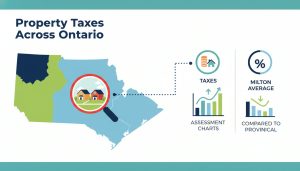
How do property taxes vary across Ontario?
How Do Property Taxes Really Change Across Ontario? You’ll Be Surprised by Milton’s Advantage
Quick Hook — Don’t Buy a Home Until You Read This
Property taxes in Ontario aren’t one-size-fits-all. Same-sized house, same neighbourhood profile, different town — and your annual bill can swing thousands of dollars. That matters when you’re budgeting, investing, or choosing where to raise a family.
Why This Matters Right Now
If you’re buying or owning property in Ontario, you need to know how tax assessment and tax rates interact. Ignoring this can cost you serious money over years. This guide cuts through the noise and shows, in plain terms, how property taxes vary across Ontario and exactly how that plays out in Milton.

The Simple Formula (Stop Guessing)
Your annual property tax = Assessed value × Municipal tax rate (plus education and other levies).
Two variables drive the bill:
- Assessed value: Determined by MPAC (Municipal Property Assessment Corporation).
- Tax rate: Set by your municipal government, expressed as a percentage or mill rate.
Clear. But the devil — and the dollars — are in how these two move across different Ontario municipalities.
Why Two Homes with Same Price Pay Different Taxes
- Assessment timing and methods
- MPAC updates values on a schedule. If your town’s housing prices jumped before the last assessment date, your assessed value may lag or lead actual market price.
- Municipal tax rates vary
- Municipalities set rates to cover local spending (roads, parks, police services, libraries). Some towns have higher services per household — higher rates.
- Tax ratios and property classes
- Residential, commercial, industrial: each class has different ratios and rates. Business properties often pay higher effective rates.
- Regional vs. local vs. school taxes
- Your bill bundles municipal, regional (if applicable), and provincial education levies. Regions like Halton and York add another layer.
How Ontario Municipalities Stack Up — The Big Picture
- High-priced markets often have lower tax rates but higher assessed values (Toronto, Oakville, Richmond Hill). Net tax can be high because value is high.
- Smaller or faster-growing towns may have higher tax rates to fund infrastructure and services.
- Growth, spending needs, and local policy choices (like tax ratios) explain the differences.
Bottom line: Don’t compare just the tax rate. Multiply rate by assessed value to see the actual bite out of your wallet.
Milton, Ontario — Where It Fits In the Province
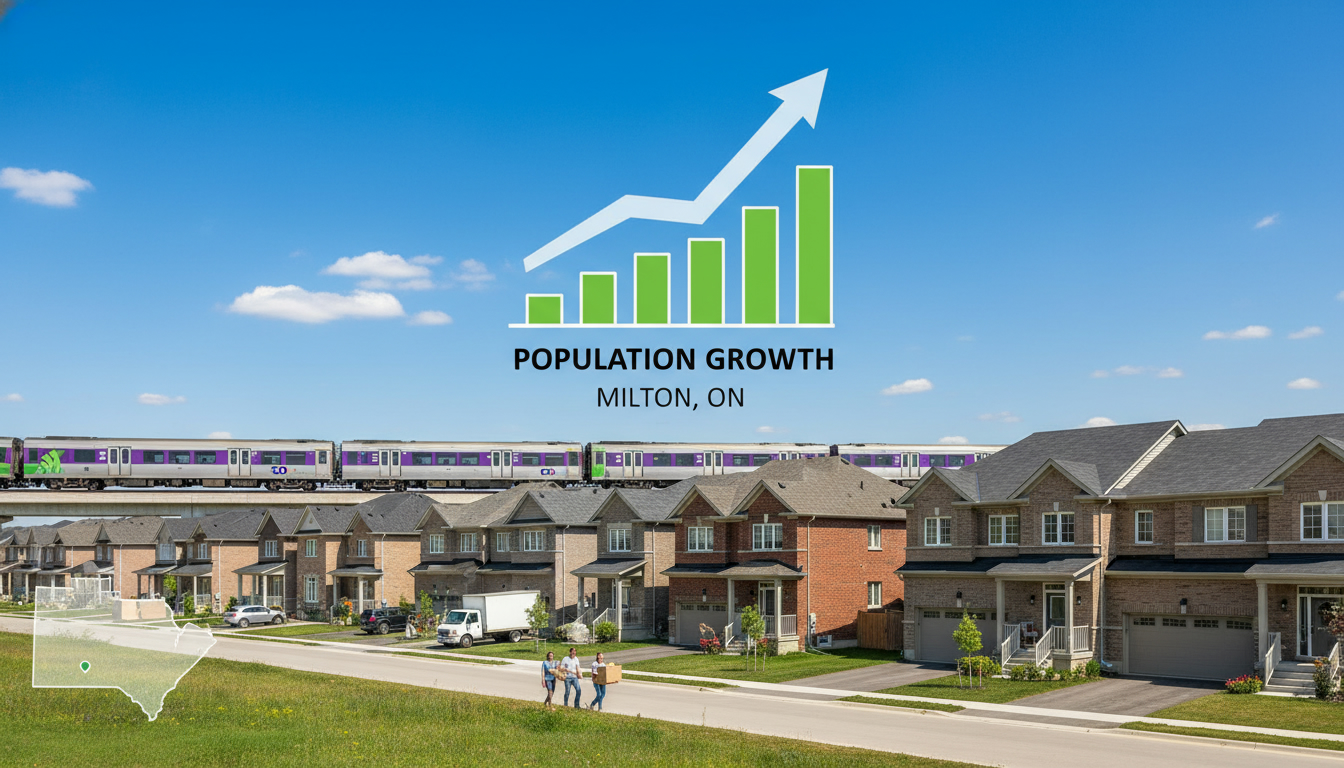
Milton is in Halton Region, growing fast, family-friendly, with new subdivisions and active infrastructure spending. Here’s what matters for Milton homeowners:
- Rapid growth increases municipal spending needs (roads, schools, transit). That can push tax rates up or keep them stable while assessments rise.
- MPAC assessments reflect recent market trends; if Milton home prices rose faster than neighbouring towns, assessed values climb and tax bills increase even if rates are stable.
- As part of Halton Region, additional regional levies apply. Compare Milton’s combined municipal + regional + education bill to neighbouring towns to understand the full picture.
Real-World Examples (How to Think About Numbers)
Say two houses sell at $900,000 — one in Milton, one in another town.
- If Town A has a lower municipal rate but higher assessments, and Milton has moderate rates but faster assessment growth, Milton’s homeowner could pay more or less depending on the balance.
Always calculate: Assessed Value × Combined Rate = Annual Tax. Use municipal websites and MPAC to get current numbers.
How Assessments Work — Why They Trigger Reactions
- MPAC evaluates properties, generally based on a specific valuation date. Assessments can feel ‘‘out of sync’’ with the market.
- When MPAC increases values, municipalities can choose to lower rates to offset the higher base — or not — depending on budget needs.
- Some homeowners get hit by sudden jumps if their area outpaced others between assessments.
Practical tip: Request a property assessment review if you think MPAC’s number is wrong. Small wins add up.
Where Milton Can Save You Money (If You Know What to Watch)
- Look at trends, not single numbers
- If Milton’s growth is steady but taxes haven’t risen proportionally, the town can be a relative bargain compared to places where rates spike.
- Consider timing on purchase
- A purchase just before a new MPAC valuation cycle can lock in a lower assessed value for a while.
- Understand local levies
- Some local improvements are funded with targeted charges or development levies that impact new homeowners. Ask your agent for the specifics.
Quick Checklist Before You Buy in Milton or Anywhere in Ontario
- Check MPAC assessed value for the exact property.
- Find the latest municipal and regional tax rates on the town and region pages.
- Confirm school board taxes and any special levies (stormwater, waste, transit).
- Ask your realtor for recent property tax bills for comparable homes in the neighbourhood.
- If you’re an investor, compute taxes as a percentage of rent or expected ROI.

How a Local Expert Adds Value — Don’t Go Alone
A local realtor who knows municipal budgets, regional charges, and MPAC patterns saves you money. They can:
- Pull recent tax bills for comps.
- Explain timing impacts from MPAC reassessments.
- Spot neighbourhood trends that affect future taxes (major developments, infrastructure projects).
If you want accurate, location-specific numbers and a practical plan to minimize tax surprises in Milton, contact a local specialist who tracks Halton budgets and MPAC updates.
Contact for Milton property tax help:
- Email: tony@sousasells.ca
- Phone: 416-477-2620
- Website: https://www.sousasells.ca
Common Myths — Busted
Myth: High house price = automatically higher taxes.
Reality: High value increases the base, but tax rates may be lower in some high-price markets.
Myth: MPAC decides how much tax you pay.
Reality: MPAC sets assessed value. Your municipality sets the tax rate.
Myth: You can’t challenge your assessment.
Reality: You can request a review and appeal through MPAC if your assessment appears incorrect.
What to Watch Over the Next 12–24 Months
- MPAC reassessment timing: Reassessments shift who pays more.
- Municipal budgets: Bigger spending plans mean higher rates or special levies.
- New developments: Rapid new housing can change ratios and infrastructure costs.
If you own or plan to buy in Milton, watch Halton council meeting notes and MPAC updates. That’s where tax changes start.
FAQ — Fast Answers to the Most Common Questions
Q: How are property taxes calculated in Ontario?
A: Assessed value (MPAC) × combined tax rate (municipal + regional + education + special levies) = annual tax.
Q: Why do tax rates differ between towns?
A: Different service levels, budget needs, tax base size, and local policy choices cause rate variation.
Q: Are property taxes higher in Milton than in other Halton towns?
A: It depends on the year and the metric. Milton’s fast growth can raise assessed values quickly; compare combined tax bills (not just rates) between towns to see actual differences.
Q: Can I appeal my MPAC assessment in Milton?
A: Yes. Review your MPAC notice, request a review online, and appeal to the Assessment Review Board if needed.
Q: How do school taxes affect my bill?
A: Education levies are set provincially and added to your municipal bill. They apply uniformly by property class across Ontario but the dollar amount depends on assessed value.
Q: Will property taxes go up as Milton grows?
A: Growth can increase spending needs, but municipalities may offset by spreading costs across a larger tax base. Watch budget decisions and development charges.
Q: Where can I find reliable current tax rates?
A: Use the Town of Milton website, Halton Region site, and MPAC for assessment values.
Q: What’s the fastest way to estimate my annual property tax?
A: Multiply the MPAC assessed value by the combined tax rate (expressed as a decimal). Example: $700,000 × 0.012 = $8,400.
Q: Should I factor property taxes into my offer price?
A: Yes. Include annual taxes in your budget and cashflow calculations. For investors, treat taxes as an operating expense.

Final—Practical Next Steps
- Get the MPAC assessed value for any property you’re considering.
- Pull the latest municipal and regional tax rates.
- Ask for recent tax bills for comparable properties in the same neighbourhood.
- Talk to a local expert who knows Milton’s budgets and MPAC timing.
If you want accurate, local, no-fluff guidance on property taxes in Milton — and how they compare across Ontario — reach out:
Tony Sousa, Local Realtor
- tony@sousasells.ca
- 416-477-2620
- https://www.sousasells.ca
Make the numbers work for you. Don’t guess.