Are there areas with higher long-term
appreciation?
Are there areas with higher long-term appreciation? — Discover Milton neighbourhoods that could multiply your investment
Quick promise
If you buy the right block in Milton, Ontario, you won’t need market timing. You need location, fundamentals, and a plan. This post tells you exactly which areas show the strongest long-term appreciation potential and why — no fluff, just what works.
Why Milton matters now (short version)
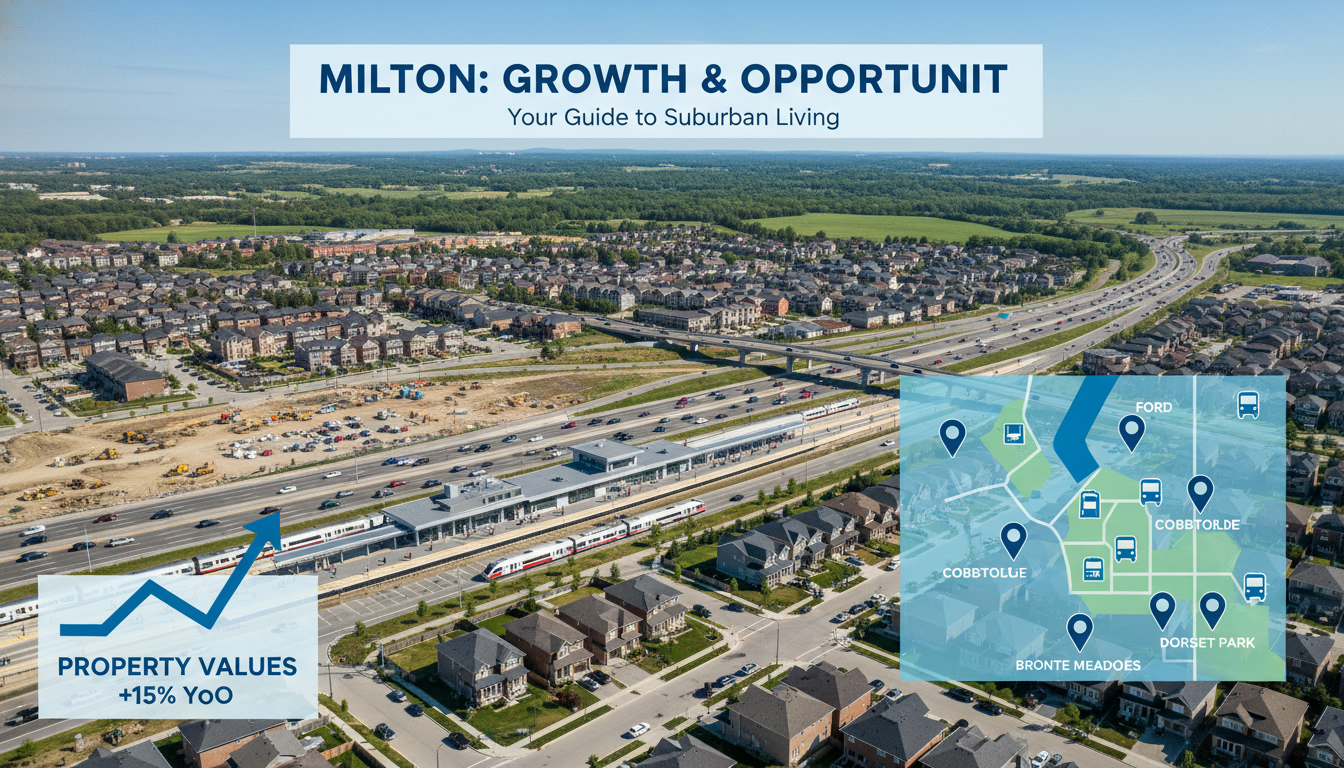
Milton sits at the edge of the Greater Toronto Area (GTA). It’s been one of Canada’s fastest-growing towns. That growth creates demand. Limited developable land, strong commuter links to Toronto, high household incomes, and ongoing infrastructure projects create conditions that push prices up over time.
That doesn’t mean every street gains equally. Some pockets will outperform. The question is: which ones and why?
The core drivers of long-term appreciation (what you must track)
Long-term property appreciation follows predictable forces. Track these and you’ll spot the high-upside areas in Milton:
- Population and job growth: More people and jobs mean more housing demand.
- Supply constraints: Greenbelt protection, conservation areas, and limited new land slow new supply.
- Transit and highway access: Properties near Milton GO Station and major highways draw premiums from commuters.
- Local amenities and schools: Quality schools, shopping, parks and community centres drive family demand.
- New developments and master-planned communities: Investment in new infrastructure and commercial space lifts nearby values.
- Economic resilience: Diversity of employment in Halton Region and the GTA matters long-term.
If an area checks several boxes above, it’s primed for higher long-term appreciation.
Where to look in Milton: three high-upside categories
Here are the specific micro-markets inside Milton to focus on. I’ll be direct: buy near transit, buy in established neighbourhoods with limited supply, or buy where major infrastructure is planned.
1) Around the Milton GO Station and commute corridors
Why it matters: Easy, reliable access to Toronto is priceless for buyers who commute. Properties within a short drive or walk of the GO station hold stronger demand during both ups and downs.
What to target: Townhomes and low-rise condos close to the station for rental appeal, and smaller detached homes that attract families who want a shorter commute.
Why long-term: As Toronto housing costs push buyers farther out, Milton’s commute corridors gain steady pressure. That pressure lifts prices more reliably than speculative hot spots.
2) Established neighbourhoods with mature lots and limited new supply
Why it matters: Old neighbourhoods with larger lots and mature trees are scarce. Developers can’t recreate that character. Scarcity equals price resilience.
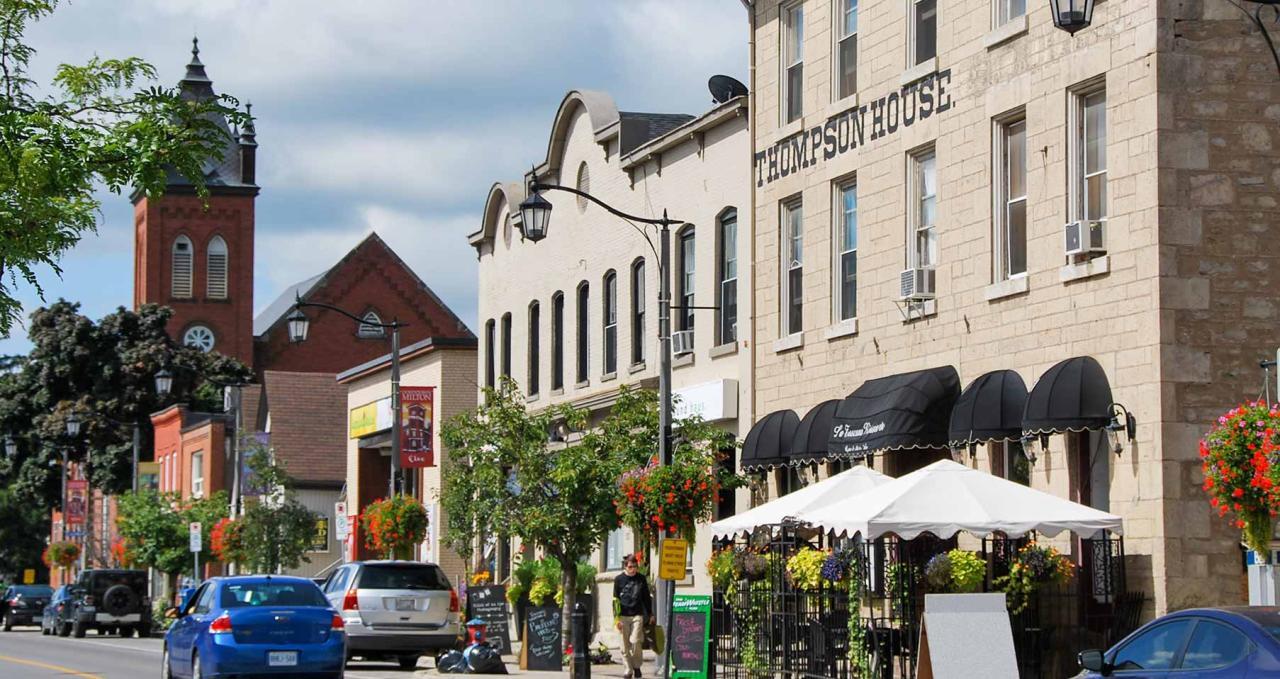
What to target: Detached homes on larger lots near downtown Milton or in mature pockets that are not marked for major infill.
Why long-term: Families and move-up buyers pay for space and character. When inventory is thin, appreciation tends to be stronger.
3) Master-planned subdivisions and areas set to receive infrastructure investment
Why it matters: New roads, schools, parks and commercial nodes create sustained demand for nearby housing.
What to target: New-build family homes in places where municipal plans show upcoming amenities and commercial development. Early buyers capture the development premium.
Why long-term: As the neighbourhood matures, values rise with each completed amenity and commercial anchor.
Which property types outperform long-term in Milton?
- Detached family homes: Best for long-term appreciation where land is scarce and families are the primary buyer pool.
- Townhouses: Great balance of affordability and growth, especially near transit and services.
- Low-rise condos: Good for rental yield and entry-level investment near the GO station. Appreciation is steadier if supply is limited.
Condo towers are more supply-sensitive and can lag during new-build waves.
Macro factors that will keep driving Milton prices
Don’t get lost in monthly headlines. These are the big, slow-moving forces that matter:
- Greenbelt rules and land-use planning keep developable land limited in Halton Region.
- Ongoing GTA population growth increases commuter demand for Milton.
- Regional employment growth in Halton and nearby employment hubs supports local housing demand.
- Infrastructure spending (roads, schools, transit improvements) translates to long-term value for nearby properties.
Short-term interest rate cycles cause volatility. Long-term appreciation depends on the fundamentals above.
How to evaluate a Milton block for higher appreciation — a checklist
Score each block you consider. If it hits 4–5 of these, it’s a winner.
- Within 10–20 minute drive or walk to Milton GO Station or major highways (401/407).
- Near top-rated schools or planned school expansions.
- In an area with limited remaining ‘greenfield’ development.
- Close to planned retail, commercial, or employment nodes.
- Low ratio of rental or short-term rental stock (owner-occupied neighbourhoods hold value better).
- Mature tree lines or unique neighbourhood character that cannot be reproduced.
If you’re buying for long-term appreciation, favor blocks that meet the checklist even if you pay a small premium.

Risk factors: what can derail appreciation in Milton
- Large new condo projects flooding supply near transit hubs.
- Significant job losses in the broader GTA economy.
- Changes to planning rules that open up new developable land nearby.
- Overbuilding in the short term that pushes resale supply higher.
Mitigate risk: diversify across property types, buy close to fundamentals (transit, schools, amenities), and hold long enough (5–10+ years) for the macro forces to play out.
Real example scenarios (how this looks in the real market)
-
A move-up family buys a detached home near an established school and mature neighbourhood. They rent out a basement suite, hold for 8–12 years. As land scarcity and school demand increase, the property sees strong appreciation.
-
An investor buys a townhome within walking distance of the GO station. Rents stay strong because commuters prefer transit access. When they sell after 7–10 years, the area’s improved amenities and transit demand lift value.
-
A buyer purchases in a new master-planned community before commercial anchors open. Appreciation accelerates as schools, shopping and job nodes appear.
These are not guesses. They’re patterns every successful Milton buyer has followed.
Practical moves: what to do this quarter
- Walk the blocks near the GO station and note which streets are owner-occupied and well-kept.
- Pull municipal planning maps: find where schools, community centres and commercial nodes are planned.
- Ask your agent for absorption rates in the neighbourhood: how fast homes sell?
- Prioritize properties that meet the checklist above even if you pay a slight premium.
Small choices today make big differences in 5–10 years.
Why work with a Milton-focused expert
Local nuance matters. You need someone who reads planning reports, monitors school boundaries, and knows where infrastructure money is going. Tony Sousa knows Milton’s micro-markets. He tracks new development applications, GO-related growth corridors, and buyer profiles. That intel turns guesswork into a plan.
Contact Tony Sousa for a guided, no-nonsense review of Milton properties: tony@sousasells.ca | 416-477-2620 | https://www.sousasells.ca

FAQ — Common questions about market trends and long-term appreciation in Milton, ON
Q: Are there specific Milton neighbourhoods that always appreciate more?
A: No neighbourhood “always” outperforms. But areas consistently linked to transit, top schools, limited supply and planned infrastructure tend to outperform. Focus on the categories outlined above rather than betting on a single street.
Q: Does proximity to the GO Station guarantee higher appreciation?
A: Not automatically. Proximity helps, but other factors matter: quality of nearby housing stock, overbuilding risk, and the balance of renters vs owners. Combine transit access with other checklist items.
Q: How long should I hold to see “long-term” appreciation?
A: Aim for 5–10 years minimum. Real estate is a slow, compounding asset. Short-term price swings are normal; fundamentals drive long-term growth.
Q: Are condos riskier than detached homes in Milton?
A: Condos are more sensitive to supply cycles. Detached homes usually hold value better when land is scarce. Townhouses offer a middle ground — good affordability and solid demand.
Q: Will higher interest rates stop Milton’s long-term appreciation?
A: Higher rates affect short-term affordability and transaction volume. They don’t erase population growth, limited land, or transit improvements. Those fundamentals tend to reassert over time.
Q: How can I validate a neighbourhood’s future growth?
A: Review municipal planning documents, look for planned schools and commercial nodes, check absorption rates, and monitor infrastructure budgets. A local expert can speed this work up.
Q: What mistakes do buyers make when chasing appreciation?
A: Common errors: buying on hype without checking fundamentals, overpaying in overheated pockets, ignoring commute patterns, and failing to check future supply pipelines.
Final takeaway
Yes — there are areas in Milton with higher long-term appreciation. They’re not random. They’re predictable when you focus on fundamentals: transit, scarcity, schools, and infrastructure. Buy where those forces line up, hold patiently, and plan for the long run.
If you want a targeted list of current Milton opportunities backed by local data, reach out: tony@sousasells.ca | 416-477-2620 | https://www.sousasells.ca
Disclaimer: This post is educational and not financial advice. Always run numbers for your personal situation.