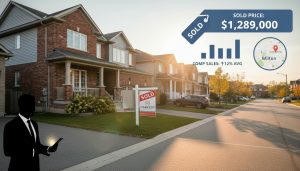

How can I find out the average price per square foot in my area?
Want to know Milton‘s average price per square foot right now? Read this and get the real number in one afternoon.
Why this matters
Price per square foot is the clearest, fastest way to benchmark your home against the market. For sellers in Milton, ON, it’s the lens investors, buyers and listing agents use to size up value. But used alone it misleads. Used correctly it tells you where to price, where to negotiate, and where to invest in upgrades.
This guide gives you a practical, step-by-step process to find the average price per square foot in your Milton neighbourhood — and how to use it to set a listing price that sells fast and nets more.
Why you should stop guessing
Too many sellers pick a number from Zillow or a quick online estimate and wait. That wastes time and money. Milton is a high-demand, fast-moving market. Prices move by neighbourhood, by home type, and by the week. You need a repeatable method that gives you a defensible price today, not a guess.
What price per square foot actually is
- Formula: Sale Price ÷ Above-grade Finished Living Area (sq ft) = Price per sq ft.
- Above-grade finished living area excludes finished basements unless your local market commonly counts them.
- Use the sale price, not the listing price.
A simple step-by-step method to get the average price per sq ft in your Milton area
- Define the market slice
- Pick the exact neighbourhood, not the whole town. Milton has pockets: older cores, commuter corridors near the GO, new subdivisions and rural edges. Compare apples to apples: detached vs detached, townhome vs townhome, condo vs condo.
- Set a time window
- Use recent sales. In active markets like Milton use the last 60–120 days. If sales are slow, widen to 6–12 months but weight recent sales heavier.
- Pull sold listings
- Use Realtor.ca, MLS, and local real estate tools (HouseSigma, Zolo, Zoocasa) to pull all sold listings in that neighbourhood for your property type and timeframe.
- If you have access to a local agent’s CMA, use it — it’s faster and more accurate.
- Calculate price per square foot for each sale
- For each sold listing: Price per sqft = Sale Price ÷ Above-grade sqft.
- If MLS lists “total living area,” confirm definition. Many tools report inaccurate square footage — confirm with listing docs or tax assessment if needed.
- Remove outliers
- Exclude sales that are clearly unique: huge renovations, estate sales, extreme renovations, partial demolitions, properties with massive lot premiums.
- Exclude listings with incomplete data.
- Find median and weighted averages
- Median price per sqft resists outliers and is usually the best single number.
- Weighted average (by similarity and recency) gives a more nuanced number: give more weight to sales closer to your address and within the last 30–60 days.
- Adjust for condition and features
- Basements, garages, major upgrades, pool, acreage, and lot premium change value. Adjust the base ppsf up or down to reflect condition and unique features.
- Example adjustments: finished basement (if counted locally) may add X% to total value but not the same per sqft as above-grade area. A large lot or premium location (near GO station, top schools, conservation areas) often commands a higher per sqft.
- Validate with a local pro
- Pull a quick Comparative Market Analysis (CMA) from a Milton agent. A local realtor will confirm the number and show recent comps you might have missed.
How this applies specifically to Milton, ON
- Milton is part of the Greater Toronto Area growth corridor. Demand is high for commuter-friendly neighbourhoods near GO Transit and major highways.
- New subdivisions push averages while older cores can show different per sqft values because of lot sizes and home styles.
- Condo, townhome and detached markets behave differently. Do not mix them when calculating an average.
- Seasonality matters: spring and early summer often show stronger per sqft numbers due to higher demand.
Common Milton adjustments to expect
- Proximity to GO station or highway: premium per sqft.
- New-build subdivisions: newer homes may have lower per sqft when first listed because builders price across many models; resale of upgraded models often sells at a premium.
- Lot size: larger lots in Milton’s older neighbourhoods can change price dynamics — price per sqft may be lower, but total price higher.
- Renovations: kitchen and bathroom upgrades deliver the highest return, but not always dollar-for-dollar in price per sqft. Some upgrades lift buyer perception more than raw sqft math.
Quick cheat-sheet: How to calculate a defensible asking price using ppsf
- Get median ppsf for your exact property type and street radius (500m–1km).
- Multiply median ppsf by your home’s above-grade square footage = baseline price.
- Adjust for condition, basement, lot size, and upgrades = final ask range.
- Use competitor active listings and days-on-market to refine the exact list price.
Why price per square foot alone will never be enough
Buyers compare by ppsf, but they buy value. Markets respond to perceived value — curb appeal, school district, finished basement, lot, and layout matter. Use ppsf to set expectations, not as the only input.
Tools that speed this up
- Realtor.ca / MLS (best primary source)
- Local CMA from a Milton agent (best fast answer)
- HouseSigma, Zolo, Zoocasa (fast and accessible)
- Municipal property records and tax assessment (cross-check square footage)
- Paid appraisal if your property is unique or the stakes are high
When to hire an appraiser or certified home inspector
- Hire an appraiser if you have a unique property, major renovations not reflected in comps, or if you want a defensible value for court or tax reasons.
- Hire a certified home inspector pre-list if you plan to market condition transparently — it reduces renegotiation after inspection.
How a local expert multiplies the value of this metric
A local agent with access to MLS can: pull clean comps, validate square footage, spot neighbourhood micro-trends and point out buyer preferences that raw data misses. That’s why local CMAs remain the fastest route to an accurate average price per sq ft in Milton.
Call to action
Stop guessing. Get a precise average price per square foot and a clear listing strategy for your Milton home. Contact Tony Sousa for a free, no-obligation Comparative Market Analysis and a local pricing plan that converts leads into sold deals.
Email: tony@sousasells.ca
Phone: 416-477-2620
Website: https://www.sousasells.ca
Comprehensive FAQ — Pricing, market value and selling in Milton, ON
Q: How do I find my home’s square footage?
A: Check your MLS listing, building permit, or municipal property records. For the most accurate number, use above-grade finished living area as reported by a certified appraiser or the builder’s floorplan.
Q: Should I include a finished basement in price per sqft?
A: Only if local buyers and MLS count basement area in living space. In Milton, above-grade area is the default. Count basement as an add-on value, not the same per sqft rate.
Q: What time window should I use for comps in Milton?
A: 60–120 days in an active market. If sales slow, expand to 6–12 months but weight recent sales higher.
Q: Does price per sqft work for condos and townhomes?
A: Yes — but calculate separately for each property type. Condos often show different per sqft dynamics because amenities and maintenance fees factor into buyer decisions.
Q: How many comps do I need?
A: Aim for 6–12 solid comps. Fewer than six and the sample is noisy; more than twelve and you may be mixing different micro-markets.
Q: Can online valuation tools be trusted?
A: They are quick but not definitive. Use them for ballpark figures, then validate with MLS comps or a CMA from a local agent.
Q: How often does Milton’s price per sqft change?
A: In a fast market it can change weekly. Track a rolling 60-day window and update your pricing plan with new sales.
Q: Will staging or small renovations change my price per sqft?
A: Yes. Staging improves perceived value and often increases offers. Target kitchen, bathrooms, and curb appeal for the best return.
Q: When should I use an appraiser?
A: Use one when your property is unique, when you need a court-accepted valuation, or when you want an independent check before a high-stakes sale.
Q: How do I use ppsf in negotiation?
A: Use it to set your list price and to counter low offers with recent comps. Show buyers where your home sits versus local median ppsf and highlight features that justify adjustments.
Final note
Price per square foot is a weapon when used correctly. For Milton sellers it gives speed and clarity. But the market rewards preparation and local expertise. If you want the exact average ppsf for your street, a clean CMA, and a listing plan that converts, reach out today.
Contact: tony@sousasells.ca | 416-477-2620 | https://www.sousasells.ca
Ready to sell? Get the number that will sell your Milton home — not the guess that will cost you money.