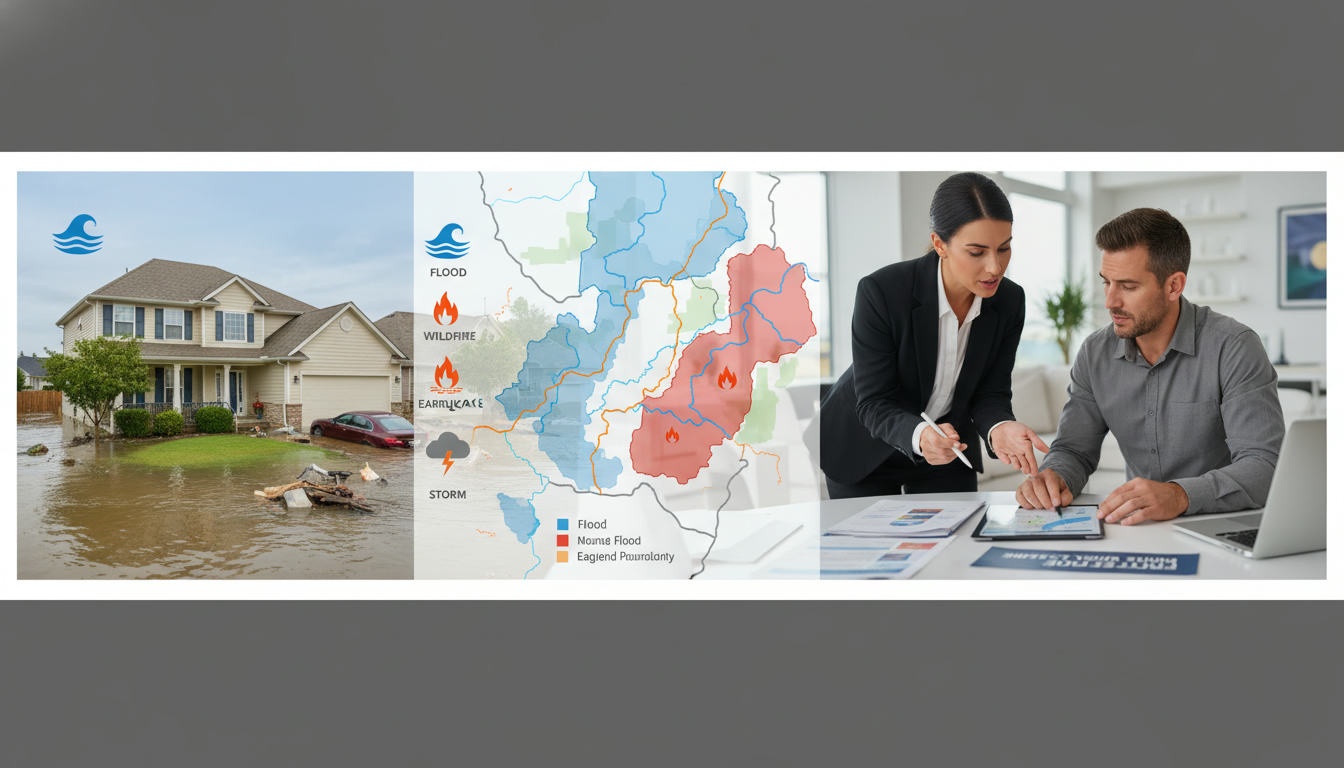
Are there natural disaster risks in my area?
Think your neighbourhood is safe from nature? Think again — here’s how to find out fast.
Quick reality check: natural disaster risks are local and growing
Natural disaster risks vary block by block. Flood risk, wildfire risk, earthquake risk, and severe storm risk are driven by local geography, infrastructure, and changing climate. Don’t rely on guesses. Use verified sources and a simple process to know your exposure.
How to check risk in three fast steps
- Check official hazard maps: In the U.S., use FEMA Flood Map Service Center and USGS earthquake hazard maps. In Canada, use provincial flood maps and Natural Resources Canada seismic maps. Local municipality sites publish floodplains, stormwater and wildfire buffers.
- Look up historical events: Search “flood history + your city,” “wildfire history + your county,” or municipal emergency reports. Past events predict future vulnerability.
- Inspect your property: Is your house on low ground, near a river, built on fill, surrounded by dead trees, or on an unreinforced foundation? Those are risk multipliers.

What the data tells us now
- Flooding is the top homeowner loss in many regions. Urban flash floods and overtaxed storm sewers are common causes. Climate-driven heavy rainfall is increasing frequency.
- Wildfire exposure has expanded beyond remote forests — wildland-urban interface communities now face regular threats.
- Earthquake risk is concentrated near tectonic zones, but older homes without seismic upgrades suffer the worst damage.
- Severe storms and wind damage are rising with stronger storm systems.
Insurance and risk: what matters most
- Standard home insurance rarely covers flood. Flood insurance or specific endorsements are often required for true protection.
- Wildfire losses can be mitigated by mitigation discounts: defensible space, ember-resistant vents, and non-combustible roofing can lower premium or improve insurability.
- For earthquake-prone areas, look for policies or riders that cover seismic retrofit and contents loss.
Actionable checklist — Do this today
- Pull your address up on FEMA/NRCan and local hazard maps.
- Order an elevation certificate or flood risk report if near water.
- Review your home insurance: confirm exclusions for flood, sewer backup, wildfire or earthquake.
- Ask for mitigation credits: tree removal, roof upgrades, foundation bolting.
- Create an emergency plan and a 72-hour kit.
Why work with a local insurance and risk expert
A realtor who understands insurance and risk reads maps, reads policies, and knows local agents who write tough risks. That saves money and reduces surprises at claim time. You need someone who will translate maps into clear steps.
Ready to know your actual exposure and get practical insurance options? Contact a local expert who will walk the property, explain the maps, and connect you with specialty insurers.
Contact: Tony Sousa — Local Realtor & Insurance & Risk Advisor
Email: tony@sousasells.ca | Phone: 416-477-2620 | https://www.sousasells.ca
Get the facts. Make a plan. Protect your home.