How do I evaluate a home’s future resale value?
Can you predict which Milton homes will sell fast and for top dollar? Here’s the no-nonsense checklist.
Quick promise
You will finish this post knowing exactly how to evaluate a home’s future resale value in Milton, Ontario. No fluff. Clear steps. Numbers you can use.
Why Milton matters for resale value
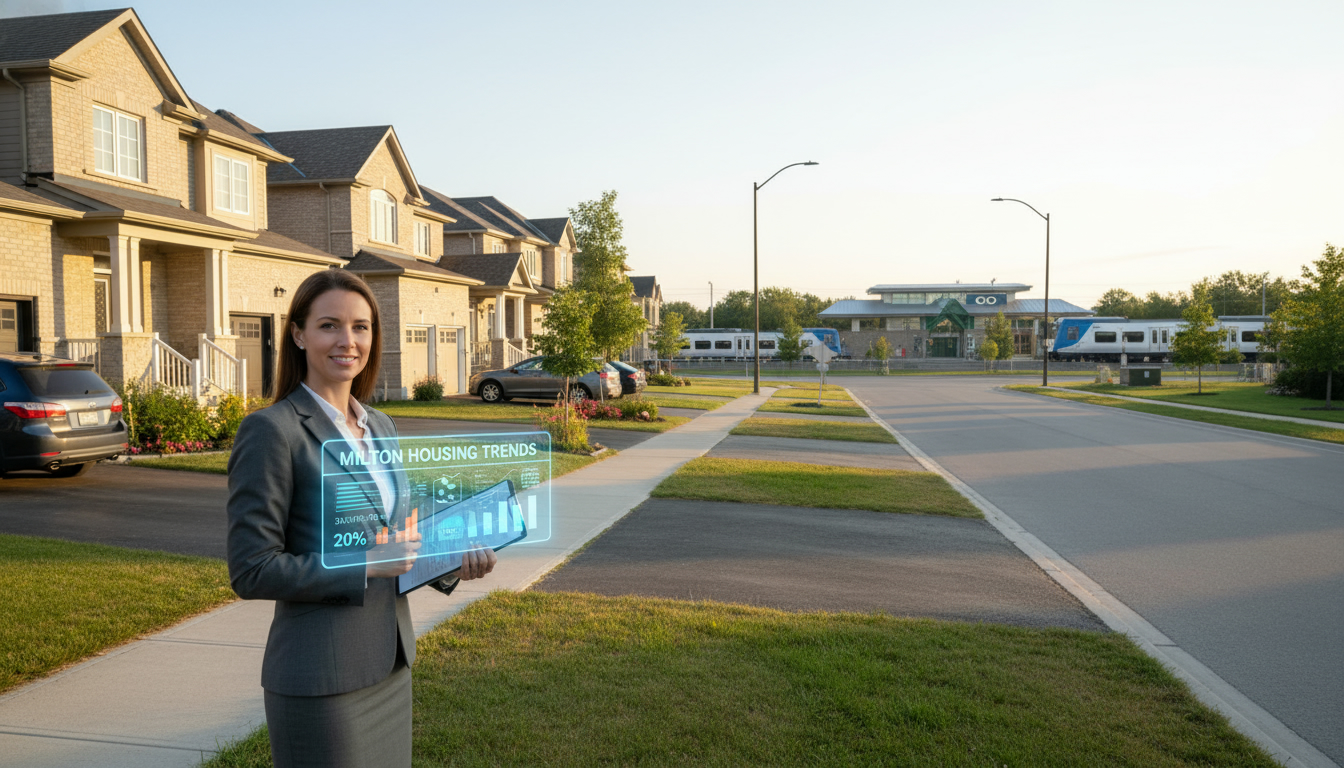
Milton, ON is one of the fastest-growing communities in the Greater Toronto Area. Commuter demand, limited Greenbelt land, and steady local amenities keep resale values strong. That means a smart buy in Milton can outperform other markets — but only if you evaluate the right factors.

The 7-point Milton resale-value checklist (use this every time)
Follow this checklist before you buy. If a home fails two or more items, it’s a red flag.
1) Location fundamentals
- Street type: Quiet low-traffic streets and crescents beat busy arterials. Roads that avoid truck routes and highways hold value.
- Walkability: Homes within walking distance to downtown Milton, schools, parks or the GO station outperform distant lots.
- Schools and community services: Good schools and nearby community centres matter to families — the biggest buyer pool in Milton.
2) Transit and commute
- Proximity to Milton GO and major highways (401, 407) matters. Check actual commute time at rush hour, not Google off-peak time. A 10–20 minute difference changes buyer demand.
- Future transit projects: Even minor improvements near the GO or bus routes lift demand. Confirm municipal plans.
3) Comparable sales (recent, local, like-for-like)
- Pull comps from the last 3–6 months in the same neighbourhood and same home type (detached vs semi vs townhouse).
- Key metrics: sale price, days on market, price per sq ft. If similar homes sell faster and higher, that’s a benchmark.
4) Layout and functional bones
- Bedrooms and bathrooms: Most Milton buyers want 3+ bedrooms and 2+ bathrooms for resale flexibility.
- Main-floor living vs. outdated compartmentalized layouts: Open, modern layouts sell faster.
- Garage and parking: Driveway + garage or legal parking for 2 cars is a resale advantage.
5) Condition and upgrade ROI
- Cosmetic fixes: Paint, flooring, minor kitchen refresh are low-cost, high-return.
- Big-ticket systems: Roof, furnace/AC, windows, electrical panel — get inspection costs and depreciation. Replace if needed; buyers discount for these.
- Kitchens and bathrooms: Modest, quality updates beat ultra-luxury upgrades that don’t match the neighbourhood.
6) Lot and outdoor space
- Backyard usable space beats mere lot size. Fenced yards, patios, and usable grade add resale appeal for Milton families.
- Front curb appeal: First impressions change offers. Landscaping and a maintained exterior are proven ROI drivers.
7) Zoning, future build potential and restrictions
- Check local zoning and Halton Region rules for accessory units or legal secondary suites. Legal rental ability increases investor and buyer demand.
- Greenbelt and urban boundary limits restrict supply and boost long-term values. Homes inside growth corridors generally fare better.
Use simple math to set realistic future price targets
Don’t wing appreciation. Use a clear estimate.
- Step 1: Find the recent average annual appreciation rate for Milton (last 5 years). If you don’t have it, use conservative 2–4% for mature neighbourhoods and 4–7% for high-demand growth pockets.
- Step 2: Apply compound growth: Future Price = Current Price * (1 + r)^n
Example: $800,000 home with 4% annual growth in 5 years: 800,000 * (1.04)^5 = $972,972. That’s your baseline market estimate — now adjust for home condition and upgrades.
How to run a fast, credible home evaluation — step-by-step
- Pull 3 recent comps in the same neighbourhood and housing type.
- Adjust for differences: bedroom count, bathrooms, finished basement, lot size, and condition.
- Inspect the house once for red flags (roof, HVAC, foundation cracks, standing water).
- Get a pre-offer repair estimate from a contractor for anything structural.
- Calculate net profit scenario: expected sale price minus purchase price, closing costs, staging/renovation, and realtor fees.
- Stress-test the numbers with a 10–20% slower market scenario.
If your worst-case still hits your target ROI, buy. If not, walk.
Renovation choices that actually lift resale value in Milton
- Kitchen: Replace worn cabinets, modern backsplash, energy-efficient appliances. Keep it aligned to neighbourhood standards.
- Bathrooms: Touch-ups, new fixtures, tile repair. One quality bathroom update yields predictable returns.
- Energy upgrades: New windows, good insulation, and an efficient furnace/AC are selling points and lower operating costs for buyers.
- Basements: Finished basements with legal egress and smart use of space (rec room + bedroom + storage) add measurable value.
Don’t over-improve. The buyer pool in any Milton neighbourhood will expect houses to match the local price band.
Market timing and macro risks
- Interest rate shifts and mortgage stress tests affect buying power. Higher rates can reduce demand and extend days on market.
- Immigration and local job growth drive demand in Milton. Watch Halton Region job announcements and Toronto commuter trends.
- Supply shocks (new developments releasing many units at once) can temporarily push prices down in short-run.
Factor these into your 3–5 year resale horizon.
How agents and investors measure resale value differently
- Agents focus on comps, marketability, and staging to hit top-dollar offers.
- Investors weigh cash-on-cash returns, rental demand, and cap rate.
If you’re both a homeowner and an investor, combine metrics: absolute resale price targets plus rental income scenarios.
Local Milton market tips you won’t find in national guides
- Pocket neighbourhoods matter: Old Milton (downtown) and areas close to the GO station attract steady family and commuter demand.
- New subdivisions sell fast when builders pause incentives. Track builder incentives — they impact resale comparables.
- School catchment shifts and new school openings move buyer maps quickly. Check the Halton District School Board updates.
Seller playbook to maximize resale value when it’s time to list
- Fix the obvious: Leaky faucets, scuffed paint, broken tiles.
- Stage minimal but effective: declutter, neutralize, highlight usable spaces.
- Professional photos with twilight shots and floor plans sell faster.
- Price to the strongest comparable bracket, not to the absolute top.
- Market to local buyers and commuters — ads showing commute times and local amenities work in Milton.

Contact for a local, data-driven resale evaluation
If you want a custom evaluation for any Milton property, request a Comparable Market Analysis (CMA) and a conservative 5-year price model. I provide full local comps, renovation cost estimates, and a worst-case scenario model.
Email: tony@sousasells.ca
Phone: 416-477-2620
Website: https://www.sousasells.ca
FAQ — Common investor and homebuyer questions in Milton, ON
Q: How much should I expect homes to appreciate in Milton in five years?
A: Use a conservative range: 2–5% annually for established pockets, 4–7% in high-demand growth zones. Always run a worst-case scenario to judge risk.
Q: Do upgrades like a high-end kitchen guarantee higher resale?
A: No. Upgrades must match the neighbourhood. Modest, quality updates usually give the best ROI.
Q: Are legal basement apartments allowed in Milton?
A: Secondary units are regulated by municipality and province. Check Halton Region and Town of Milton zoning. A legal unit increases rental demand and resale appeal.
Q: How important is proximity to the GO station?
A: Very. Commuter access is a consistent demand driver in Milton. Homes within a short drive or walk to transit attract a larger buyer pool.
Q: Should I buy a fixer-upper or a move-in-ready home for resale value?
A: Fixer-uppers can yield value if renovation costs are accurate and the neighbourhood supports the upgraded finished price. Move-in-ready reduces risk and holding costs.
Q: What’s the biggest red flag when evaluating a property’s resale value?
A: Structural issues (foundation, water infiltration), poor lot drainage, and locations beside heavy traffic routes are major red flags.
Q: How do recent builder incentives affect resale comps?
A: Builder incentives can depress nearby resale comparisons because they lower net purchase prices. Adjust comps for incentives when modeling resale.
Q: Should I factor in property taxes when estimating resale value?
A: Yes. Higher taxes can reduce buyer demand. Run net carry cost calculations including taxes, utilities, and condo fees if applicable.
Q: What’s the best way to get accurate comps for Milton homes?
A: Work with a local agent who runs a CMA from MLS data and adjusts for condition and upgrades. Public portals lag and miss off-market data.
Q: How many years should I plan to hold a Milton property to maximize resale value?
A: A 3–7 year horizon balances transaction costs and appreciation for most buyers. Investors might target a 5–10 year hold depending on rental strategy.
If you want a data-backed resale projection for a specific Milton property, email tony@sousasells.ca or call 416-477-2620. Get a CMA, renovation budget, and a conservative 5-year price model — no fluff, just the facts.
Author: Tony Sousa, Milton real estate expert. Website: https://www.sousasells.ca