Are there environmental hazards in the area?
Are there environmental hazards in Milton, ON — and should you worry? Read this before you buy.
Quick, honest answer
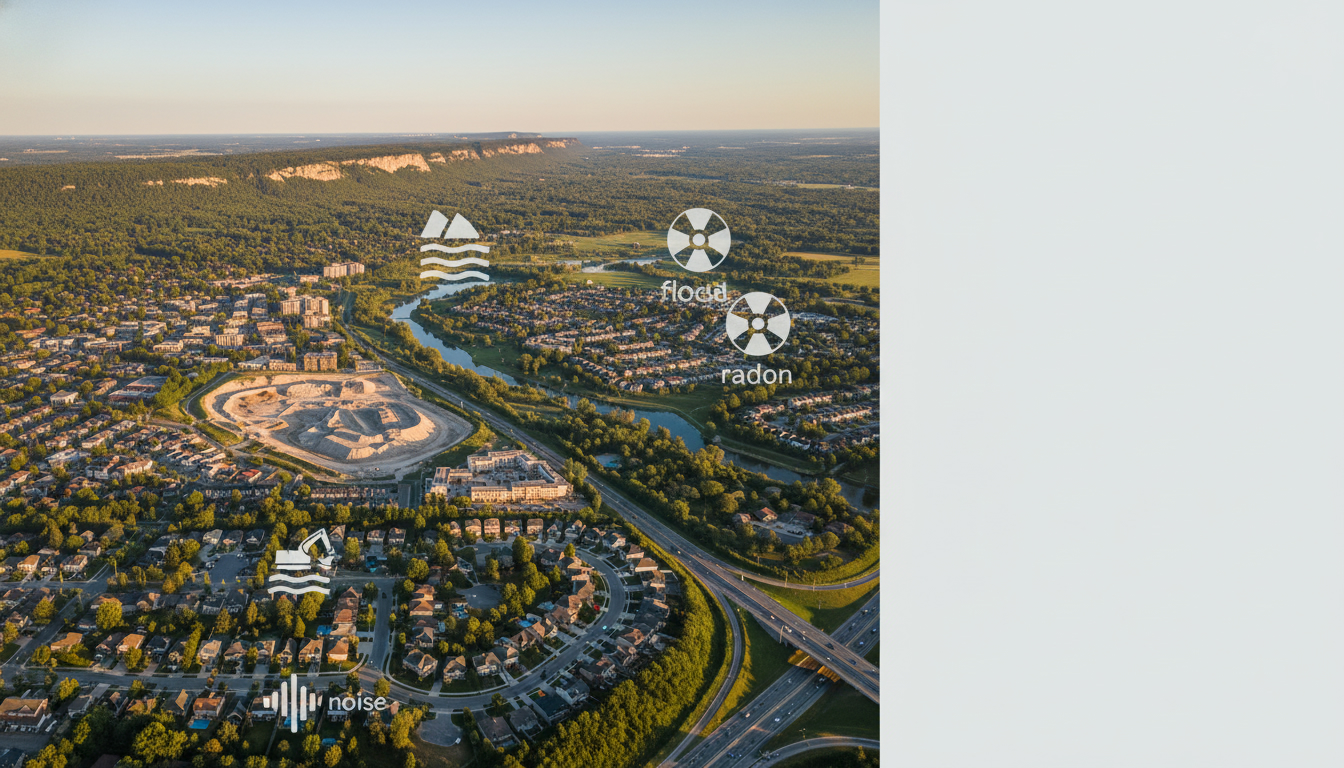
Yes — like every growing community, Milton has environmental hazards you must know about. Most are manageable if you do the right checks: floodplain exposure around creeks, nearby quarry and aggregate operations, some historically contaminated sites, radon in parts of the region, and local air/noise impacts near highways and rail. None of these automatically means “don’t buy,” but ignoring them will cost you time, money, and peace of mind.
Why this matters right now
Milton is booming. Fast growth means new homes, new roads, and construction next to sensitive areas: the Niagara Escarpment, floodplains, and agricultural lands. Buyers who rush in without due diligence end up with unexpected remediation costs, insurance headaches, and resale hurdles. I help buyers see these issues early and negotiate from strength.

The main environmental hazards in Milton, explained
Below are the hazards that come up most often in Milton, what they mean, and how to check them.
1) Flooding and valley corridor risk
- What: Milton sits in the Sixteen Mile Creek watershed and has deep river valleys. Heavy rain or rapid snowmelt can cause localized flooding and basement water problems.
- Where: Low-lying lots near Sixteen Mile Creek and its tributaries are most at risk. New subdivisions usually map out low-rise areas, but older properties may be in flood-prone pockets.
- Check: Conservation Halton flood maps and Halton Region natural heritage/floodplain maps. Ask for elevation certificates and municipal floodplain determinations.
2) Niagara Escarpment / slope stability and development limits
- What: Parts of Milton touch or lie below the Niagara Escarpment. There are restrictions on building, clearing trees, and grading. Slope stability and erosion are concerns on steep slopes.
- Where: Properties near the escarpment or on hill slopes.
- Check: Niagara Escarpment Commission maps, Conservation Halton, and municipal planning departments for setback and permit requirements.
3) Aggregate (quarry) operations, blasting, dust, and truck traffic
- What: Milton and its surrounding area have active aggregate extraction. Quarrying can mean blasting, dust, added heavy truck traffic, and occasional noise.
- Where: Rural edges and areas north/west of town. Quarry boundaries are mapped and regulated, but sound and dust can travel.
- Check: Ontario Aggregate Resources mapping, municipal planning notices, and minutes from local council meetings about active permits.
4) Contaminated sites and historical industrial land
- What: Older industrial or commercial parcels — gas stations, repair shops, or industrial yards — can leave soil and groundwater contamination.
- Where: Industrial zones and older mixed-use pockets.
- Check: Ontario’s Environmental Site Registry, Halton Region property records, and request a Phase I Environmental Site Assessment (ESA) when buying.
5) Radon gas
- What: Radon is a naturally occurring radioactive gas that can accumulate in basements. Ontario has variable radon levels across regions.
- Where: Radon levels can vary street to street; the only way to know is testing.
- Check: Perform a home radon test (recommended 3 months in winter). Health Canada’s radon maps give regional guidance but not property-specific results.
6) Air quality and traffic/rail impacts
- What: Roadways (Highway 401, local highways) and rail corridors can increase local air pollution and noise. Industrial emissions are monitored, but local hotspots exist.
- Where: Properties close to highways, busy arterial roads, or rail yards.
- Check: Environment and Climate Change Canada (air quality index), local noise bylaws, and drive-time checks during rush hour.
7) Private wells and septic systems
- What: Rural properties may rely on wells or septic systems. Risks include bacterial contamination, nitrates, and failing septic fields.
- Check: Test well water for bacteria, nitrates, and heavy metals. Have a septic inspection if the property uses one.
8) Climate-change driven risks (storms, extreme heat)
- What: Bigger storms, increased rainfall, and warmer summers are changing risk profiles. Design standards are evolving to adapt.
- Check: Look at municipal stormwater assessments and long-term planning documents.
How to do due diligence — an action checklist buyers can use
- Ask the seller for a Property Disclosure Statement and records of any environmental work.
- Search: Conservation Halton flood maps, Niagara Escarpment Commission maps, Halton Region planning maps, and the Ontario Environmental Site Registry.
- Order a Phase I Environmental Site Assessment (ESA) for any property with industrial/commercial history.
- If Phase I flags issues, order a Phase II ESA (soil/groundwater testing).
- Test for radon (short test kits are cheap; 3-month tests in winter are best).
- Test private well water (bacteria, nitrates, metals).
- Ask the municipality for zoning, outstanding orders, or enforcement actions.
- Confirm floodplain status with Conservation Halton and get elevation or flood-proofing plans if needed.
- Check for aggregate permits, recent blasting notices, and haul routes.
- Include environmental conditions in your offer and timelines for ESA reviews.
Typical costs (ballpark)
- Radon test kit: $30–$150.
- Well water test: $100–$300 (depending on tests).
- Phase I ESA: $500–$2,000.
- Phase II ESA: $2,000–$20,000+ (depends on findings).
- Remediation: Highly variable — from a few thousand to many tens of thousands.
Who enforces standards and where to look for records
- Conservation Halton — floodplains, valleylands, and permitting.
- Niagara Escarpment Commission — escarpment rules and development control.
- Halton Region — public health, water quality, and planning records.
- Ontario Ministry of the Environment, Conservation and Parks (MECP) — environmental site registry and contaminated site records.
- Environment and Climate Change Canada (ECCC) — regional air quality data.
Common myths — busted
- “If it’s in Milton it’s clean.” False. Milton has protected areas and clean neighbourhoods, but also older sites and industrial edges. Don’t assume anything.
- “New builds are risk-free.” New builds reduce certain risks but can be built over sensitive soils or near quarries. Check the site plan and permits.
- “You’ll see signs for every problem.” Not always. Some hazards, like groundwater contamination or radon, are invisible without testing.

Buyer protections and negotiation leverage
If a Phase I or municipal check raises a flag, you have leverage:
- Ask the seller to fund further testing.
- Request price adjustments or credit at closing for remediation or mitigation.
- Walk away if risks exceed your tolerance.
How I help buyers (quick, direct)
I make environmental due diligence simple. I know where to look, which experts to call, and how to build inspection clauses into offers that protect you. My goal: buy the right home at the right price — without surprise environmental bills.
Contact me for a tailored checklist for any Milton property and immediate access to trusted environmental consultants.
—
FAQ — Quick answers buyers actually use
Q: Are properties in Milton commonly affected by floods?
A: Some are. Flood risk is focused around Sixteen Mile Creek valleys and low-lying areas. Always check Conservation Halton maps.
Q: How likely is radon in Milton homes?
A: Radon levels vary. Some neighborhoods test high; others don’t. A 3-month test in the lowest living space is the only reliable answer.
Q: Should I order a Phase I ESA on every property?
A: For standard suburban homes it’s often overkill. For properties near commercial/industrial sites, older mixed-use lots, or vacant land, a Phase I ESA is a small price for protection.
Q: Can quarry blasting damage my house?
A: Modern operations have strict blasting controls, but vibration and dust complaints occur. Check proximity, blasting reports, and haul routes prior to buying.
Q: Where do I find official records about contamination?
A: Start with Ontario’s Environmental Site Registry, Halton Region, and Conservation Halton. I’ll point you to the right records for any property.
Q: How do these hazards affect resale value?
A: Known hazards, if not addressed, reduce buyer pools and sale price. Mitigated problems with records and repairs have much smaller impacts.
Q: Who pays for remediation?
A: That’s negotiable. Often sellers cover remediation or price adjustments when a known issue is discovered during a sale.
Q: What is the single best immediate step?
A: Ask for a full list of property disclosures and pull Conservation Halton and Halton Region maps. If anything looks off, pause and order a Phase I ESA.
—
If you’re looking at homes in Milton, don’t guess. Use a step-by-step plan and the right pros. I offer immediate property checks and will arrange radon, well, and ESA testing through trusted partners.
Contact: Tony Sousa, Local Realtor — tony@sousasells.ca | 416-477-2620 | https://www.sousasells.ca