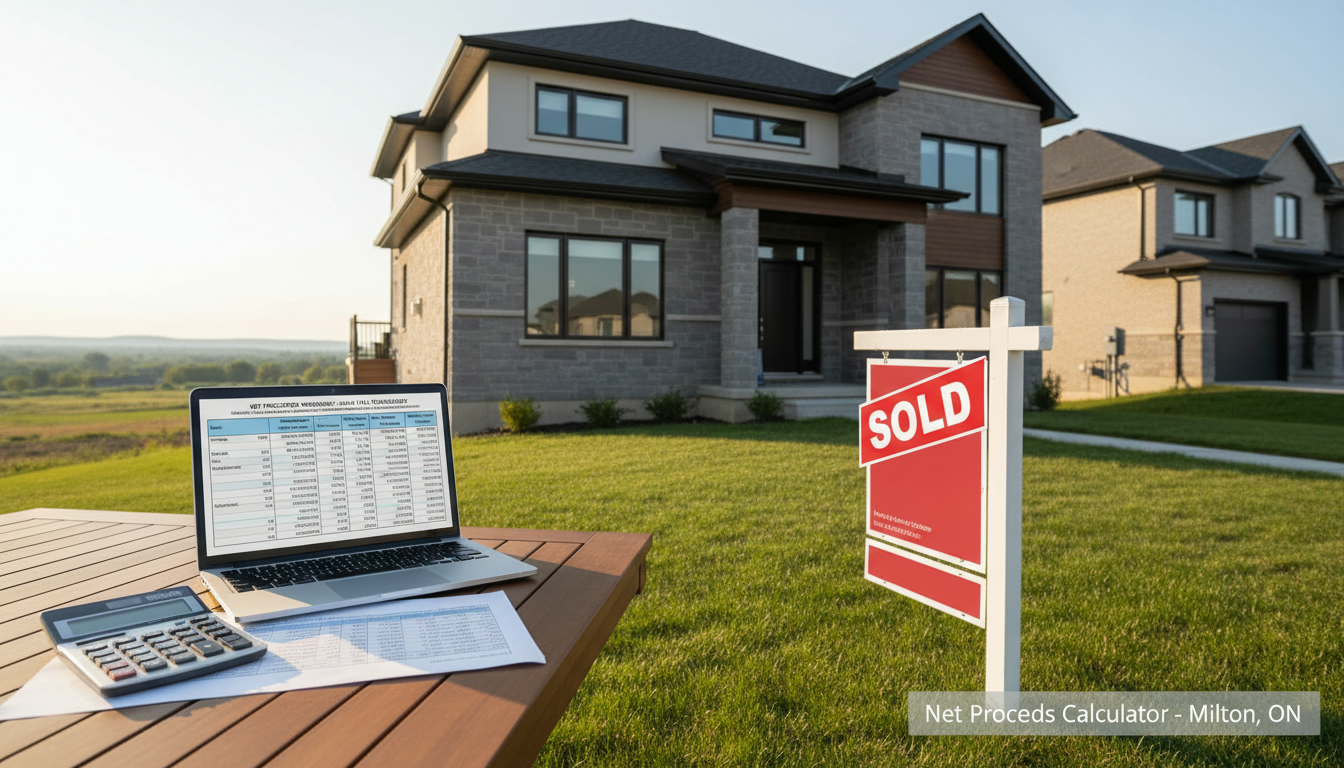
How do I calculate my net proceeds after sale?
Get your real number now: How do I calculate my net proceeds after sale? Read this and stop guessing.
Why net proceeds matter to Milton home sellers
You can’t make smart decisions from a guess. Net proceeds tell you what lands in your bank after a home sale. For Milton, Ontario sellers, that number decides your next down payment, tax bill, and retirement move. Know it before you list.
This post gives a clear, practical formula, Milton-specific tax and cost notes, and a sample calculation you can copy. No fluff. No surprises.
Simple formula: your net proceeds in one line
Net Proceeds = Sale Price – (Real Estate Commission + HST on commission + Closing Costs + Mortgage Payoff + Adjustments + Legal Fees + Repairs & Prep + Other Fees + Capital Gains Tax (if any))
Break it down, line by line, and you’ll know exactly what you keep.

Key items Milton sellers must include
- Sale price: the final agreed sale price.
- Real estate commission: typical local rate (varies). Always confirm the exact rate with your listing agent.
- HST on commission: in Ontario, HST (13%) applies to the commission portion charged for services.
- Mortgage payoff: balance plus any prepayment penalty and discharge fee.
- Legal fees: closing lawyer or notary fees to transfer title and disburse funds.
- Closing costs / adjustments: utilities, property tax adjustments, condo fees adjustments, home warranty credit, etc.
- Repairs, staging, and prep: money spent to make the house market-ready.
- Capital gains tax: only on properties that are not your principal residence or a portion if partial use.
- Other fees: title insurance (if seller pays), certificates, clearances, etc.
Important Milton & Ontario specifics
- HST: Commission and many professional fees have HST (13%) applied. Always calculate commission + 13%.
- Land Transfer Tax: typically paid by the buyer in Ontario. Milton sellers generally do not pay provincial land transfer tax.
- Principal residence exemption: if your property was your principal residence for every year you owned it, you likely owe no capital gains tax on the sale. If not, expect capital gains tax on any profit.
- Capital gains rules: 50% of the capital gain is taxable at your marginal tax rate. That’s federal + provincial combined.
- Municipal taxes & adjustments: Milton is in Halton Region. Property tax adjustments between buyer and seller are common on closing day.
What the numbers usually look like in Milton (typical ranges)
- Commission (total): often 4% to 5% of sale price (may vary). Example: 2.5% listing + 2.5% buyer agent.
- HST on commission: 13% of commission amount.
- Legal fees: $800 to $2,000 (depends on complexity).
- Mortgage discharge fee: $200 to $500 + possible prepayment penalty (depends on lender and mortgage terms).
- Staging and repairs: $0 to $10,000+ depending on property condition and strategy.
- Capital gains tax: depends on your tax bracket and whether the home was principal residence.
These are ranges. Use your actual numbers when calculating.
Step-by-step calculation with a real Milton example
Assume:
- Sale price: $850,000 (typical for many Milton properties — use your actual number).
- Commission: 5% total = $42,500.
- HST on commission: 13% of $42,500 = $5,525.
- Mortgage payoff: $400,000 outstanding.
- Legal fees: $1,200.
- Discharge fee: $350.
- Repairs/staging: $3,000.
- Adjustments (taxes, utilities): $1,000.
- Capital gain: none (property sold as principal residence).
Calculation:
- Gross sale proceeds: $850,000
- Less commission: -$42,500
- Less HST on commission: -$5,525
- Less mortgage payoff: -$400,000
- Less legal & discharge fees: -$1,550
- Less repairs & staging: -$3,000
- Less adjustments: -$1,000
Net proceeds = $850,000 – ($42,500 + $5,525 + $400,000 + $1,550 + $3,000 + $1,000)
Net proceeds = $396,425
That’s the money that gets wired to you after closing.
If capital gains tax applied, you’d subtract the estimated tax. For example, if you had a $100,000 gain and your marginal rate produced $13,000 tax on the taxable portion, subtract that too.

Capital gains — clear rules, simple math
If the house is not your principal residence for the full ownership period, you may owe capital gains tax. Steps:
- Calculate capital gain: Sale price – Adjusted Cost Base (ACB) – Selling expenses (commission, legal) = Capital Gain.
- Taxable portion: 50% of capital gain is included in your taxable income.
- Tax owed = Taxable portion x combined marginal tax rate (federal + Ontario).
Example: If capital gain = $100,000, taxable portion = $50,000. If your marginal tax rate is 26% combined, tax owed = $13,000.
Always consult your accountant because adjusted cost base can include renovations and other additions that reduce your gain.
Common seller mistakes that cut your net proceeds
- Ignoring HST on commission. That 13% adds up.
- Forgetting mortgage prepayment penalties. Ask your lender early.
- Assuming land transfer tax applies to you. Buyers usually pay it, but double-check special cases.
- Not applying principal residence exemption correctly. Missing an election can cost you money.
- Leaving out closing adjustments (condo fees, utilities, property tax adjustments).
- Not documenting renovations — you could reduce taxable gains.
Avoid these and you keep more cash.
How to get an accurate net proceeds number fast
- Get a written estimate from your listing agent showing commission and HST. Confirm the split and the total cost.
- Ask your lender for a mortgage payoff statement with any penalties and discharge fees.
- Request estimates from a lawyer for closing costs and disbursements.
- Add known repairs, staging, and moving costs.
- If the property isn’t your principal residence, bring records to your accountant to estimate capital gains tax.
- Run the formula. Build a spreadsheet and update numbers as offers come in.
This process saves surprises on closing day.
Why local expertise matters in Milton
Milton market rules and costs track Halton Region norms. A local real estate professional who regularly closes transactions in Milton will know:
- Typical commission splits and how that affects net proceeds.
- Local closing adjustment patterns (taxes, utilities, condo reconciliations).
- Common legal fees in Halton and likely timelines for payoffs and discharges.
- How buyer demand affects negotiation levers you can use to reduce seller-paid costs.
That local insight translates into thousands of dollars in saved fees and faster closings.

Quick checklist for Milton sellers before listing
- Confirm mortgage payout and potential penalties.
- Get a realistic agent estimate for net proceeds using local commission rates and HST.
- Budget for legal fees and adjustments.
- Decide staging/repairs budget vs. expected sale uplift.
- Ask your accountant about capital gains if not a full principal residence.
- Prepare documents for closing (deed, mortgage statements, receipts for renovations).
Contact local help — make the math painless
If you want an accurate, no-nonsense net proceeds estimate for your Milton home, get a local breakdown from someone who closes deals here. Email tony@sousasells.ca or call 416-477-2620. Visit https://www.sousasells.ca.
Tony Sousa knows Milton market realities and will deliver a detailed net-proceeds worksheet tailored to your sale.
FAQ — Net proceeds, taxes and financial considerations for Milton sellers
Q: Do sellers pay land transfer tax in Milton?
A: No. Land transfer tax in Ontario is typically paid by the buyer. The City of Toronto has a municipal LTT; Milton does not. Sellers generally do not pay LTT.
Q: Is HST charged on the home sale?
A: Generally, HST does not apply to the sale of used residential properties. However, HST does apply to services tied to the sale — most notably the real estate commission and some legal fees. Add 13% HST to those service amounts.
Q: How is capital gains tax calculated if I didn’t live in the house full-time?
A: Capital gain = Sale price – Adjusted Cost Base – Selling expenses. Fifty percent of that gain is taxable at your marginal income tax rate. Speak with your accountant to determine ACB and any eligible exemptions.
Q: What typical commission should I expect in Milton?
A: Commissions vary. Many sellers see totals between 4% and 5% of the sale price. Confirm the exact rate with your agent. Remember to add 13% HST to the commission amount.
Q: What legal and closing costs will I face?
A: Expect lawyer/notary fees for title transfer and disbursements. A typical range is $800–$2,000, plus any mortgage discharge fees and adjustments for property taxes or condo fees.
Q: Will I owe tax if the house is my principal residence?
A: If the property qualified as your principal residence for every year you owned it, you likely owe no capital gains tax. Partial use or rental periods complicate the calculation and can create a capital gain. Consult a tax professional.
Q: How can I reduce my taxable capital gain?
A: Keep records of renovations and improvements (these increase your adjusted cost base). Use any applicable principal residence years. Speak with an accountant for any elections or reporting strategies.
Q: What if my mortgage has a prepayment penalty?
A: Ask your lender for a payoff statement early in the process. Include prepayment penalties and discharge fees in your net proceeds calculation. These can be significant.
Q: Who pays for repairs discovered in inspections?
A: Negotiable. Sometimes the seller fixes issues or provides credits to the buyer. Budget for possible repairs or credits when estimating net proceeds.
Final word
Get a precise estimate. Use the formula above. Talk to a local Milton agent and your accountant. Know your net proceeds before you sign an agreement.
For a free, custom net proceeds worksheet for your Milton home, reach out to Tony Sousa at tony@sousasells.ca or call 416-477-2620. Visit https://www.sousasells.ca to learn more.