How close are hospitals, schools, and grocery
stores?
How Close Are Hospitals, Schools, and Grocery Stores? You’ll Be Surprised How Much This Changes Your Sale.
Why proximity is not a ‘nice to have’ — it drives price and speed
If you’re selling a home in Milton, Ontario, location isn’t just a marketing line. It’s the lever that raises price and cuts days on market. Buyers don’t buy a house. They buy a life that starts with the nearest hospital, the local schools, and where they shop for food each week.
This post tells you what matters, how to measure it, and what to do to turn proximity into cold, hard offers. No fluff. Actionable steps anyone can use.
The three proximity pillars every Milton seller must prove
- Hospitals: Safety, emergency response, long-term care access.
- Schools: Day-to-day convenience, resale demand for families, school reputation.
- Grocery stores: Convenience, walkability, neighborhood desirability.
Buyers weight these differently. Families care most about schools. Older buyers prioritize hospitals. Everyone wants grocery options within a short drive or walk. As a seller, you must know which buyers you’re targeting and package proximity to match.
How buyers measure proximity (and how you should present it)
Buyers think in minutes, not kilometers. They look for a quick answer: “How long will it take to get to the hospital, drop my kids at school, or pick up milk?” Use these metrics in your listing and marketing materials:
- Walk time: 5–20 minutes for local errands. Highlight if key amenities fall in this range.
- Drive time: 5–15 minutes is excellent in suburban markets like Milton.
- Transit time: If the property is near a GO Station or bus route, show commute times.
- Number of options: “Three grocery stores within 10 minutes” beats a vague claim.
How to calculate: use Google Maps drive and walking estimates during peak times (weekday mornings and evenings). Check transit schedules for public transport times. Use Walk Score or local municipal maps for visuals.

Why Milton’s location profile matters right now
Milton is growing fast. Developers build, roads expand, buyers move from GTA cores looking for space and value. That growth creates two realities for sellers:
1) Proximity matters more because buyable land is rarer and new communities compete on convenience.
2) Buyers compare neighborhoods easily online. If your listing doesn’t state hard proximity numbers, it loses to listings that do.
You can win by being precise and tactical.
What to include in your listing — exact language that converts
Words matter. Say less, show more. Use these lines in your listing and flyers:
- “Milton District Hospital: 9-minute drive (2.8 km) — ambulance access and emergency care.”
- “Two public elementary schools within a 10-minute walk.”
- “Main grocery store chain within a 6-minute drive; neighborhood market within a 12-minute walk.”
- “15-minute drive to the Milton GO Station (peak-hour commute time shown).”
Don’t guess. Check times and distances, then use them. Buyers trust numbers.
Tactical steps to add perceived value around proximity
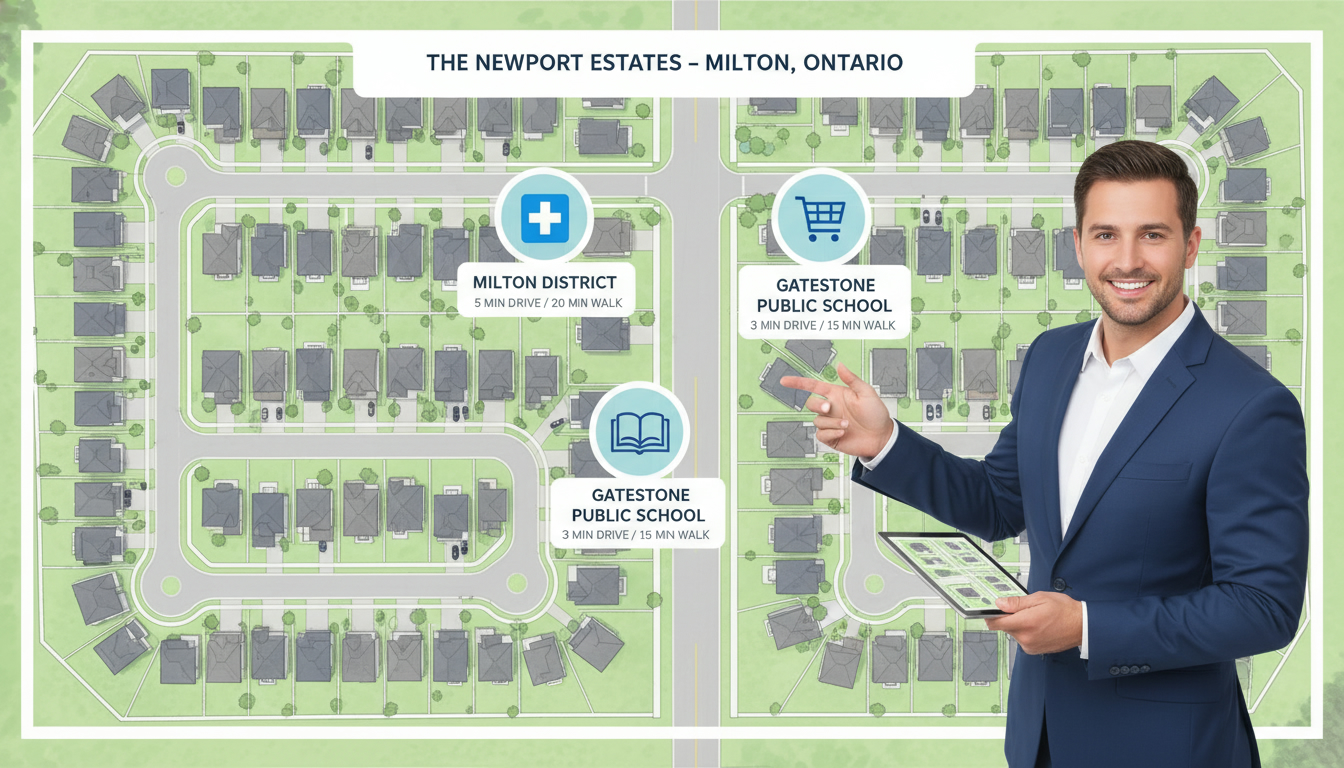
- Create a one-page neighborhood map. Use icons for hospital, schools, grocery, parks, and transit. Put this in the online gallery and printed packages.
- Get quotes from local schools or the school board if available — show catchment info.
- Highlight safety features tied to proximity: ambulance routes, flood-free elevations, and well-lit pedestrian paths.
- Include testimonials from neighbors about convenience (short quotes work).
- Show local retail variety: name the grocery stores, farmer’s markets, pharmacies and quick-serve options.
These small upgrades boost perceived convenience and justify a higher asking price.
Pricing strategy tied to proximity — how to think about it
Proximity can justify a 2–8% premium in suburban markets. Here’s how to use it:
- If your home is within a 5–10 minute drive to a major hospital and has top-rated schools within walking distance, price at the top of the comparable range.
- If the property is farther from key amenities, price competitively and highlight other wins: lot size, finishes, or drive-time to a GO station.
Always back pricing with numbers: comparable sold prices and exact proximity metrics.
Common seller mistakes (and how to avoid them)
- Vague claims: “Close to schools” won’t cut it. Put times and distances.
- Missing visuals: Buyers scan listings. If they can’t see a map in 3 seconds, they move on.
- Ignoring noise or traffic: Proximity to a highway interchange matters. Address it directly in your marketing if it’s an issue.
- Not updating marketing after inspections: If the municipality upgrades roads or a new grocery opens, update your listing immediately.
Tools every Milton seller should use right now
- Google Maps: Drive and walking times, street view.
- Walk Score: Quick neighborhood convenience grade.
- Halton District School Board & Halton Catholic District School Board websites: catchment and ranking info.
- Town of Milton planning maps: future developments and planned infrastructure.
Use these tools to create a facts sheet buyers can download from your listing.
Quick neighborhood checklist for Milton listings
- Nearest hospital name, address, and minutes by car.
- Primary and secondary schools in catchment — minutes by walk/drive.
- Major grocery stores and specialty markets — minutes by walk/drive.
- Local transit options and peak commute times.
- Safety and walkability notes: sidewalks, crosswalks, lighting.
- Any planned municipal changes (new grocery, school, road) with expected completion date.
Add this checklist to your open house folder.
Case study example (how proximity closed a deal faster)
Seller profile: 4-bed detached home in central Milton. Used strategy:
- Measured exact times to hospital (8 min), two elementary schools (6–10 min walk), and grocery (5 min drive).
- Created one-page map for online listing and open house.
- Priced at high end of comps and promoted convenience to families and retirees.
Result: Two offers above asking within 8 days. Buyer feedback mentioned the map and commute times as decisive.

How to handle properties with weaker proximity
If your home is farther from key amenities, don’t hide it. Sell the benefits it does have:
- Quiet streets, larger lots, mature trees.
- Lower property taxes or association features.
- Quick highway access for commuters.
Also consider small investments that shift perception: a local delivery locker for groceries, partnering with a local shuttle service, or highlighting a nearby community hub.
Final playbook — three things to do this week
- Run Google Maps for hospital, schools, grocery and get walk/drive times at peak hours.
- Create a one-page neighborhood map and add it to your listing.
- Update your pricing strategy using proximity metrics and comparable sales.
Do these. You’ll either sell faster or validate your price with facts.
About the local guidance
For sellers in Milton, a local market expert who knows which neighborhoods attract families, retirees, and commuters matters. If you want a market-ready neighborhood package and precise proximity data for your home, reach out for a tailored plan.
Contact: Tony Sousa — Local Realtor
Email: tony@sousasells.ca | Phone: 416-477-2620 | Website: https://www.sousasells.ca
FAQ — What Milton home sellers ask about neighborhood proximity
Q: How important are hospitals when selling a home in Milton?
A: Very important for older buyers and families with health needs. Proximity to Milton District Hospital or immediate ambulance routes increases buyer confidence. Show drive times and accessibility.
Q: Should I list school names in my listing?
A: Yes. List school names, catchment info, and minutes by walk/drive. Buyers with kids search for exact school names.
Q: How close does a grocery store need to be to add value?
A: Walkable (under 15 minutes) or a short drive (5–10 minutes) to a full-service grocery store is ideal. Multiple nearby grocery options add value.
Q: What if my home is farther from amenities than others?
A: Be honest. Highlight what you do have: quiet streets, lot size, lower traffic. Offer solutions: delivery convenience, local shuttle info, or a strong home staging package.
Q: How do I prove proximity claims to buyers?
A: Provide screenshots from Google Maps with times, a printable neighborhood map, and links to school board catchment pages. Include these in your listing and open-house folder.
Q: Will proximity to a hospital ever hurt a sale?
A: It can if the house is directly adjacent to noisy emergency routes or large hospital infrastructure. Address potential noise proactively and show mitigation (double-glazing, landscaping).
Q: How often should I update my neighborhood info?
A: Immediately when something changes. New grocery openings, school boundary changes, or municipal road updates should be reflected in marketing materials.
Q: Can proximity justify a higher asking price in Milton?
A: Yes. In many Milton neighborhoods proximity to high-quality schools, quick hospital access, and nearby grocery stores can justify a premium within the comparable range.
Q: Where can I get an official school catchment map?
A: From the Halton District School Board or Halton Catholic District School Board websites. Include these links in your listing package.
Q: What’s the fastest way to make proximity a selling point?
A: Produce a one-page neighborhood map with verified drive/walk times and feature it on the listing, MLS remarks, and open-house materials.
If you want a customized neighborhood map and hard proximity numbers for your Milton home, contact Tony Sousa — he’ll deliver the exact metrics and a tailored pricing plan.
Contact: tony@sousasells.ca | 416-477-2620 | https://www.sousasells.ca