
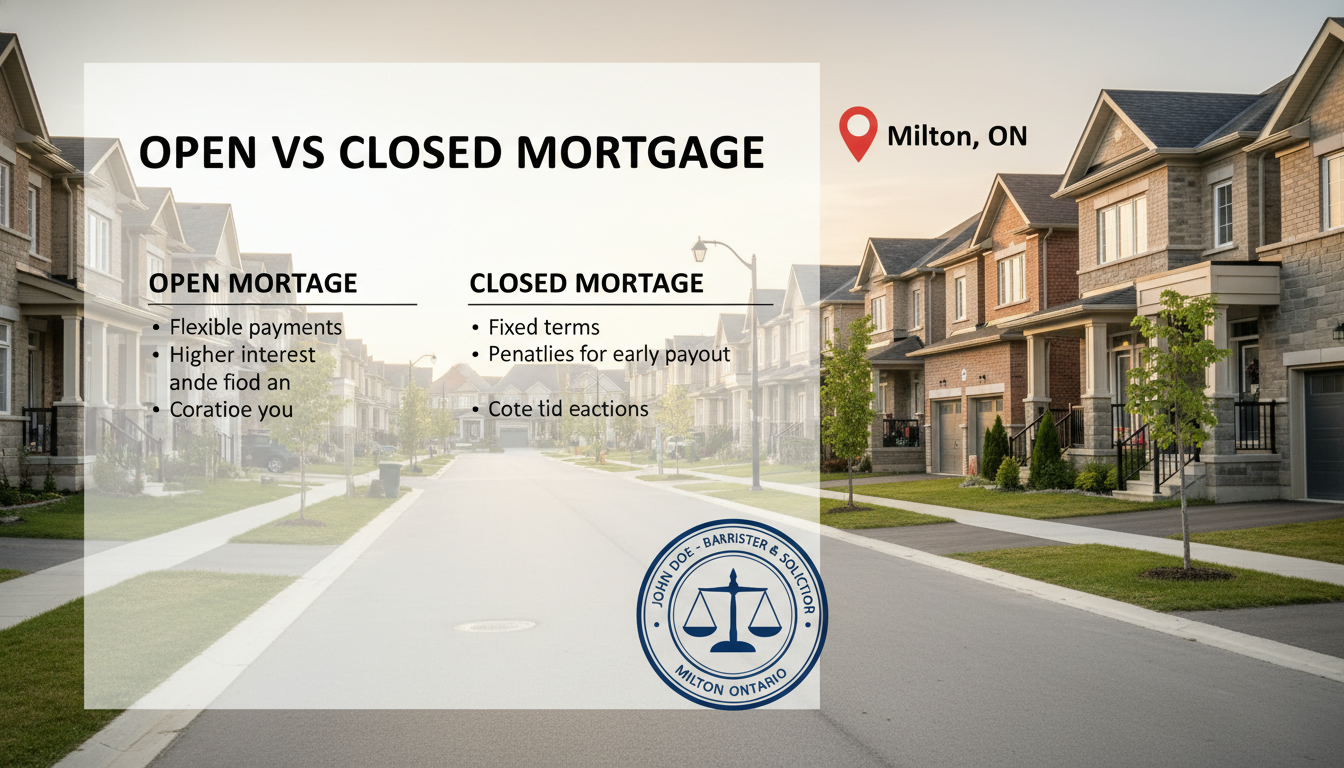
What’s the difference between open and closed mortgages?
“Sell or move early? Here’s how your mortgage will either cost you thousands—or save you them.”
Why this matters to Milton home sellers
If you own a house in Milton, ON and you’re selling within the next few years, the type of mortgage you signed will directly affect your bottom line. The wrong mortgage can mean heavy penalties, surprise payoffs, and closing delays. The right mortgage can let you move cleanly, keep costs low, and win offers from buyers who need flexibility.
I’ll explain in plain language: what open and closed mortgages are, the real financial impact for sellers and buyers in Milton, and exactly what to do to protect your equity when you sell.
Open vs Closed Mortgage — the simple truth
- Open mortgage: You can pay off all or part of the mortgage anytime without a penalty. Open mortgages are flexible. They usually carry higher interest rates. Use them if you plan to sell or refinance very soon.
- Closed mortgage: You’re locked into the mortgage terms for a set period. Paying off early can trigger penalties. Closed mortgages generally have lower interest rates. Use them if you plan to stay through the term and want a lower monthly rate.
That’s it. One gives freedom at higher cost. The other gives savings at the risk of penalties.

What sellers in Milton need to understand right away
-
Penalties can wipe out your profit. If you sell before a closed mortgage term ends, you’ll typically owe a prepayment penalty. For fixed-rate closed mortgages in Ontario, lenders often use the Interest Rate Differential (IRD) calculation. For variable-rate closed mortgages, a common penalty is three months’ interest. These penalties can be thousands of dollars.
-
Mortgages are liens on title. When a mortgage is registered on your property title it’s a legal charge — a lien. Your lawyer or title company must clear that lien at closing. If a lien remains, the buyer won’t get clean title and the sale can collapse.
-
Portability can save you money. Many closed mortgages are portable. Portability means you transfer the existing mortgage (and its current rate) to your new property without breaking the mortgage. If you’re buying another house in Milton or nearby Oakville/Burlington, portability can avoid penalties.
-
Assumption options are rare but useful. Some mortgages allow a buyer to assume your mortgage at the same rate and terms. That can make your home more attractive to buyers who need lower rates than current market offers. Not all lenders allow assumption and lender approval is required.
-
Get a payoff statement early. Before listing, request a mortgage payoff statement from your lender. It shows the balance, the penalty (if any), and the date the figure is valid through. Use that number to price and negotiate accurately.
How closed vs open mortgages affect buyers in Milton
-
Buyer assuming a mortgage: If a buyer assumes your mortgage, they inherit the rate and term. This could be valuable when rates are higher. The buyer still needs lender approval and must qualify.
-
Lender discharge timelines: When a seller pays out a mortgage, the lender must provide a discharge of mortgage to remove the lien from title. This is part of closing paperwork and can take time. Your closing lawyer coordinates this.
-
Market competitiveness: Homes with assumable mortgages can be more attractive in a rising-rate environment. Buyers in Milton who need lower monthly payments may prefer homes where the existing mortgage is favorable and assumable.
Local specifics for Milton, Ontario sellers
-
Local lenders: Major banks and credit unions in Milton follow Ontario mortgage penalty rules. Small private lenders may have different terms. Always read the mortgage commitment.
-
Land registration: Ontario land titles are managed by the provincial land registration system. Your lawyer runs a title search to identify mortgages and liens. If there are municipal tax arrears or construction liens in Milton, they must be cleared before closing.
-
Real estate market timing: Milton’s market moves fast. If you list without knowing your mortgage payoff, you risk delays. Ask your realtor and mortgage broker for a payout statement before listing.
Practical steps to protect your money when selling in Milton
- Ask for a payout figure from your lender immediately. Don’t wait until you have an offer.
- Check if your mortgage is portable. If so, plan to port if you’re buying another property.
- Confirm assumption rules with your lender. If assumable, advertise it—this can attract buyers.
- Talk to a mortgage broker if penalties are extreme. Refinancing to a short-term open mortgage can sometimes reduce penalties if you plan to sell soon.
- Involve a local real estate lawyer early. Clearing liens and ordering a title search prevents last-minute surprises.

Examples that make it obvious
Example A: You have a closed fixed mortgage with 3 years left and want to sell now. The bank charges IRD as a penalty. Your buyer offers a market price, but your IRD is $8,000. After realtor fees and closing costs, you may net much less than expected.
Example B: You have an open mortgage you took for six months while renovating. You sell with zero penality because open mortgages let you pay out anytime. You keep your equity.
Example C: Your mortgage is portable. You sell and buy a new Milton home. You port the mortgage and avoid the penalty. You keep your equity and a low rate.
Real numbers you need to ask for (and where to find them)
- Current mortgage balance: ask your lender.
- Daily interest accrual: included in payoff statement.
- Prepayment penalty estimate: ask your lender for a written estimate if you plan to sell within the term.
- Discharge fee: some lenders charge a fee to register the discharge of mortgage.
- Legal fees for title search and removal of liens: ask your lawyer.
Always get these numbers in writing.
How liens other than the mortgage impact closing
- Tax arrears: Municipal property tax arrears in Milton are liens and must be paid before title transfer.
- Construction liens: Subcontractors can register liens for unpaid work. These must be cleared by settlement or court order.
- Judgment liens: Creditors can register liens against property. These must be removed.
A full title search done by your lawyer will list all registered charges. Clearing each lien is mandatory before the buyer receives clear title.
Why you need a local mortgage and real estate expert
Mortgages and liens are legal and financial instruments that change by lender and by province. Milton sellers benefit from local knowledge: which lenders are flexible, how quickly local lawyers process discharges, and which buyers will value assumable mortgages.
That’s why working with a local expert matters. I represent hometown knowledge for Milton, ON: I know the lenders, the legal teams, and how buyers in this market behave. If you want to sell with confidence, contact Tony Sousa at tony@sousasells.ca or call 416-477-2620. Visit https://www.sousasells.ca for more resources.

Quick checklist before you list
- Get a written payoff statement.
- Confirm portability or assumption options.
- Order a title search through your lawyer.
- Estimate penalties and factor into your net proceeds.
- Decide whether to refinance to an open mortgage if selling very soon.
FAQ — Milton home sellers’ top mortgage and lien questions
Q: What’s the fastest way to find out my mortgage penalty?
A: Request a written payoff statement from your lender. It will list the penalty calculation. Do this before you accept an offer.
Q: Can I sell my house and keep the mortgage?
A: Not usually. The mortgage is a charge on the property you’re selling. You can port it to your new mortgage or the buyer may assume it with lender approval.
Q: What if there is a construction lien on my title?
A: Construction liens must be resolved before closing. You or the buyer’s lawyer can negotiate a holdback or arrange payment to remove the lien.
Q: Are open mortgages always better if I plan to sell soon?
A: Not always. Open mortgages cost more in interest. If you know your selling timeline and it’s short, they can save you a penalty. Compare the interest cost vs the likely penalty.
Q: How long does a mortgage discharge take in Ontario?
A: Timing varies by lender. Some provide electronic discharge quickly; others may take several business days. Your lawyer coordinates timing with the lender to meet closing.
Q: Can buyers assume my mortgage and is that attractive?
A: If your mortgage is assumable and the buyer qualifies, it can be attractive when market rates are higher than your existing rate. This can speed a sale and secure a better price.
Q: Who pays outstanding tax or judgment liens at closing?
A: Outstanding municipal taxes and judgment liens must be paid or otherwise addressed before title transfer. The seller usually clears these, but negotiations can include holdbacks.
Q: Do private lenders register different penalties?
A: Yes. Private and alternative lenders often have different penalty structures. Read your mortgage agreement and get a payout in writing.
Final, blunt advice for Milton sellers
Don’t guess. Know your payoff. Know your penalty. Know if your mortgage is portable or assumable. The difference between open and closed mortgages will determine whether you keep your profit or hand it to the lender.
If you want clear numbers and a local plan, email Tony Sousa at tony@sousasells.ca or call 416-477-2620. Get a no-nonsense review of your mortgage and a step-by-step plan to sell with cash in your pocket.
Image credit: Local property market photography and title search visuals.