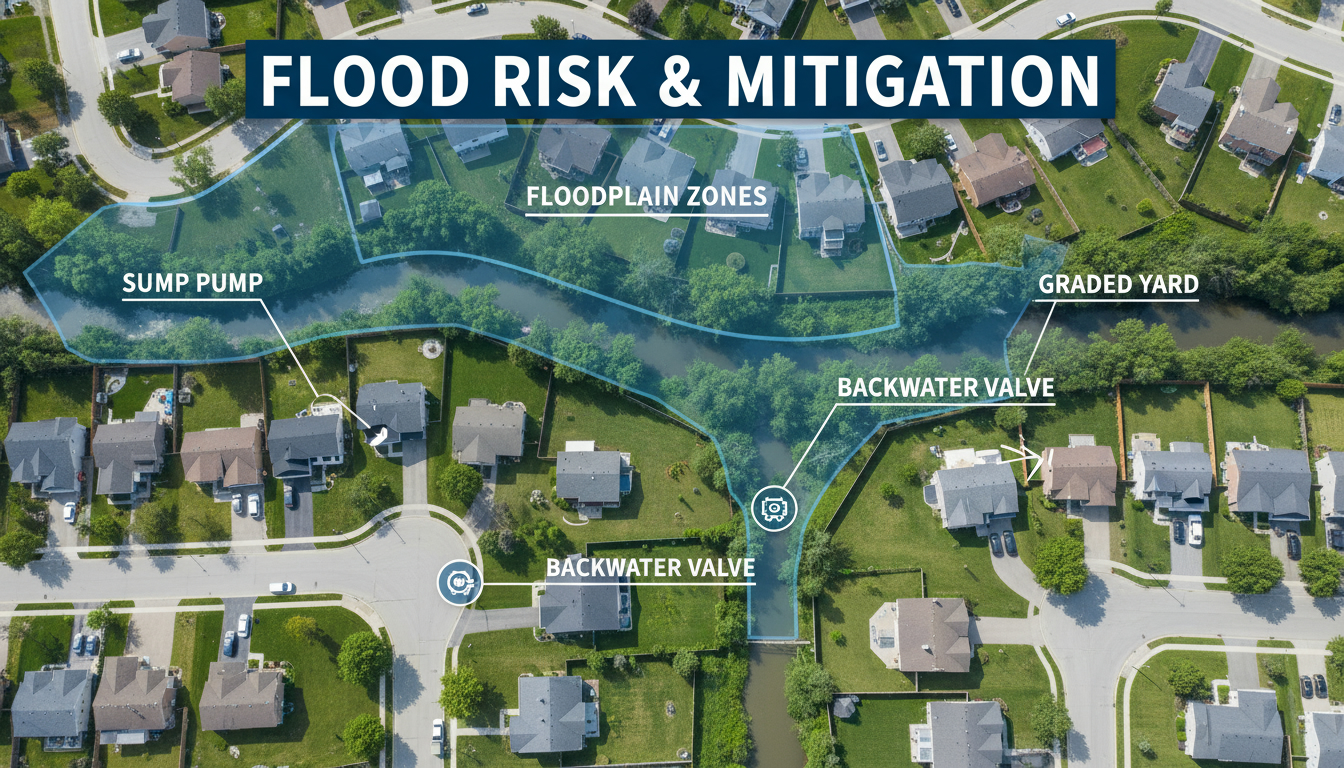
How do I assess flood and natural disaster
risk?
“Could your Milton house be a flood time-bomb? Here’s the quick test every seller must run.”
Why this matters now — quick and blunt
If you’re selling a home in Milton, Ontario you don’t get luxury of hope. Buyers, insurers, and lenders are underwriting risk tighter than ever. Floods and severe storms are more frequent. If you don’t assess risk and act, you’ll lose money, time, or both. This guide tells you exactly how to assess flood and natural disaster risk — step-by-step — and what to do next to protect value and close the sale.
Snapshot: Milton’s real exposure
- Milton sits in Halton Region and is serviced by Conservation Halton for watershed and floodplain oversight.
- Major watercourses that affect local risk include Sixteen Mile Creek and local tributaries.
- Extreme rainfall events have increased across Southern Ontario over the last decade — the storms that once were “rare” now arrive more often.
That means neighborhoods once considered safe may face overland flooding, sewer backup, or erosion risks you didn’t plan for. Buyers know this. Smart sellers prepare.
Step 1 — Start with maps (fast, free, decisive)
Do this immediately. Maps give you the single fastest read on whether your property sits on or near a floodplain.
- Check Conservation Halton’s floodplain maps and mapping tools. They show regulated floodplain, valley slopes and areas where development is restricted.
- Use the Halton Region GIS viewer for municipal layers: storm sewer lines, floodplain overlays, and historical flood areas.
- Ontario’s Natural Hazards mapping and the province’s flood hazard data can confirm findings.
If your property touches a floodplain or is inside a regulated area, flag it. This is a red flag for buyers and insurers.

Step 2 — Confirm history: Has this house flooded before?
Knowledge beats guesswork. Find documented evidence. Ask these questions and collect proof:
- Ask the seller (if you didn’t live there) for any water event history: dates, cause (storm, sewer backup, river overflow), repairs done.
- Request municipal records: has the property been listed on historical claims or municipal repair logs?
- Get a pre-listing inspection with a certified inspector who checks for past water damage signs: floor elevation, discolouration, efflorescence, musty smell, drywall seams, floor crowns.
Full disclosure is required under Ontario law for known material defects. If the home flooded, disclose it. Not disclosing is a legal and sale-risk mistake.
Step 3 — Understand the insurance angle (this kills deals if missed)
Standard homeowner policies in Canada commonly exclude overland flood (surface water) damage. They often cover sewer backup only if you buy an endorsement.
- Ask your broker for clarity: is overland flood coverage available for the property? At what cost? Is there a deductible specifically for flood?
- Request a written insurance availability and premium estimate from a broker before listing. Present this to buyers or their agents — it calms them and avoids surprise declines at mortgage time.
- If insurers refuse new overland coverage or charge prohibitively high rates, price accordingly. Buyers will ask — be ready with facts.
Step 4 — Technical checks to order now (quick wins)
Hire professionals for these targeted checks. They’re not expensive compared to the cost of a failed sale.
- Elevation or survey verification: confirm lowest finished floor elevation relative to local flood levels. A licensed surveyor or engineer can do this.
- Drainage and grading inspection: ensure lot slopes away from foundation, downspouts extend at least 2 metres from the foundation.
- Sump pump and backwater valve check: confirm operability and battery backup. If not present, consider installing — it’s cheap insurance for buyer confidence.
- Sewer capacity check: contact Halton Region to find if the sewer system has a history of backups in your street.
Small fixes here make your listing stronger and reduce closing friction.
Step 5 — Fix, mitigate, document (sell confidence with proof)
Buyers will pay for certainty. Provide it.
- Install or service a sump pump with battery backup. Cost: $800–$2,500 depending on model and install.
- Add a backwater valve for sewer backup protection. Cost: $800–$1,800.
- Improve grading and gutters. Re-extend downspouts, add splash pads, re-grade high-risk spots. Cost: inexpensive but high ROI.
- Waterproof foundation where needed and replace damaged insulation or drywall.
- Get a post-mitigation inspection or engineer letter verifying remedial work.
Include invoices, warranties, and the inspection letter in the listing. Buyers want documented risk reduction — not promises.
Step 6 — Pricing and marketing strategy for sellers in Milton
If you have risk exposure, don’t hide it. Use it to frame value and create a competitive listing.
- If mitigation is complete, market the home as “Mitigation Upgraded” and list the work done and warranties. That positions the house ahead of comparable listings with unknowns.
- If you can’t fully mitigate, price for the market reality. Use the pre-listing inspection to justify the price point.
- Offer to share insurance quotes and the mitigation report with prospective buyers. Transparency sells faster and at better prices than surprises at conditional removal or closing.
Step 7 — Legal and disclosure obligations (don’t gamble)
Ontario recognizes material latent defects; flooding history is material. If you know of past floods, sewer backups, or corrective repairs, disclose them in writing. Use the SPIS (Seller Property Information Statement) and include copies of repair invoices and inspection/engineer reports.
Failing to disclose can cost you in litigation, rescinded sales, or damaged reputation in Milton’s tight market.
Checklist: What to have ready before you list (printable and simple)
- Conservation Halton floodplain map screenshot for property
- Halton Region GIS report for your address
- Pre-listing inspection report (structural + moisture)
- Written insurance availability/quote from a broker for overland and sewer backup
- Invoices and warranties for mitigation work (sump, backwater valve, grading)
- Survey or elevation verification if available
- SPIS with full disclosure
Bring these to your first buyer showing and attach them to the listing package online.
How Tony Sousa helps Milton sellers (direct and measurable)
I’m Tony Sousa — local Milton Realtor specializing in Insurance & Risk for sellers. I help sellers:
- Interpret Conservation Halton maps and identify true risk vs. noise.
- Get fast broker insurance checks and written coverage options for buyers.
- Coordinate targeted inspections and remediation contractors.
- Package risk documents so buyers see certainty, not doubt.
If you want a rapid risk assessment for your Milton property, email tony@sousasells.ca or call 416-477-2620. I’ll run the local checks and tell you exactly what buyers and insurers will ask for — and how to fix it.
Real example (anonymous): What a quick strategy saved a seller
A mid-century bungalow near Sixteen Mile tributary failed a casual map check. Tony ordered a survey, found the low finished-floor height, and had the seller install a battery-backed sump and backwater valve. With documents and insurance quotes in hand, the house sold in 9 days at full price. Without the fixes and documentation the sale would have stalled at mortgage approval.
Final rules — if you remember only three things
- Maps first. Get Conservation Halton and Halton Region GIS data now.
- Insurance second. Get written coverage availability and premiums.
- Document everything. Buyers want proof — inspections, invoices, and broker letters.
FAQ — Quick answers Milton sellers need
Q: Do I have to tell buyers if my house flooded before?
A: Yes. If you know about a past flood or material damage, disclose it. It’s a material fact in Ontario. Use SPIS and include documentation.
Q: Will flood history kill my sale?
A: Not if you handle it. Mitigation, documentation, and upfront insurance quotes can keep the sale moving and protect price. Silence kills more deals than risk does.
Q: Does standard home insurance cover overland flooding?
A: Usually no. Most standard policies exclude overland flood. Sewer backup may be optional. Always get a written quote from a broker.
Q: How do I find out if I’m in a floodplain?
A: Check Conservation Halton’s floodplain maps and Halton Region’s GIS viewer. If maps show regulated floodplain or valley slopes, treat it as a risk.
Q: What fixes matter most to buyers?
A: Sump pump with battery backup, backwater valve, improved grading and downspouts, and documented professional repairs. Buyers want proof these were done right.
Q: How much do flood mitigation upgrades cost?
A: Small fixes like grading and downspouts can be under $1,000. Sump pumps and backwater valves typically run $800–$3,000 installed. Structural waterproofing is higher.
Q: Can I get compensated for mitigation work at sale?
A: Yes. Properly documented mitigation often preserves or increases sale value. Use inspection reports and warranties to justify price.
Q: Who do I contact for a local assessment?
A: Email tony@sousasells.ca or call 416-477-2620 for a quick, local risk audit and seller strategy.
If you’re selling in Milton, don’t wait until a buyer’s home inspector or an insurer raises the issue. Run the checks, mitigate the risk, document the fixes, and sell with confidence. Contact me and I’ll show you exactly what buyers and insurers will look for — and how to turn risk into a selling advantage.