
How does location affect home value in Mississauga?
“How does location affect home value in Mississauga — and why every street matters if you’re selling in Milton?”
Why location is the single biggest pricing lever you own
Location isn’t one factor among many. It’s the multiplier. Two identical houses, blocks apart in Mississauga, can sell for wildly different prices because of one invisible thing: location. Location sets the buyer pool, the competition, the perceived lifestyle, and the price ceiling. If you want to sell for top dollar in Milton, understand how Mississauga prices its homes — then apply the same logic locally.
This is a direct, no-nonsense playbook. Read it, use it, and get more money for your Milton home.
How location affects home value — the practical list
- Proximity to major employment hubs: Homes nearer large employers or easy commutes to Toronto and Mississauga attract more buyers and higher offers.
- Transit access and commute time: A short walk to GO stations or express transit increases demand and price per square foot.
- Schools and school boundaries: Top-rated schools lift value. Buyers pay a premium to be in the right catchment area.
- Amenities and retail: Coffee shops, grocery stores, parks and high-quality restaurants increase daily convenience — and price.
- Neighbourhood reputation and safety: Good schools, low crime, and tidy streets create buyer trust and higher bids.
- Waterfront and views: Waterfront, ravine, or skyline views command strong premiums.
- Future developments and zoning: Planned transit, hospitals, or commercial centres can boost value. Negative zoning (industrial, landfill plans) kills value.
- Micro-location issues: Busy roads, flight paths, flooding risk, or noisy commercial neighbours cut value even if the general area is strong.
These rules hold in Mississauga — and they map directly to Milton.

What Mississauga teaches us that Milton sellers must use
Mississauga values proximity to Square One, transit, and the lakeshore. Milton buyers prize easy commutes, family-friendly parks, and top schools. Translate that into tactical moves:
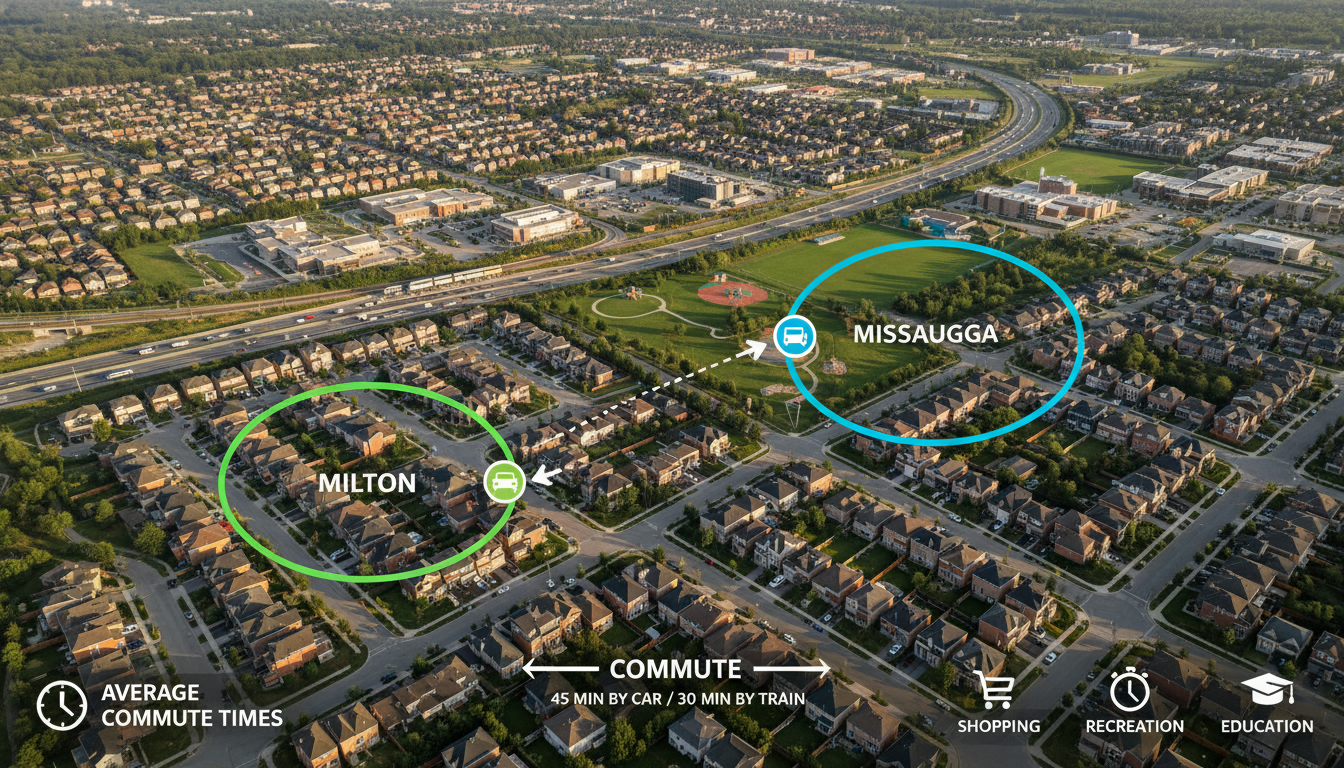
- Highlight commute times: Show exact drive and GO transit times to downtown Toronto, Mississauga and major employment nodes.
- Emphasize schools and extracurricular hubs: If your property is inside a sought-after school boundary or close to parks, spotlight that.
- Use amenity maps: Buyers care what’s nearby. Create a simple one-page map showing grocery stores, transit, parks, and leisure within a 10-minute radius.
- Be honest about negatives: If close to a busy road or low-lying area, show mitigation steps (soundproof windows, drainage upgrades) and price accordingly.
Milton-specific factors that change price fast
- GO Transit and commuter routes: Milton sellers must quantify the commute. Buyers in Milton still commute to Mississauga and Toronto. Be explicit: include drive time during peak hours.
- Highway access: Access to major highways affects suburban value. Show precise access points and typical congestion windows.
- New developments and growth nodes: Milton’s new communities and growth corridors can push comps up fast. Track municipal plans and use them in your pitch.
- Conservation areas and outdoor amenities: Proximity to parks, trails, and conservation areas increases appeal to families and outdoor buyers.
- Lot size and yard privacy: In Milton, larger lots and private backyards are a premium — call that out in headlines and marketing copy.
How to price your Milton home using location data (step-by-step)
- Gather precise comps: Pull sales from the last 3 months within a 1km radius and within the same school boundary. Filter by lot size, age, and finished living area.
- Adjust for micro-location: Subtract value for negative micro-factors (busy road, small lot) and add for positives (walk score, transit, view).
- Calculate price per square foot bands: Create low/median/high bands for your sub-neighbourhood. Your list price should sit strategically within these bands depending on your goals.
- Factor in market velocity: If inventory is low and days on market are falling, list at the high end of the band to capture competitive offers.
- Use a pricing ladder: Set an initial list price that attracts buyers and leaves room for escalation. If the market is hot, set a price slightly below a psychological barrier to create multiple offers.
Pricing strategy examples (realistic, practical)
- Slow market, similar comps selling below list: Price at or slightly below market value, invest in marketing and staging, target move-in ready buyers.
- Fast market, multiple offers common: Price at or slightly below a key price threshold (e.g., $799,000 instead of $825,000) to trigger traffic and bidding wars.
- Home needs updates but in a great micro-location: Price competitively and present the home as a value opportunity — buyers will pay for location and renovate.

Small investments that move the needle — and the ones that don’t
High ROI improvements for Milton sellers:
- Curb appeal: tidy yard, fresh paint on trim, pressure wash. Cost: small. ROI: high.
- Kitchen and bathroom touch-ups: update hardware, deep clean, neutralize countertops. Cost: moderate. ROI: high.
- Highlighting commute benefits: create a commute chart and include it in the listing. Cost: minimal. ROI: high.
Low ROI fixes to skip:
- Overbuilding expensive customizations that only appeal to niche buyers.
- Adding small features that don’t change layout (expensive light fixtures, rare tiles).
Marketing that turns location into offers
- Use professional photos and aerial shots that show proximity to parks, transit and highways.
- Create a neighbourhood one-sheet that maps commuting corridors, schools, and local amenities.
- Run targeted ads to buyer personas who value your location: families, commuters, first-time buyers.
- Stage the property to match the buyer profile that the location attracts (family-friendly or commuter-ready).
How negotiation changes with location
When location is a strength, use it to set expectations: request short conditional periods, keep showings flexible, and be firm on closing dates. When location is a weakness, offer incentives that don’t reduce headline price (rate buydowns, small closing credits) instead of cutting list price too early.
Use a local expert who understands micro-markets
Listing with someone who knows Milton’s lanes, conservation zones, school boundaries and planned developments matters. They’ll price using relevant comps, predict buyer behavior, and market the exact location benefits. That’s how you avoid underpricing or overpricing your biggest asset.

Call to action
Selling a home in Milton? Don’t guess. Get a precise, no-fluff valuation that accounts for micro-location, commute dynamics, and current buyer demand. Contact Tony Sousa — local Milton specialist — for a data-driven pricing plan and neighbourhood marketing package.
Email: tony@sousasells.ca
Phone: 416-477-2620
Website: https://www.sousasells.ca
FAQ — Common seller questions about pricing, location impact, and Milton market trends
How much does location alone affect price?
Location can be the difference between a typical price and a premium price. In practical terms, location factors (commute, school, amenities, micro-issues) can move value 5–25% depending on the feature. Waterfront or top school zones push numbers up more; minor negatives push numbers down a few percent.
How do I compare my Milton home to Mississauga comps?
Compare by buy-side drivers, not city lines. Match commute times, school quality, nearby amenities, and lot features. Mississauga comps help illustrate what buyers pay for certain benefits — mirror that when positioning your Milton listing.
Should I spend on renovations to beat location limits?
Renovations can close gaps but won’t fully overcome a poor micro-location. Prioritize cosmetic, high-impact updates (paint, flooring, fixtures) and fix any visible issues. If location is prime, smaller improvements deliver big returns.
When is the best time to list in Milton?
Spring and early fall generally attract the most active buyers. However, market velocity (inventory low, rising prices) can make any time good. A local agent will analyze current data and advise timing to maximize value.
How many comps are enough for a reliable price?
Aim for at least 6–12 sold comps in the last 3–6 months within a tight radius and the same school boundary. Adjust for differences in lot size, upgrades, and micro-location.
What’s the biggest pricing mistake Milton sellers make?
Ignoring micro-location adjustments and relying on broad neighbourhood averages. Small differences — a busy road, a GO station walk-score, school boundary — alter buyer demand and price. Use targeted comps and precise marketing.
How do future developments affect my listing today?
Positive developments (new transit, shopping centres, parks) can be used to justify a higher price — but always document municipal plans. Negative changes (industrial rezoning, landfill plans) should be disclosed and priced appropriately.
How do I communicate location strengths in my listing?
Use maps, commute charts, nearby amenity lists, school boundary confirmation, and aerial photos. Buyers want clarity and proof — give it to them.
Want a hard, data-driven pricing plan for your Milton property? Contact Tony Sousa for a free valuation and strategic selling plan built on local market intelligence.
Email: tony@sousasells.ca | Phone: 416-477-2620 | https://www.sousasells.ca