
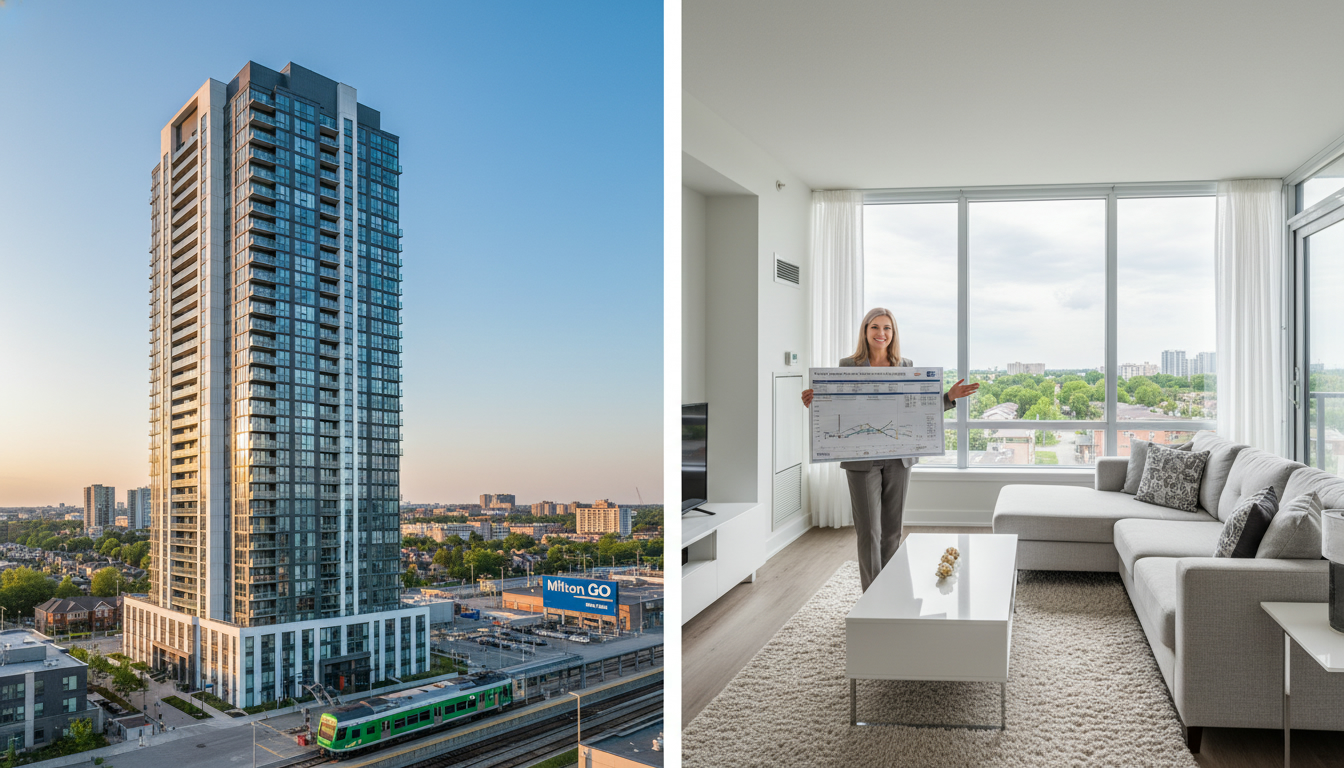
How do I price my condo competitively?
Clickbait: Want to sell your Milton condo fast and for top dollar? Price it like a pro — not like a hopeful homeowner.
Why pricing your condo correctly beats everything else
Pricing is the lever that controls speed, buyer interest, and final sale price. Overprice and buyers ignore you. Underprice and you give money away. Get it right and you create urgency, multiple offers, and a sale that outperforms expectations.
This guide gives Milton, Ontario condo sellers direct, tactical steps to price competitively. No fluff. Actionable methods. Local market focus. Use these now and stop guessing.
Milton market snapshot — what sellers need to know
Milton is a growth market. Commuters to Toronto, families moving for schools, and buyers priced out of the core all drive demand for condos. Several features matter more here than in other towns:
- Proximity to Milton GO and major highways increases buyer interest and price.
- New developments change inventory quickly — check recent closings in your specific building and nearby towers.
- Condo fees and included amenities (parking, locker, utilities) strongly affect buyer decisions.
Local buyers are value-driven. They compare units within tight price bands and notice differences in fees, floor level, views, and finishes. Your job: make your condo the obvious choice at the right price.

Step 1 — Build an accurate, aggressive CMA (Comparative Market Analysis)
A correct CMA isn’t about grabbing random sold prices. It’s a surgical process:
- Use 3–6 sold comps in the last 3–6 months, ideally the same building. If none, use closest buildings with similar age, layout, and amenities.
- Adjust for floor (higher floors with views = premium), balcony, parking, locker, recent renovations, and size differences.
- Include active and expired listings. Actives show current competition. Expired listings show where the market rejected price.
- Compare list-to-sale ratios in Milton micro-neighbourhoods. Aim for a realistic target (e.g., 95–100% of list in balanced markets).
If a professional agent presents comps that are unverified or cherry-picked, question them.
Step 2 — Understand buyer purchasing power and the condo fee drag
Buyers calculate affordability based on monthly carrying costs. When condo fees are high, a buyer’s approved mortgage drops. Convert condo fees into an effective price adjustment.
Quick math you can use when pricing:
- Monthly carrying = condo fees + estimated utilities + (annual property taxes / 12).
- Example: If monthly carrying is $750, and a buyer’s mortgage stretch is tight, a $10,000 higher price may be the difference between qualifying or not.
Practical rule: For every $25–$40 increase in condo fee, reduce the marketable price by about $5,000–$8,000 (depending on interest rates and buyer incomes). Use conservative adjustments when fees are above average for Milton.
Step 3 — Hit the psychological price points — smart thresholds win attention
Buyers search and filter by round numbers. Pricing at $499,900 versus $500,000 can attract significantly more views.
- Use buyer search behavior to your advantage: price just below major thresholds ($399,900, $499,900, $599,900).
- When the market is hot, price aggressively to create a bidding environment. When it’s slow, price to the sweet spot buyers see in search filters.
Do not randomly add $10–$20k to test the market without a backup plan. Every extra day on MLS reduces perceived value.
Step 4 — Prepare the condo to command the price
Pricing and condition work together. Small, strategic fixes move buyers to higher offers:
- Paint in neutral tones, replace outdated lighting, clean or change flooring if damaged. These cost-effective changes show value.
- Stage to emphasize space. Remove 50% of furniture to create visual flow. Buyers must picture themselves living there.
- Get professional photos, a floor plan, and a 3D walk-through. A well-photographed listing gets more showings and better offers.
When asking for a premium, document upgrades: receipts, warranties, and before/after photos.
Step 5 — Choose the right listing price strategy
You have three options. Pick the one that fits your local data and your goals:
- Market Price: List at the top of the competitive range. This attracts buyers quickly and nets full market value if there’s solid demand.
- Slight Underprice: List slightly below market to create multiple-offer pressure. Use when inventory is low and demand is high.
- Overprice with a Plan: Only works if you have unique features and can afford longer days on market. This is risky in Milton where buyers compare aggressively.
Most Milton condos perform best with Market Price or Slight Underprice strategies. The goal is 7–14 days to peak interest and 2–3 weeks to an offer.
Step 6 — Promote the value, not just the features
Milton buyers care about commute time, schools, and future resale. Your listing must say how your condo improves their life:
- Lead with commute specifics: “5-minute drive to Milton GO, 45–55 minute commute to downtown Toronto.”
- Highlight value: low condo fee per sq ft, newer windows, efficient layout, parking included.
- Use local keywords: Milton condo for sale, Milton real estate, Milton condo near GO station, Milton downtown condo.
Digital ad targeting matters. Geo-target Milton, Oakville commuters, and Toronto buyers searching for cheaper options. Use the listing to funnel traffic to an agent who handles offers expertly.
Step 7 — Manage offers and create competition
A correctly priced listing attracts multiple offers. If you receive more than one:
- Set a clear offer deadline to force comparability.
- Ask for unconditional offers if your market allows it, or at least short, reasonable condition periods.
- Consider escalation clauses if you expect a bidding war — but cap them and require transparency.
Never accept the first offer without comparing net proceeds after adjustments, legal costs, and potential closing timing differences.
Step 8 — When and how to adjust price
If you get low showings or no offers in 10–14 days, you need to act:
- Re-evaluate comps and feedback. If multiple showings but no offers, condition or price is usually the issue.
- Drop price in a single, meaningful step (2–4% for most condos) rather than several tiny reductions. Big moves reset buyer perception.
Be proactive. Slow, tiny drops signal weakness.

Why working with a Milton condo specialist multiplies results
A generalist lists homes. A Milton condo specialist knows the micro-market: which floors and layouts command premiums, which buyers are actively searching, and when to trigger offers.
If you want the highest predictable result, you want someone who sells Milton condos consistently. They bring better comps, sharper pricing, faster feedback loops, and tighter negotiation.
Contact Tony Sousa — Milton condo specialist: tony@sousasells.ca | 416-477-2620 | https://www.sousasells.ca
FAQ — Pricing condos competitively in Milton
Q: How do I start pricing my condo if there are no recent sales in my building?
A: Use similar nearby buildings with comparable age and amenities. Adjust for floor, parking, and finish. Add active and expired listings to gauge current demand.
Q: How much should I worry about condo fees when pricing?
A: Worry a lot. High condo fees reduce buyer mortgage capacity. Convert fees into an equivalent price adjustment and highlight what’s included in the fees.
Q: Can I list above market to “test” buyer interest?
A: Not recommended. In Milton buyers compare aggressively. Time on market damages perceived value. If you test, be prepared to drop price quickly.
Q: When should I accept the first offer?
A: Only if it meets your net target and has acceptable conditions. Compare it to what you would accept after negotiations and concessions. If uncertain, get professional advice.
Q: How long should my property stay on market before I drop the price?
A: If you have low showings or no offers in 10–14 days, re-evaluate. If feedback indicates price, make a meaningful reduction and re-launch marketing.
Q: What pricing mistakes do Milton sellers make most often?
A: Overpricing to “leave room” for negotiation, ignoring condo fees, and failing to account for commuter buyers. Also, poor photos and staging lead to fewer showings even at the right price.
Q: Should I disclose recent renovations when pricing?
A: Yes. Document everything. Buyers pay more for verified, high-quality upgrades. Provide receipts and photos in your property package.
Q: How do taxes and future assessments affect pricing?
A: Factor in current taxes and any known upcoming special assessments or reserve fund projects. Buyers factor those costs in; transparency builds trust and prevents renegotiation.
Selling a Milton condo is a numbers and messaging game. Price based on accurate comps, adjust for fees and value drivers, present the unit perfectly, and manage offers like a hawk. Do that and you stop losing money and start capturing the market price.
Ready to price your condo right and get buyers fighting over it? Contact Milton condo expert Tony Sousa at tony@sousasells.ca or call 416-477-2620. Visit https://www.sousasells.ca for a free market evaluation.