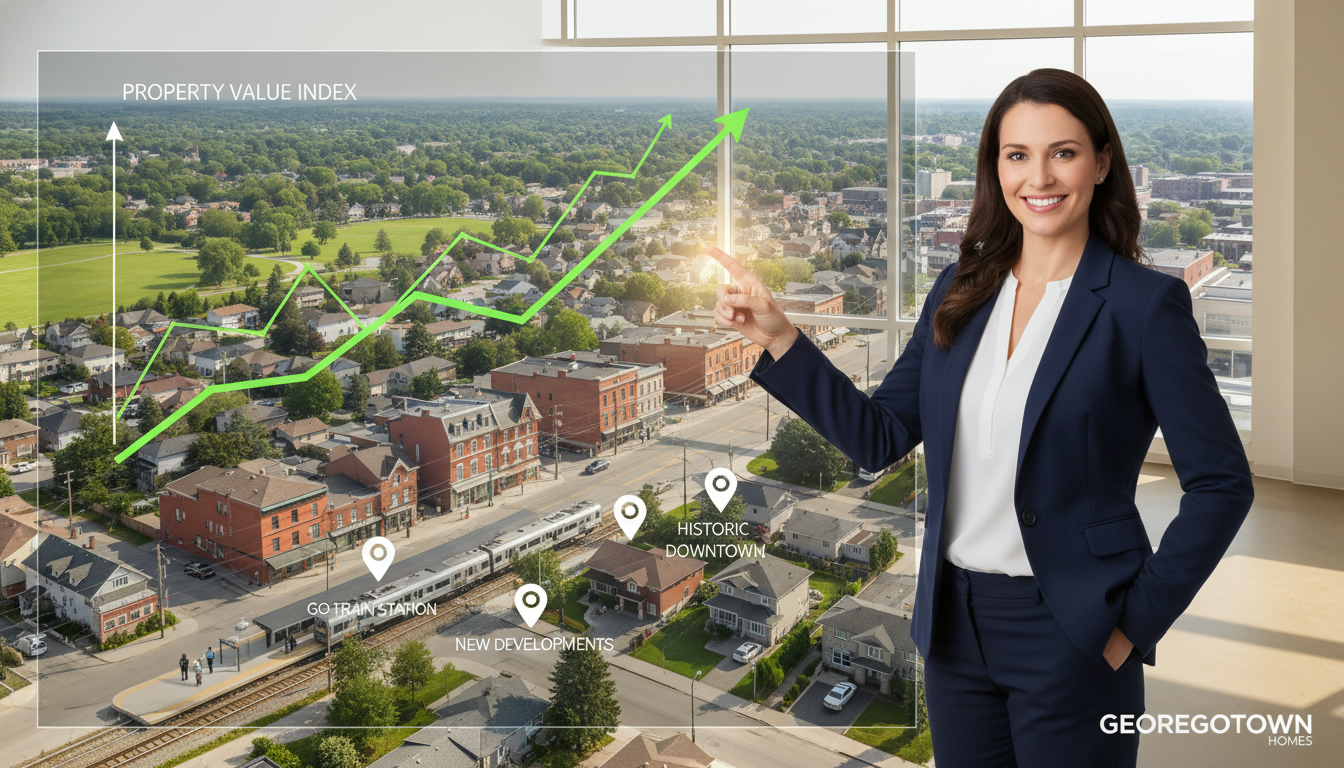
How do I evaluate long-term appreciation potential?
How do I evaluate long-term appreciation potential — and sell for more in Georgetown, ON?
If you’re a home seller in Georgetown, Ontario, you don’t need guesswork. You need a repeatable process that separates houses that will appreciate from those that will stall. This post gives that process, local market insight, and a tactical checklist you can use today.
Why long-term appreciation matters for sellers
Appreciation isn’t just a number on paper. It determines when you should list, how much to invest in upgrades, and which offers to accept. Sellers who act on appreciation signals consistently capture higher net proceeds and avoid price regret.
This is not theory. It’s practical evaluation—location, infrastructure, supply dynamics, and demand drivers. Below I break down the factors that move Georgetown property values and show how to quantify them.
The seven factors that control long-term appreciation in Georgetown
- Location and micro-neighborhood quality
- Proximity to Georgetown GO station and major commuter routes increases demand from Toronto commuters. Properties within walking distance to transit capture a premium and usually appreciate faster.
- Top-rated public schools, parks, and walkable downtown shopping create stable buyer pools. Seek properties near trusted schools and established neighbourhood cores.
- Micro factors matter: lot depth, orientation, corner lots, and street noise. Two homes on the same block can perform very differently.
- Supply constraints and zoning
- Georgetown sits inside Halton Region, where land availability is limited compared to farther suburbs. Limited greenfield supply plus controlled infill policies support long-term price growth.
- Monitor zoning changes, official plan updates, and approved subdivisions. New high-density approvals nearby can increase demand for family homes or, conversely, put downward pressure depending on type.
- Transportation and infrastructure projects
- GO Transit improvements, service frequency increases, and any planned road upgrades materially boost demand. A faster, more frequent commute pulls buyers from the GTA.
- Track regional infrastructure announcements from Metrolinx and Halton Region. Even rumors of improved service can change buyer behavior quickly.
- Employment and economic catchment
- Georgetown’s value is tied to the Greater Toronto Area employment market. If Toronto jobs grow or remote work stabilizes, more buyers consider Georgetown for value plus lifestyle.
- Local employment growth, new business parks, and retail expansions in Halton Hills support steady demand from local workers.
- Demographics and demand mix
- Families, professionals, and downsizers behave differently. Homes appealing to multiple buyer types (good schools, commuter access, low-maintenance yards) see stronger long-term demand.
- Watch population projections from Halton Region and local school enrollment trends.
- Housing condition and renovation potential
- Structural soundness and convertibility matter. A well-located home with upside—basement suites, legal duplex potential, or lot severance options—produces outsized returns.
- Cosmetic upgrades alone add less to long-term appreciation than improving functional square footage or creating additional legal rental income.
- Market cycles and timing
- Real estate is cyclical. Knowing where Georgetown sits in the cycle helps you decide whether to sell now or wait. Use months of inventory, list-to-sale price ratios, and days on market as your cycle indicators.

A practical, repeatable evaluation process (7 steps)
This is the checklist top selling agents use. Run these steps on any property to estimate appreciation potential.
- Gather the baseline numbers
- 5–10 year historical price trend for the neighbourhood (average annual appreciation).
- Current months of inventory and list-to-sale price ratio.
- Check transportation proximity
- Is the property within a 10–20 minute walk to Georgetown GO station? Closer is better.
- Any planned transit upgrades within a 5–10 year planning horizon?
- Review municipal planning and zoning
- Is the lot in a heritage conservation district or a redevelopment area?
- Any approvals for high-density projects within 1–2 kilometres that could change desirability?
- Inspect the physical upside
- Can you add a legal unit, finish the basement, or expand the footprint within zoning rules?
- Is the roof, furnace, and windows near replacement? Structural issues destroy leverage.
- Analyze comparable sales and absorption
- Pull 6–12 months of sold comps within the micro-neighbourhood.
- Compare those to days-on-market and how often properties sell over asking.
- Calculate rent and cap rate (if relevant)
- If the home can be rented, what net rental yield does it offer? Acceptable yields vary, but a reasonable metric gives you downside protection if market slows.
- Score and decide
- Create a simple 1–5 score for each factor above and total it. Set a threshold for “sell now,” “hold and improve,” or “invest and wait.”
How to quantify appreciation: a simple model
You don’t need complex finance. Use a 3-line model:
- Current average appreciation (neighbourhood): A% per year
- Adjustments: +B% for transit proximity, +C% for supply constraints, -D% for nearby large developments (if negative)
- Expected annual appreciation = A + B + C – D
Example: If Georgetown neighbourhood avg = 3% (A), transit premium = +1% (B), supply constraint = +0.5% (C), new nearby high-density = -0.5% (D) → expected = 4%.
Then use compounding to estimate 5- and 10-year values. This simple model reveals whether expected value outpaces alternative investments and selling costs.
What sellers in Georgetown often get wrong
- Betting everything on cosmetic fixes. Buyers pay for space and location first. Invest where you add functional square footage or create clear buyer appeal (convertible basement, finished attic, better layout).
- Ignoring local planning announcements. A new subdivision or major commercial node can change a street’s desirability in months.
- Treating the whole town the same. Downtown Georgetown, the historic core, and newer subdivisions perform differently. Understand micro-markets.
Tactical seller moves to capture appreciation
- Stage and market to the buyer pool who will drive future demand: commuters and families. Highlight transit proximity, schools, and walkability in the listing.
- Fix function before form. Replace critical systems first, then finalize cosmetic staging.
- Price strategically. In a low-inventory market, slightly underpricing to create multiple offers can push your final sale well above intrinsic value.
- Consider pre-list improvements with a clear ROI (legal basement suite, small kitchen reconfiguration). Ask your realtor for expected return thresholds.

Local signs to watch in Georgetown (live dashboard)
- GO service announcements and ridership increases
- Halton Region population forecasts and subdivision approvals
- Local school enrollment shifts
- New commercial permits or retail anchors announced in downtown Georgetown
- Months of inventory and list-to-sale price ratios in your exact neighbourhood
Conclusion: Sell with data, not hope
If you want the highest net proceeds, evaluate long-term appreciation before you spend on upgrades or pick a listing date. Use the checklist here. Score your property. If the score is high, invest where it matters. If not, sell smart and price to attract the buyer who will pay for the location and features that matter.
Contact a local expert who runs this analysis for every listing, knows Halton Region planning, and leverages neighbourhood micro-data so you don’t leave money on the table.
For a free property appreciation assessment for your Georgetown home, email tony@sousasells.ca or call 416-477-2620. Visit https://www.sousasells.ca for more.
Frequently Asked Questions (FAQ)
How fast do homes in Georgetown typically appreciate?
Long-term appreciation varies by neighbourhood and property type. Use 5–10 year historical trends for your micro-area. Town-wide averages smooth out important local differences. Run the checklist in this post and adjust the baseline by transit proximity and supply constraints.
Should I renovate to increase appreciation potential?
Only if the renovation increases usable square footage, creates a legal rental unit, or fixes structural/major mechanical issues. Cosmetic updates improve sale speed and presentation but rarely change long-term appreciation.
Will upcoming transit or infrastructure projects raise my property value?
Often yes. Increased transit frequency or improved commuter times reliably increase demand, especially from buyers who commute to Toronto. Monitor official announcements from Metrolinx and Halton Region.
How do zoning and development approvals affect resale value?
Positive approvals (new parks, schools, or family-oriented infrastructure) tend to raise values. High-density developments nearby can both increase local services and change the buyer mix—sometimes reducing premiums for single-family lots.
What metrics should I track weekly as a seller?
List-to-sale price ratio, days on market, and months of inventory for your micro-neighbourhood. Also track local sold comps, new listings, and any municipal announcements.
Can rental income protect downside if the market softens?
Yes. If your home can produce a competitive rental yield, you gain flexibility: rent it until the market recovers. Calculate net yield after expenses and compare to local cap rates.
Who should I call to get an accurate appreciation assessment?
A local realtor who specializes in Georgetown and Halton Region planning. They should provide neighborhood-specific comps, check municipal plans, and run the seven-step evaluation above.
Are there parts of Georgetown to avoid as a seller?
Avoid properties with permanent negatives you can’t change: major industrial neighbours, severe floodplain designation, or properties with structural/legal complications. These depress long-term demand and appreciation.
How quickly should I act if an infrastructure announcement happens?
Act fast to re-evaluate your strategy. In many cases buyer sentiment shifts immediately. Update pricing, marketing, and staging to capture the new buyer pool.
How can I get a free personalized report for my home?
Email tony@sousasells.ca or call 416-477-2620. Ask for a Neighborhood Appreciation Analysis for Georgetown, ON.
Contact information
Tony Sousa — Local Realtor, Georgetown, ON
Email: tony@sousasells.ca
Phone: 416-477-2620
Website: https://www.sousasells.ca