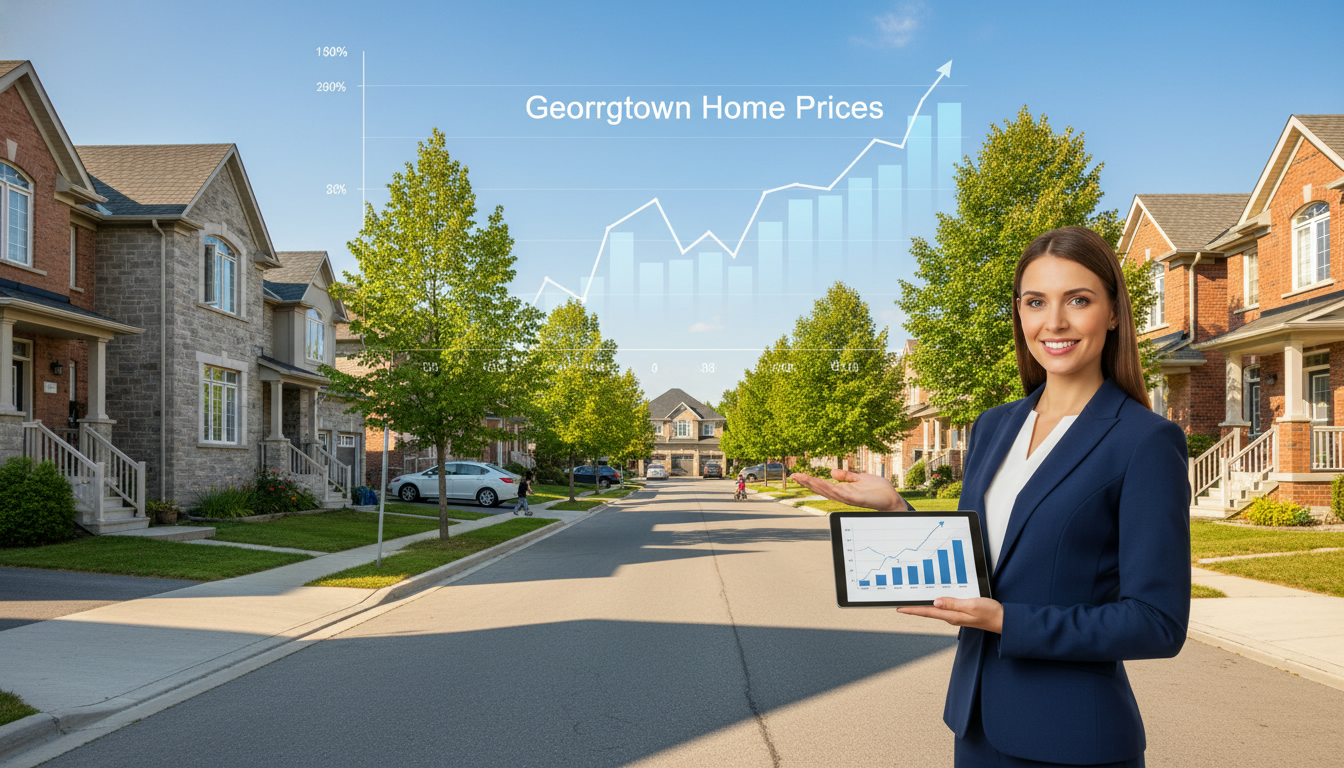
Are home prices rising or falling in my city?
Are Georgetown home prices soaring — or sliding? The blunt answer below tells sellers exactly what to do today.
Quick Answer: What’s Happening with Home Prices in Georgetown, ON
Short version: prices are not exploding the way they did in 2020–2022, but they aren’t collapsing either. The Georgetown housing market has moved from a hyper-competitive sellers’ market toward a balanced market with pockets of strength. That means sellers who price correctly, market aggressively, and move fast can still get strong offers. Sellers who treat the market like it’s 2021 will lose time and money.
Keywords: Georgetown ON home prices, Georgetown housing market, home sellers Georgetown, Georgetown real estate trends
The Reality — Plain and Simple
I’ll give you a clear framework to read the market. Use these four metrics to judge whether prices are rising or falling in your neighbourhood:
- Inventory (active listings)
- Sales velocity (sales per month and days on market)
- Sale-to-list ratio (what homes sell for vs. list price)
- Price direction (median/average price over rolling 3- or 6-month periods)
Right now (based on regional data trends through 2024 and local MLS feeds):
- Inventory has increased compared with the pandemic peak years. More homes on market means buyers have options.
- Days on market have lengthened compared with 2021–2022, but not dramatically for well-priced homes in sought-after pockets.
- Sale-to-list ratios have pulled back toward 98%–100% in balanced pockets, with tougher neighbourhoods dropping below 95%.
- Median prices have flattened or dipped slightly year-over-year in some product types — while townhomes and certain detached segments nearer transit corridors retained value better.
Translation for sellers: you still have power if you act like a professional marketer. You lose power if you overprice and wait.

Why the Shift Happened (Short, Actionable Explanation)
- Interest rates rose and stabilized at higher levels. That reduced maximum buyer budgets.
- More sellers listed homes as the market normalized. Inventory increased.
- Buyers became choosier. They demand value: condition, price, and convenience now determine outcomes.
This is not a crash. It’s a market correction and normalization. That creates opportunity for sellers who execute.
How to Tell If Prices Are Rising or Falling in Your Street — A 5-Minute Audit
Follow these steps yourself right now. No guesswork.
- Pull 3-month median sold price for your neighbourhood vs same period last year. If median has risen — prices are rising. If flat or down — prices are stable or falling.
- Check active inventory: more than a 20% rise vs last year signals buyer advantage.
- Look at days on market (DOM): DOM > 20 and climbing = cooling.
- Sale-to-list ratio under 97% = sellers are discounting.
- Compare new listings vs closed sales month-over-month. If new listings > closed sales, inventory pressure is increasing.
If 3 or more of these read “cooling,” prices are trending down or flat. If 3 or more read “tight,” prices are rising.
Data-Driven Steps Sellers Must Take Today
If you want top dollar in Georgetown, follow this playbook.
- Price with precision
- Use a 3-month rolling median, not 12-month averages. Price to that reality.
- Start slightly under fair market value if you want multiple offers fast.
- Fix high-ROI items only
- Paint, declutter, basic landscaping, and minor kitchen or bath fixes move deals faster than major renovations.
- Market like a CEO
- Professional photos, a 3D walkthrough, targeted social ads to Halton/Georgetown buyers, and email blasts to local agents.
- Create urgency without gimmicks
- Set a realistic conditional deadline for offers (if it fits your plan) and communicate documented buyer interest points.
- Negotiate with data
- Show comps, days on market, and buyer loan conditions. Push for stronger offers on price, deposit, and closing dates.
These actions beat waiting for the market to “bounce back.”
Neighborhoods and Product Types: What’s Holding Value in Georgetown
- Detached family homes in prime school zones and near GO Transit have been more resilient.
- Newer townhomes and executive condos in transit corridors maintained closer to peak prices.
- Older bungalows needing full renovations face sharper discounts.
Action for sellers: highlight proximity to transit, schools, and recent upgrades in your marketing. Those features matter now more than ever.
Pricing Strategies That Work Right Now
- Strategy A — Quick sale, strong offers: Price 1–3% under realistic market value. This creates traffic and competition.
- Strategy B — Max retail, longer hold: Price at market, invest in staging/inspection, be ready for longer time on market.
- Strategy C — Conditional timing: List during high-buyer activity windows (spring/early fall) with a pre-marketing campaign.
Pick one strategy and commit. Mixed signals confuse buyers and agents.
The Negotiation Edge: What Buyers Want — And How Sellers Counter
Buyers want clarity. They prefer clean conditions and predictable timelines. Counter with:
- Strong deposit and limited conditions
- Clear closing windows that suit market demand
- Pre-inspection reports that reduce surprise negotiations
When you bring certainty, buyers pay up.
When to Wait, When to Sell
Sell if:
- You need to move for work or family.
- You’ve already built equity and your next move is affordable.
- Your home is in a strong micro-market (near transit, schools, upgrades).
Wait or prepare if:
- Your home needs major repairs and you don’t want to reduce price.
- You want absolute peak value and can hold for 12–24 months — but only if you can stomach carrying costs.
Local Market Signals to Watch Weekly
- New listings in Georgetown neighborhood
- Average days on market for comparable homes
- Recent sale prices vs list prices
- Mortgage rate movements and local lender appetite
If you don’t want to track this, hire an expert to do it and translate it into a sell plan.

Case Studies (Short, Realistic Examples)
- Case 1: A seller priced a 4-bed detached near the GO 2% under market. Result: 7 showings in 72 hours, 3 offers, sold 6% above list.
- Case 2: A seller priced 10% over market, sat for 45 days, then dropped price to market and sold 5% under original expected value.
Lesson: pricing and execution beat hope.
Action Plan — 7-Day Checklist for Georgetown Sellers
Day 1: Request a free Comparative Market Analysis (CMA) tailored to your street. (Contact below.)
Day 2: Order pro photos and a 3D virtual tour.
Day 3–4: Complete minor repairs, paint, declutter.
Day 5: Launch targeted marketing to Halton, GTA buyers and local agents.
Day 6: Host broker and public opens with clear buyer tracking.
Day 7: Review offers and negotiate with data.
Follow this and you’ll convert market noise into certainty.
Why Local Expertise Matters (Short Proposition)
Markets behave differently block-by-block. Georgetown’s proximity to Toronto, Halton Hills growth, and GO access create micro-markets. You need someone who reads local data and executes marketing, not a generic agent who lists and waits.
Final Recommendation for Sellers in Georgetown, ON
Are prices rising or falling? They’re stabilizing after the boom. Some pockets rise, some cool. The difference between success and regret is how you price, present, and market. Move like a professional.
If you want an immediate, data-driven answer for your exact address, get a free, no-obligation Comparative Market Analysis and sell plan tailored to your street.
Contact: Tony Sousa — tony@sousasells.ca | 416-477-2620 | https://www.sousasells.ca

FAQ — Answers Georgetown Home Sellers Ask Most
Q: Are Georgetown home prices going to crash?
A: No. A crash implies a steep, sudden drop. Current trends show normalization from peak levels, not collapse. Local demand, limited land in some pockets, and proximity to transit prevent a crash.
Q: How much can I expect to get above or below list price?
A: That depends on pricing and condition. Well-priced, staged homes in strong pockets can beat list price. Overpriced listings typically sell below list after price drops. Aim for a data-backed list price.
Q: How long will my home take to sell in Georgetown today?
A: Expect longer DOM than 2021–2022. For well-priced homes in desirable neighbourhoods, 7–21 days is realistic. Less desirable or overpriced homes can take 30+ days.
Q: What’s the best time of year to sell in Georgetown?
A: Spring and early fall attract the most buyers. But a strong marketing push can produce excellent results year-round.
Q: Should I renovate before selling?
A: Do high-ROI, low-cost fixes: fresh paint, curb appeal, fixtures, minor kitchen/bath touch-ups. Avoid major renovations unless you plan to stay and capture long-term value.
Q: How do interest rates affect my sale price?
A: Higher rates reduce buyer purchasing power. That can suppress top-dollar offers, especially for more expensive properties. Strong pricing and buyer certainty mitigate the impact.
Q: Can I get a guaranteed sale price?
A: Some programs offer guarantees, but they come with trade-offs and fees. The safer bet is a strong marketing plan and professional negotiation to maximize net proceeds.
Q: How do I know if my neighbourhood is one of the resilient pockets?
A: Look for recent sales within a 1–2 km radius, near transit or top schools, and homes with minimal renovations needed. A local CMA will show this clearly.
Q: What’s the first step to sell my home quickly and for the most money?
A: Book a local, no-cost CMA and a sell strategy session. That delivers pricing clarity and a step-by-step execution plan.
If you want a fast, accurate price and a step-by-step sell plan customized to your address, contact Tony Sousa: tony@sousasells.ca | 416-477-2620 | https://www.sousasells.ca