
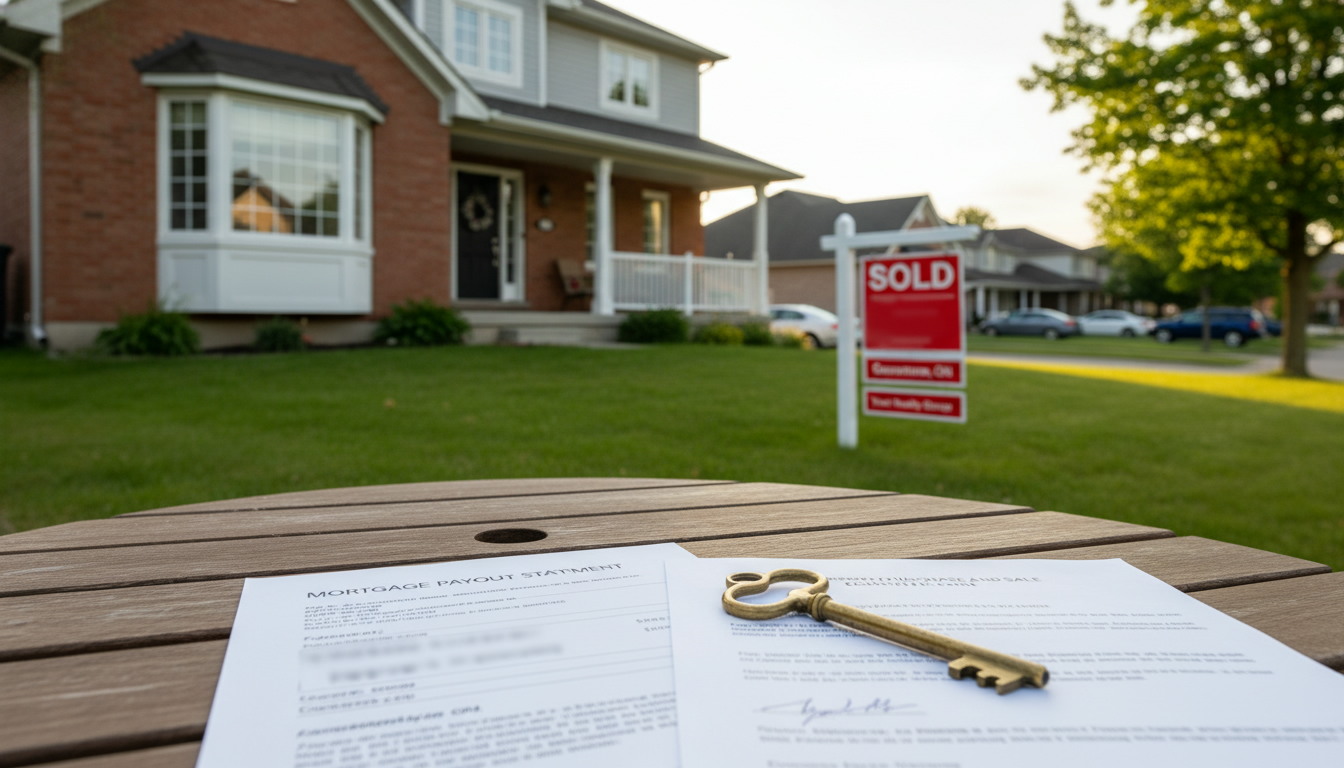
What happens to my mortgage if I sell my house?
Sell your house in Georgetown? What happens to your mortgage — short, clear answer.
Quick answer
When you sell your house in Georgetown, your mortgage must be dealt with at closing. Usually the mortgage is paid off with the sale money. If you break the mortgage early you might pay a fee. Some mortgages can be moved to your next home. Talk to your lender and your lawyer early.
Why this matters for home sellers in Georgetown, ON
You want the most cash at closing. You want no surprises. Georgetown is part of Halton Hills. Buyers here move fast. Prices and timelines can change. If you don’t plan your mortgage payoff, you can lose money or miss a closing day. Simple steps now save money and stress later.

Step-by-step: what happens to your mortgage when you sell
- Get your payout statement
- Call your lender and ask for a payout statement (also called mortgage statement).
- It shows the exact amount you must pay on a specific date. It includes balance, interest, and any fees.
- Share the payout with your lawyer and your realtor
- Your lawyer will use the payout at closing to pay the lender.
- Your realtor will calculate your net proceeds (sale price minus mortgage payoff, closing costs, realtor fees, and legal fees).
- Closing day: lender gets paid
- Buyer pays their funds to their lawyer. Your lawyer pays your lender the mortgage balance from the sale proceeds.
- After discharge, the bank removes the mortgage from the title and you get the rest of the money.
- If your mortgage is broken early
- If your term is not up, the lender may charge a penalty. That can be big.
- There may also be a discharge fee to remove the mortgage from title.
Your options as a seller in Georgetown
Option A — Pay off the mortgage at closing
- Most sellers do this. The lender gets paid and the mortgage is closed.
- You get the sale net proceeds.
Option B — Port your mortgage to a new home
- If your mortgage is portable and you buy another house, you may transfer the mortgage to the new home.
- Porting avoids prepayment penalties and may keep your interest rate.
- You must qualify for the mortgage on the new property. Lender approval is needed.
Option C — Let the buyer assume your mortgage
- Some mortgages are assumable. Buyer takes over your mortgage and its terms.
- Lender approval is required. Not all buyers qualify.
Option D — Pay the prepayment penalty and close the mortgage
- If porting is not possible, you may pay the penalty and close the loan.
- Compare the penalty to the cost of keeping a higher rate on a new mortgage.
Common fees to expect
- Mortgage payout amount (the largest item).
- Prepayment penalty (if term broken).
- Mortgage discharge fee (charged by the lender).
- Legal fees for closing and title changes.
- Realtor commission and closing adjustments (taxes, utilities).
How to know if porting saves money
- Ask the lender for the exact penalty and the payout amount.
- Get quotes for new mortgage rates today.
- Compare costs: penalty + new mortgage fees vs. porting or switching.
- If your rate is low and you can port, it often saves money.

Local tip for Georgetown sellers
- Georgetown sells fast. If you time the sale right, you may sell at top price and have enough to pay penalty and still profit.
- If you plan to buy in Halton or nearby Toronto suburbs, ask lenders about porting and bridging loans.
- Talk to a local realtor who knows closing timelines in Georgetown. They will plan the payout date to match closing day.
How to prepare now (do this today)
- Call your lender and get a current payout statement.
- Ask if your mortgage is portable or assumable.
- Ask what the prepayment penalty and discharge fee would be for the day you plan to sell.
- Talk to your lawyer about timing and payment on closing day.
- Ask a local realtor to show likely net proceeds at different price points.
Do this now. It takes one call. It saves money.
Simple math example (easy to follow)
- Sale price: $800,000
- Mortgage balance: $500,000
- Realtor fee (5%): $40,000
- Prepayment penalty: $6,000
- Legal and closing costs: $2,500
Net to seller = 800,000 – 500,000 – 40,000 – 6,000 – 2,500 = $251,500
This shows why you need the exact payout and penalty. Numbers change the plan.
What if the sale price is less than your mortgage? (Shortfall)
- If you owe more than the sale price, you must still pay the lender the shortfall.
- Talk to your lender early. They may accept a negotiated payoff in rare cases. Lenders will want security or other arrangements.

Closing day checklist for mortgage payoff
- Confirm payout amount with lender for closing date.
- Confirm funds flow with your lawyer.
- Confirm keys and final walk-through with buyer and realtor.
- Confirm discharge is filed so title is clear.
How a local realtor helps you keep more cash
- The right price and timing reduce the chance you need a quick sale at a loss.
- Local agents know typical closing dates and lender timing in Georgetown.
- They can coordinate your payout date with your lawyer and lender.
Why you need a plan, not a guess
Guessing costs money. Plan gets you the best net proceeds. Call the lender. Talk to the lawyer. Book a local realtor. Do it in this order: lender, lawyer, realtor. That keeps the money in your pocket.
Want help with your mortgage payoff and sale in Georgetown?
I work with sellers in Georgetown every week. I will get your payout number and show you the net proceeds. I will plan timing so the payoff happens smoothly at closing.
Contact: Tony Sousa
Email: tony@sousasells.ca
Phone: 416-477-2620
Website: https://www.sousasells.ca

FAQ — Mortgage and selling in Georgetown
Q: Do I always have to pay my mortgage when I sell?
A: Yes. The lender must be paid or the mortgage transferred. The payoff normally happens at closing.
Q: What is a payout statement?
A: A document from your lender that shows the exact amount owed on a given date.
Q: Can I avoid a prepayment penalty?
A: Only if your mortgage is portable or assumable and the lender agrees. Sometimes lenders waive or reduce penalties, but do not count on it.
Q: How big can the prepayment penalty be?
A: It depends on your mortgage type and lender. For fixed rates it is often the interest rate differential (IRD); for variable rates it may be three months’ interest.
Q: How long before listing should I get payout info?
A: Get it before you list. At least a few weeks earlier. That lets you price the house and plan closing day.
Q: Can a buyer take over my mortgage?
A: Only if the mortgage terms allow assumption and the lender approves the buyer.
Q: What if my sale closes later than the payout date on the statement?
A: The payout statement is date-specific. A lender can issue an updated statement for your closing date. Your lawyer will confirm final numbers at closing.
Q: Who pays the discharge fee?
A: Usually the seller pays discharge fees unless you agree otherwise in the sale contract.
Q: Do I pay taxes on the sale of my home?
A: If the home is your principal residence, you likely do not pay capital gains tax. Talk to an accountant for your personal case.
Q: Where can I get help in Georgetown?
A: A local realtor and a real estate lawyer. I can introduce you to both. Contact details above.
If you want clear numbers and a plan for your sale in Georgetown, call or email. I will get your payout, show your net, and line up the closing day so your mortgage is paid on time. No surprises. No guessing. Just results.