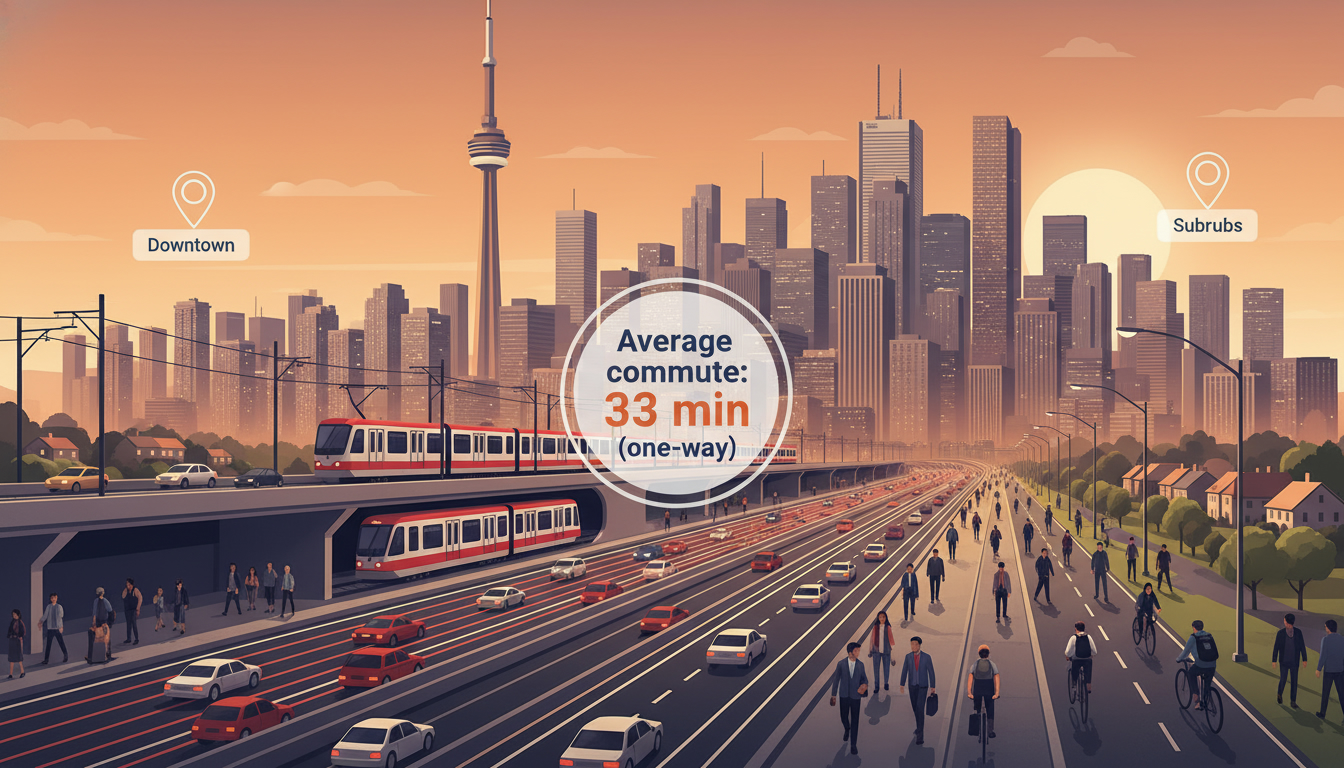
What is the average commute time in Toronto?
Shocking truth: Is your commute in Toronto really 33 minutes one-way?
Quick answer — the average commute time in Toronto
The average one-way commute time in the City of Toronto is about 33 minutes (one-way). For the broader Toronto Census Metropolitan Area (GTA), the average sits near 31 minutes. These figures come from Statistics Canada (2021 Census) and recent municipal travel surveys. If you ride transit, expect a longer trip — transit commutes average roughly 40–45 minutes one-way.
Why this number matters to homebuyers and sellers
Commute time shapes daily life, resale value, and neighbourhood demand. Buyers prioritize shorter, predictable commutes. Sellers in low-commute corridors win faster offers and higher prices. If you’re choosing a home in Toronto or the GTA, commute time is not a detail — it’s a financial factor.
Breakdown by mode (typical ranges)
- Driving: ~25–30 minutes one-way in many inner-city and near-suburban routes. Congestion increases time during peak hours.
- Public transit: ~40–45 minutes one-way on average for TTC-heavy commutes; GO Transit users to downtown often see 30–50 minutes depending on origin.
- Cycling/walking: 10–25 minutes for short commutes inside central neighbourhoods.
These are ranges based on municipal travel data and Statistics Canada commuting profiles. Your actual time depends on exact route, peak windows, and transfers.
Local insights that matter
- West-end neighbourhoods near subway/GO connections cut transit time significantly.
- East-end access to mixed bus/subway routes can add 10–15 minutes versus direct subway lines.
- Remote suburbs in the outer GTA typically add 10–20 minutes for drivers and 20–40 minutes for transit riders.
If you value time, prioritize properties inside transit nodes (subway/GO) or near highways with reliable peak flow.
How to use this data when buying or selling
- Buyers: Compare commute time estimates for your exact address during rush hour, not off-peak. Use route planners and talk to locals.
- Sellers: Highlight short commutes in listings with exact drive/transit times to downtown or major employment hubs. Buyers respond to clear numbers.
Why work with a local commute-savvy realtor
You need a realtor who knows actual commute trade-offs across the city. I provide street-level commute comparisons, transit-transfer counts, and peak-time estimates so buyers make fast, confident decisions. Sellers get targeted pricing based on commute premiums in the neighbourhood.
Contact: Tony Sousa — Local Toronto realtor with commute-first market strategy. [email protected] | 416-477-2620 | https://www.sousasells.ca
Need a precise commute comparison for a specific address? Reach out — I’ll run real drive and transit-time tests during peak hours and send a printable commute report.
Homes For Sale in Toronto
Browse current properties available right now. Click any listing to view photos, floor plans, or schedule a private tour.


