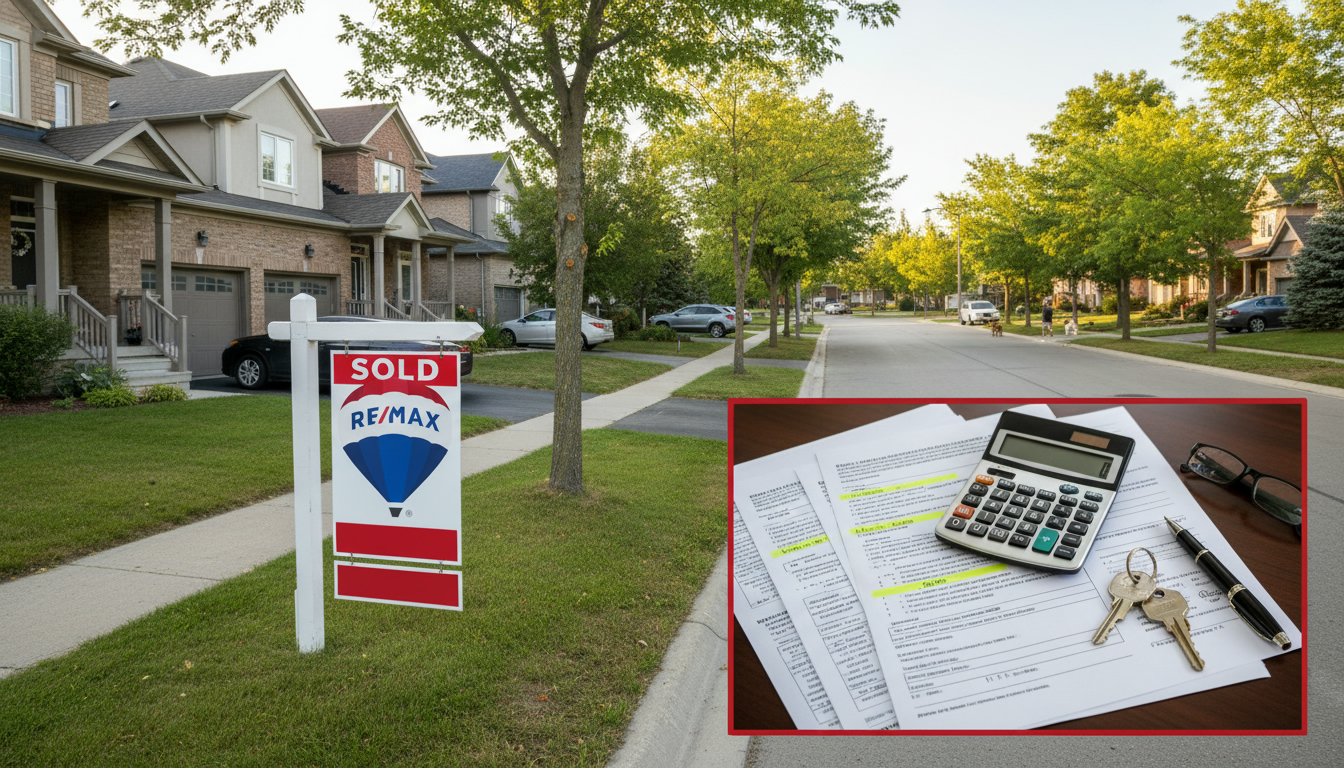
Do I have to pay capital gains tax when I sell my home?
“Will you owe capital gains tax when you sell your Milton home? Most sellers get this wrong — read this before you list.”
Quick answer in plain terms
If the house you sell in Milton was your principal residence for every year you owned it, you likely pay no capital gains tax because of the Principal Residence Exemption (PRE). If it was ever used as a rental, an investment, a cottage, or you owned multiple properties, you may owe tax on part or all of the gain. In Canada, 50% of the capital gain is taxable and must be reported. For Milton home sellers, the rules are the same as the rest of Canada — but local market forces and common homeowner choices make planning essential.
Why Milton sellers must pay attention
Milton’s real estate market has seen strong price growth. Many homeowners bought years ago and now face large nominal gains when selling. That’s good — but it triggers tax questions. Small mistakes on reporting or records can cost thousands. The Canada Revenue Agency (CRA) requires reporting the sale and designating your principal residence for each year. Failing to report can lead to penalties and loss of the exemption.

How capital gains on a home are calculated (simple math)
- Proceeds of disposition: selling price less selling costs (agent commission, legal fees tied to the sale).
- Adjusted Cost Base (ACB): what you paid for the home plus costs that increase value (major renovations, additions), plus certain purchase closing costs.
- Capital gain = Proceeds – ACB.
- Taxable capital gain = 50% of capital gain. That 50% is added to your income for the year.
Example: Sell for $900,000, selling costs $36,000, proceeds = $864,000. Bought for $300,000 and spent $80,000 on capital renovations; ACB = $380,000. Capital gain = $484,000. Taxable capital gain = $242,000. Your tax depends on your marginal tax rate.
Principal Residence Exemption (PRE) — the crucial rule
- If the property was your principal residence for every year you owned it, you can usually exempt the entire gain using the PRE.
- You must report the sale and fill out the designation on your tax return (Schedule 3 and Form T2091(IND)). Since 2016, CRA requires reporting to claim the exemption.
- If you owned multiple properties, you can designate only one property per year as your principal residence.
Practical Milton tip: If you lived in the house and then rented it out for a while, you may face a “change in use” deemed disposition at fair market value the year you changed use. There are elections under the Income Tax Act (for example s.45(2)) that can defer recognition — but they are technical. Talk to an accountant for mixed-use cases.
Common scenarios for Milton sellers and the tax outcome
1) Lived in house full-time, never rented: Likely no capital gains tax (claim PRE).
2) Bought as an investment property or never lived in it: Capital gains tax applies on sale.
3) Lived there, then moved out and rented: You may have to report part of the gain unless you made an election.
4) Short-term rentals/Airbnb: Income from rentals is taxable as business/investment income; capital gains treatment on sale depends on whether CRA treats it as inventory or capital property.
5) Renovated heavily before sale: Capital renovations increase your ACB if they are capital in nature (additions, new roof, major structural work). Cosmetic repairs are usually not added.
Local tax considerations beyond capital gains
- Land Transfer Tax: Paid when buying a property in Ontario, not when selling. Milton buyers pay Ontario land transfer tax; sellers don’t.
- HST: Resale homes are generally not subject to HST. New homes or substantially renovated homes may have HST implications.
- Property tax adjustments: Closing involves pro-rated property taxes — not a capital gains issue, but important for net proceeds.

Record-keeping checklist — do this now
- Keep the original purchase agreement and closing statement.
- Keep receipts for all capital improvements (invoices for additions, structural work, major systems upgrades).
- Keep REALTOR® commission statements and closing legal bills.
- Keep records of any periods when the property was rented.
- If you used the home partially for business, keep clear schedules showing percentage of use.
Good record-keeping shrinks surprises. If you can’t find receipts, CRA allows reasonable estimates, but documentation is far safer.
How to minimize or avoid capital gains tax legally
1) Claim the Principal Residence Exemption for years you lived in the property.
2) Boost your ACB with legitimate capital improvements (document them).
3) Use the timing: If you and your spouse own multiple properties, planners may be able to coordinate designations to reduce tax over the ownership period.
4) If you converted your principal residence to a rental, consider the s.45(2) election to defer deemed disposition — only with professional advice.
5) Consider tax-deferral strategies if you’re moving into another property (complex, needs an accountant).
Never try to avoid tax illegally. The CRA audits high-value transactions, especially in hot markets like Milton.
Practical selling tips that affect tax and net proceeds
- Price for market, not tax. Don’t leave money on the table to avoid a tax bracket.
- Work with a REALTOR® who understands Milton’s market. Commission reduces proceeds but can increase net after tax if it raises sale price.
- Time the sale if possible: If the sale will push you into a much higher tax bracket this year, consult an accountant about timing or income splitting strategies.
- Get multiple bids and stage appropriately. A higher sale price often offsets the tax owed.
Forms and reporting — what you must file in Canada
- Schedule 3 (Capital Gains) with your T1 tax return the year of sale.
- Form T2091(IND) to claim the Principal Residence Exemption.
- If you fail to report a principal residence disposition, you may face penalties, and CRA may deny the exemption.

When to call an accountant or tax lawyer
Call a tax professional if any of these apply:
- You rented the home for any time during ownership.
- You used the home partly for business (home office, daycare, etc.).
- You converted between rental and principal residence.
- You co-own with a non-resident or non-spouse.
- The gain is large and you need to plan tax timing.
Local recommendation: Use a Milton-based REALTOR® and a Canadian tax accountant who knows PRE rules and the change-of-use elections. A combined team reduces surprises.
Why local expertise matters in Milton
Milton transactions often include buyers moving within the Greater Toronto Area, downsizers selling high-appreciation homes, and investors flipping properties. A local expert knows:
- Which neighbourhoods command premium pricing.
- How staging and timing translate to higher offers.
- Common closing adjustments in Halton Region that affect net proceeds.
That local knowledge translates directly into dollars — more price, more net after tax.
Quick action plan for Milton sellers (do this this week)
1) Gather purchase documents and receipts for renovations.
2) Hire a REALTOR® experienced in Milton pricing and negotiations.
3) Talk to an accountant if you ever rented the property or used it commercially.
4) Prepare to report the sale on your tax return and claim PRE if eligible.
5) Don’t sign away documents without tax advice if you had change-of-use years.
Contact for personalized guidance
Selling in Milton is high-stakes. If you want a no-nonsense market evaluation and clear next steps tailored to your tax position, get local help.
Tony Sousa — Local Milton Realtor & seller advisor
Email: tony@sousasells.ca
Phone: 416-477-2620
Website: https://www.sousasells.ca
Reach out. Know your tax position before you list.

FAQ — Capital gains tax and financial considerations for Milton home sellers
Q: Do I always pay capital gains tax when I sell my home in Milton?
A: No. If the property was your principal residence for every year you owned it, you can usually claim the Principal Residence Exemption and pay no capital gains tax. If it wasn’t, you likely owe tax on 50% of the gain.
Q: What counts as my principal residence?
A: A property you inhabited during the year and ordinarily used as your main home. You can only designate one property per family unit per year.
Q: Do I need to report the sale if I claim the PRE?
A: Yes. Since 2016 you must report the sale and designate the property to claim the PRE. Failure to report may cause penalties.
Q: I rented my home for two years after living there. Do I pay tax on that period?
A: Possibly. A change of use can trigger a deemed disposition at fair market value. There are elections to defer recognition in certain cases. Consult an accountant.
Q: Are renovation costs deductible?
A: Routine repairs are not added to ACB. Capital improvements that increase the property’s value or extend its life (additions, new roof, major renovation) can increase ACB and reduce capital gain.
Q: What about inheritance or death?
A: Different rules apply. Property transferred on death can have deemed disposition rules. Speak to a tax lawyer or accountant.
Q: Does selling trigger HST or land transfer tax?
A: HST typically does not apply to resale homes. Land transfer tax applies to buyers in Ontario, not sellers. Sellers should still watch for HST on newly built or substantially renovated homes.
Q: How can I reduce my tax bill legally?
A: Claim PRE where eligible, document capital improvements to increase ACB, use change-of-use elections where appropriate, and time transactions with professional tax planning.
Q: What should I bring to a first meeting with an accountant or REALTOR®?
A: Purchase and sale agreements, closing statements, receipts for renovations, records of rental use, and timelines for occupancy.
If you want a straight answer about your situation, contact Tony at tony@sousasells.ca or call 416-477-2620. Local experience wins when numbers are large and rules are strict.