How can I check crime rates in a neighborhood?
Want to know if your Milton street is safe — right now? Read this fast and get real data you can use.
Quick reality: why checking crime rates matters for Milton home sellers
If you’re selling a home in Milton, ON, buyers will research the neighborhood before the offer. They don’t buy just a house. They buy the street, the schools, the commute, and the feeling of safety. If you can show accurate safety data, you control the conversation. If you ignore it, you lose trust and buyers.
This guide gives a hard, practical plan to check crime rates in Milton, Ontario — where to look, what numbers mean, how to use the info to sell faster and at a better price.
7-step checklist to check crime rates in a Milton neighbourhood
- Check the Halton Regional Police Service (HRPS) site
- Start here. HRPS publishes local crime stats, press releases, and annual reports. Look for neighbourhood-level breakdowns, incident maps, and recent press updates. This is your primary source for official, police-reported crime.
- Use Statistics Canada data
- Statistics Canada publishes police-reported crime data and the Crime Severity Index (CSI). CSI shows seriousness and trends by municipality. Use Milton and Halton Region numbers to compare with provincial and national averages.
- Search municipal open data and Halton Region dashboards
- Milton and Halton publish open data portals with public safety layers. Look for incident datasets, calls for service, and community safety initiatives.
- Check local crime maps and tools
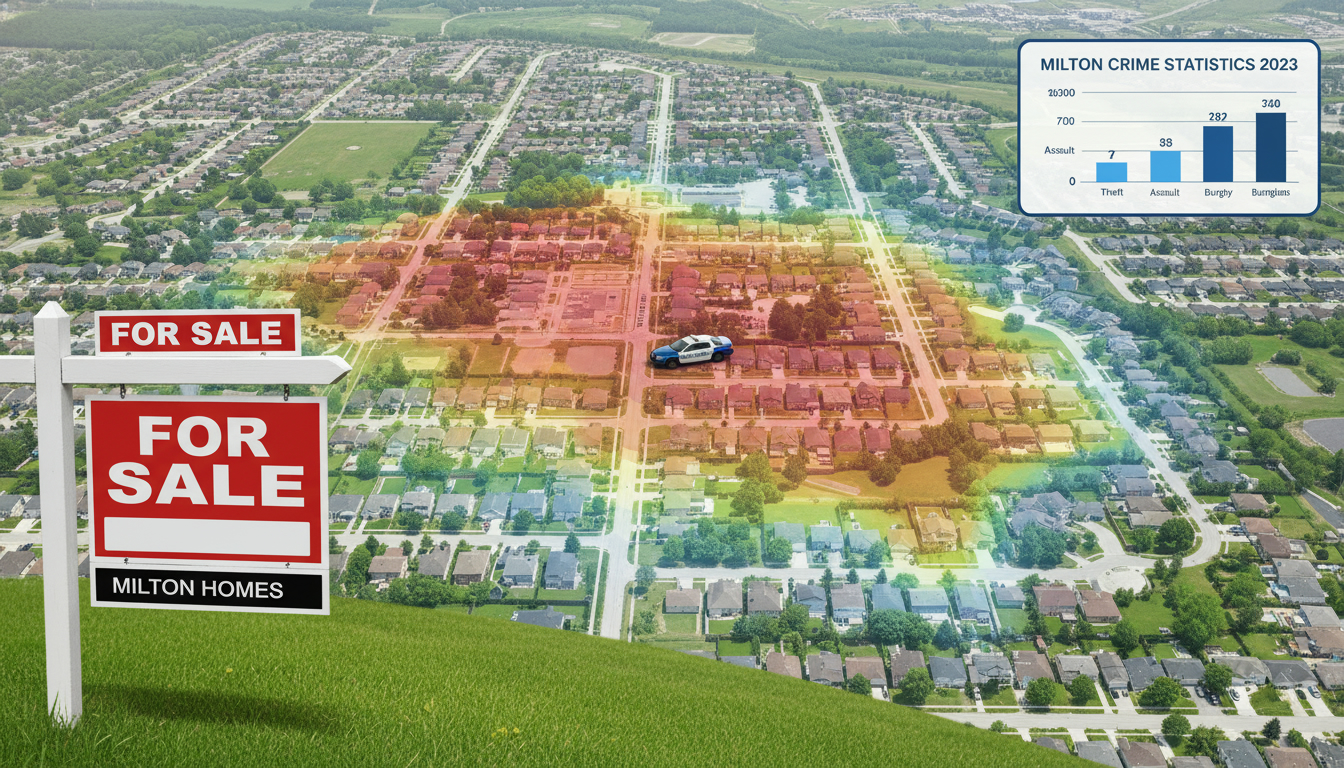
- Use crime mapping platforms that aggregate police data (crime maps or public-safety portals). These visuals show hot spots and recent incidents. Confirm their data source — ideally they pull directly from HRPS or official feeds.
- Read local news and community forums
- MiltonToday, local Facebook groups, and neighbourhood forums often report incidents before official summaries. Use them to spot patterns, but verify with police data.
- Visit the area at multiple times
- Data is numbers. Context is live observation. Walk the street during day and night. Note lighting, presence of youth gatherings, storefront security, and police or community patrol cars.
- Ask neighbours and local realtors for perspective
- Talk to long-term neighbours, property managers, and experienced local realtors. They’ll tell you whether problems are isolated or chronic.
How to interpret the numbers — make them simple
-
Absolute numbers vs. rates: A single assault in a small neighbourhood can spike headlines. Look at rates per 100,000 people and multi-year trends.
-
Crime Severity Index (CSI): Not just frequency. CSI weights serious crimes more heavily. Compare Milton and Halton CSI to Ontario’s CSI.
-
Types of crime matter: For sellers, property crime (break-ins, theft) affects buyers’ perceptions most. Violent crime affects different buyer segments.
-
Trend lines beat single events: A one-off incident doesn’t define a community. Rising multi-year trends are the real red flags.
Tools and URLs to use (where to click)
- Halton Regional Police Service: police locator, daily blotter, and annual stats.
- Statistics Canada: police-reported crime statistics and the Crime Severity Index for municipalities.
- Halton Region and Town of Milton open data portals.
- Local news sites: regional community sections.
- Community groups: Facebook neighbourhood groups, local Nextdoor threads.
Tip: always screenshot sources and save URLs. When buyers ask, show them the official pages — not hearsay.
What Milton home sellers must do with crime data
-
Pre-empt questions in your listing packet. Include a neighbourhood safety section with links to HRPS and Statistics Canada pages. Buyers respect transparency.
-
Highlight improvements. If street lighting, new policing initiatives, or community patrols exist, list them. If the neighbourhood has active neighbourhood watch programs, say so.
-
Upgrade visible security affordably. Smart lighting, cameras, and secure locks reduce buyer anxiety and appear in listing photos.
-
Use data in pricing strategy. If small negative trends show up, price for market reality and add incentives — not vague concessions.
-
Market the positives aggressively. Show low property crime compared to neighbouring towns, proximity to community services, schools, and recent infrastructure improvements.
Common seller scenarios and exact actions
Scenario A — Data looks great
- Action: Use the stats as a selling point. Add a one-page “Community Safety Snapshot” to your listing package showing 3-year downward trend, HRPS positive initiatives, and nearby amenities.
Scenario B — A recent incident made headlines
- Action: Acknowledge it, explain context, and show trends. Buyers respect honesty. Provide official links, emphasize it was isolated, and show steps taken by the community.
Scenario C — Data shows a rising trend in property crime
- Action: Invest in visible security, emphasize community action plans, and price competitively. Offer a home warranty or security system credit to remove buyer friction.

How a local expert helps you sell faster (without hype)
A competent local realtor does three things better than you:
- Knows the exact data sources and how to pull neighbourhood-level reports.
- Knows buyer psychology — how to present safety info so buyers feel confident instead of worried.
- Knows which fixes move the needle (lighting, locks, staging) and which are wasted money.
If you want Milton-specific expertise, you need someone who lives and works here, knows Halton Regional Police processes, and has sold in each Milton subdivision. That’s the difference between listing and selling.
How to present safety data in your listing packet (exact template)
- Page 1: Community Safety Snapshot — 3 bullets: HRPS crime rate (last 12 months), property crime trend (3 years), CSI vs Ontario.
- Page 2: Official links — HRPS stats, Statistics Canada pages, Halton/Open Data links with screenshots and dates.
- Page 3: Community action & improvements — lighting upgrades, neighbourhood watch, new transit or community centre.
- Page 4: Security highlights of the home — locks, alarm, cameras, smart lights (use photos).
Use bold headings. Keep it one printable page plus links.
Use data to remove objections during buyer inspections
Buyers bring inspectors and ask about neighbourhood safety. Instead of arguing, hand them the one-page snapshot. It’s factual, concise, and prevents fear-driven low offers.
Local context: Milton, ON specifics you must check
-
Growth and change: Milton has been one of Canada’s fastest-growing towns. Rapid growth brings new housing and new pressures on services.
-
Halton Regional Police posture: HRPS has community policing teams assigned to Milton. Look for community policing updates, youth outreach programs, and traffic enforcement initiatives.
-
Development hotspots: New subdivisions can attract construction-related thefts. Compare older established pockets vs. new developments when analyzing risk.
-
Transit and commuter patterns: Roadways and GO train stations change foot traffic patterns and can affect petty crime distribution.
Final practical checklist — 10-minute audit for any Milton address
- Open HRPS and search Milton incidents for the last 12 months. Save screenshots.
- Pull Milton CSI from Statistics Canada. Note trend for 3 years.
- Check Halton Region open data for incident maps.
- Google “[Your street], Milton crime” and scan local news.
- Visit the street daytime and evening. Note lighting and activity.
- Ask two neighbours if comfortable.
- Add findings to a one-page Community Safety Snapshot.
- Add 3 low-cost upgrades to improve perceived safety (lighting, cameras, motion sensors).
- Show snapshot to buyers before showings.
- Get a local realtor who can explain trends and negotiate confidently.
Contact and next steps
If you want a Milton-specific neighbourhood safety audit, I’ll compile the official HRPS data, Statistics Canada trends, and a one-page seller-ready summary that you can include in your listing. That saves you time and removes buyer objections.
Email: tony@sousasells.ca
Phone: 416-477-2620
Website: https://www.sousasells.ca
I work in Milton and Halton. I know where stats matter and where buyer perceptions matter more. Call or email — I’ll deliver a seller-ready safety snapshot within 48 hours.
FAQ — Common seller and buyer questions about checking crime rates in Milton
Q: Where is the most reliable crime data for Milton?
A: Halton Regional Police Service and Statistics Canada. Use HRPS for incident-level and StatsCan for Crime Severity Index and regional comparisons.
Q: How do I find crime by street in Milton?
A: Use HRPS incident maps and Halton open data. Some crime-mapping tools also show incidents by address cluster. Verify any third-party tool against HRPS.
Q: Will a single headline crime hurt my sale?
A: Not if you handle it correctly. Acknowledge, show official data that it’s isolated, and use safety upgrades to reassure buyers.
Q: What numbers should I include in a seller packet?
A: HRPS annual incident rate, three-year trend, property crime rate, and CSI comparison to Ontario.
Q: Are third-party crime map websites reliable?
A: They can help but always verify with HRPS. Third-party tools sometimes lag or reclassify incidents.
Q: How much do security upgrades help my sale?
A: Visible and affordable upgrades (lighting, cameras) improve buyer confidence and can reduce negotiation friction. They often provide ROI greater than cost because they reduce perceived risk.
Q: Should I disclose crime on a listing?
A: Disclose facts when asked. Proactively providing official safety data is usually better than reacting to buyer concerns.
Q: Can a realtor help challenge negative perceptions?
A: Yes. A local realtor with Milton experience can present data, show community improvements, and guide pricing to match market reality.
Q: How quickly can you get a safety snapshot for my home?
A: Within 48 hours of request.
Q: Who enforces safety upgrades or community policing in Milton?
A: Halton Regional Police Service works with the Town of Milton and Halton Region on community safety initiatives.
If you’re selling in Milton, don’t guess. Use official data. Be transparent. And if you want a clean, seller-ready safety packet built from HRPS and Statistics Canada data, contact tony@sousasells.ca or call 416-477-2620. I’ll give you the exact numbers, sources, and the one-page snapshot buyers want to see.