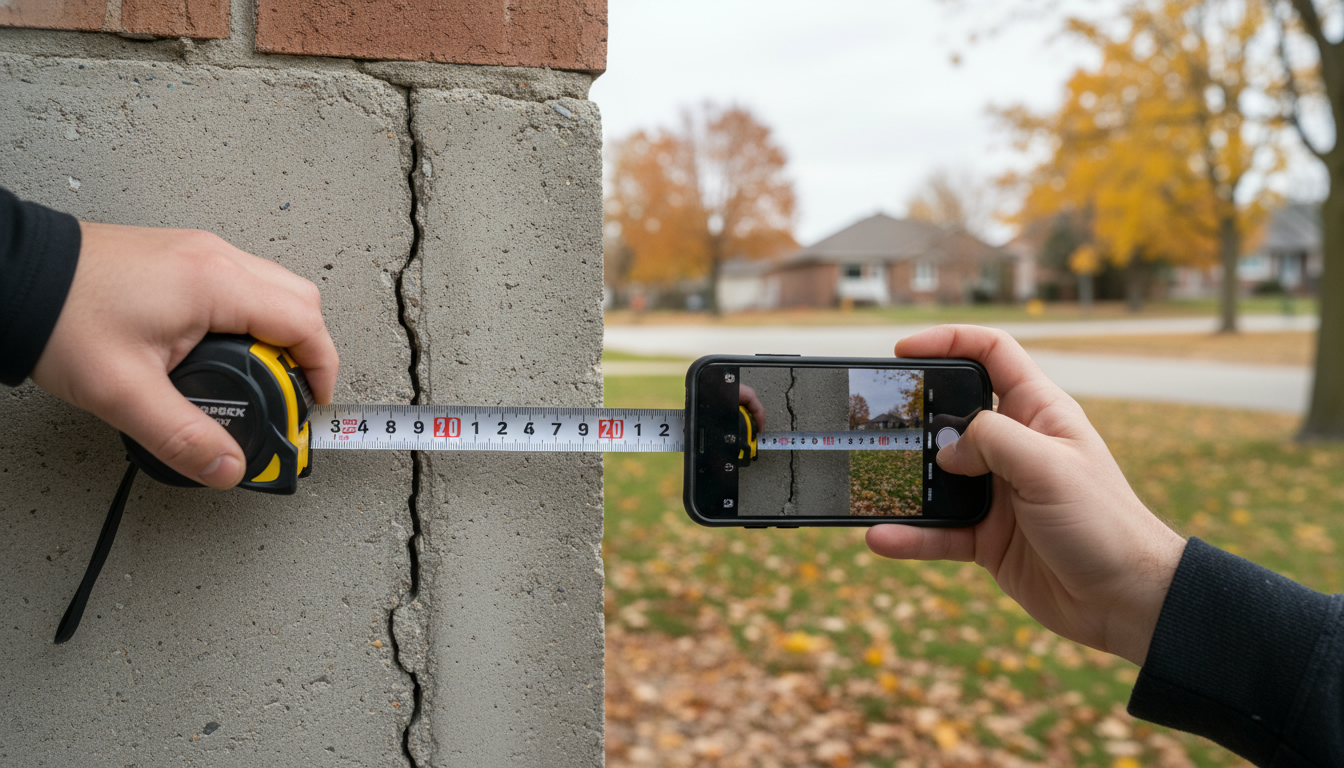
How do I check for foundation cracks?
Worried your house is splitting? Here’s the fast, no-nonsense way Milton homeowners find foundation cracks and decide what to do next — before the cost explodes.
Quick answer: How do I check for foundation cracks?
Do a focused visual inspection inside and outside. Measure each crack, map its location, check for movement over time, and look for secondary signs (sticking doors, bowing walls, uneven floors). If a crack is wider than 1/4″ or shows horizontal movement, call a professional now. For Milton, Ontario, factor in clay soil and freeze-thaw cycles — that makes some cracks more urgent.
Why this matters in Milton, Ontario
Milton sits on clay and mixed soils. Clay shrinks in dry months and heaves in wet months. That stresses foundations. Add heavy tree roots, poor drainage, and Toronto-area weather swings, and small cracks can become big problems fast. Knowing how to inspect correctly can save thousands when buying, selling, or maintaining a home.

The step-by-step foundation crack inspection you can do today
- Gather tools: tape measure (or ruler), level, flashlight, pencil, camera or smartphone, and a coin or matchstick for scale.
- Walk the entire perimeter outside. Look for vertical, horizontal, and stair-step cracks in poured concrete and block walls.
- Inside the basement, inspect foundation walls, floor joints, and where walls meet floors. Look for hairline cracks, gaps, or water stains.
- Measure the widest part of each crack. Note length, orientation (vertical/horizontal/stair-step), and location (corner, mid-wall, near window well).
- Mark and date each crack on a simple sketch or take a labeled photo. Repeat in two weeks to check for growth.
- Check doors, windows, and sheetrock: do doors stick, gaps at frames, or diagonal cracks above openings appear?
- Examine floors: are there sudden slopes, gaps between floor and baseboard, or new bouncing spots?
- Test drainage: check downspouts, grading, and gutter function. Water near the foundation means higher risk.
What types of cracks mean trouble — know the red flags
- Hairline vertical cracks (less than 1/16″) — usually cosmetic, monitor.
- Vertical cracks up to 1/8″ — often hairline, monitor, seal if leaking.
- Cracks 1/8″ to 1/4″ — get a professional inspection; possible settlement.
- Cracks wider than 1/4″ — likely structural concern; consult a structural engineer.
- Horizontal cracks or outward bowing — urgent. This suggests lateral pressure from soil or water; call a pro immediately.
- Stair-step cracks in block walls — often sign of differential settlement; inspect now.
- Cracks with active water leakage — fix drainage and call a foundation contractor.
How to measure and document cracks (smart, simple, useful)
- Place a coin or use a tape measure next to the crack when taking photos. Smartphones can misrepresent scale.
- Use a permanent marker to write the date and a simple label directly on the wall near the crack (on tape, not on finished wall).
- Maintain a log: date, location, width, photo file name, and notes (weather, recent heavy rain, nearby construction).
- Re-check after two weeks and one month. Growth = action.
Interior signs that often accompany foundation problems
- Doors or windows that suddenly stick or won’t latch.
- New diagonal cracks in drywall, especially above doors and windows.
- Gaps between moulding and walls.
- Sinking or spongy floors.
- Moisture, mold, or musty smells.

Exterior signs to never ignore
- Cracks on exterior foundation walls, often wider at the top or bottom.
- Separation between porch or stairs and the house.
- Water pooling near the foundation or poor grading.
- Soggy areas after rain, or water running toward the house.
Why DIY stops and professional help starts
You can detect, document, and manage minor cracks. But when cracks are wide, horizontal, accompanied by bowing walls, or tied to active water intrusion, you need professionals:
- Licensed home inspector (Milton area): full condition report, photos, recommendations.
- Structural engineer: evaluation, load-bearing analysis, stamped report for repair plans.
- Foundation contractor: repair options and accurate pricing.
If you’re selling or buying in Milton, a structural engineer’s report and contractor quotes protect price and liability.
How home inspectors evaluate foundation cracks in Milton
A qualified home inspector will:
- Inspect the entire perimeter and interior basement.
- Measure cracks and describe orientation and severity.
- Check moisture, drainage, and evidence of past repairs.
- Recommend further evaluation if structural issues are suspected.
- Provide a written report with photos and action items.
In Milton, inspectors also note local factors: soil type, tree proximity, and historical drainage issues in the neighbourhood.
Quick fix options and realistic cost ranges (Milton pricing outlook)
- Sealant/epoxy injection for non-structural cracks: $200–$1,000 depending on size and accessibility.
- Crack repair and repointing on block walls: $500–$3,000.
- External drain/grade correction and gutters: $1,000–$6,000.
- Structural repairs (steel braces, helical piers, underpinning): $5,000–$30,000+ depending on severity.
Costs vary. Get three quotes and a written scope. Cheap fixes without diagnosis create expensive surprises.

Local tips for Milton homeowners to prevent future damage
- Maintain positive grading: slope soil away from the foundation by at least 2% over the first 1–2 metres.
- Keep gutters clean; extend downspouts 1.5–3 metres from the house.
- Avoid planting large trees right next to the foundation; roots and soil moisture changes can shift soil.
- Install a functioning sump pump in low basements and check it before fall freeze.
- After major landscaping or construction, re-check foundation cracks.
Selling or buying a home in Milton: what buyers and sellers must know
Sellers: Disclose known cracks and any repairs. Have documentation and receipts. Buyers seeing major cracks may demand repairs, price adjustments, or walk away.
Buyers: Don’t skip the foundation check. Ask for a focused foundation inspection or engineer’s report if you find cracks. Use the report to negotiate.
When to call a structural engineer right away
- Horizontal cracks or bowing walls.
- Cracks wider than 1/4″ with active movement.
- Steps in block walls that get worse over weeks.
- Settling that causes doors/windows to jam quickly.
A structural engineer provides a plan and priority list. Contractors should base repair quotes on that plan.
Take action checklist (copy this)
- Walk perimeter today. Photograph and measure any cracks.
- Check gutters and grading now.
- Mark and log cracks with date.
- If any crack >1/4″ or horizontal, schedule an engineer.
- If selling or buying, get an inspector or engineer report before final offers.

FAQ — Foundation cracks, home inspections, and Milton-specific answers
Q: Are all foundation cracks dangerous?
A: No. Many vertical hairline cracks are from concrete curing or minor settlement and are cosmetic. But cracks that are wide, horizontal, or showing movement can be structural. Always document and monitor.
Q: How do I tell if a crack is getting worse?
A: Measure the widest point and take dated photos. Check again in two weeks and a month. Any measurable growth or new cracks means call a professional.
Q: What does a horizontal crack mean?
A: Horizontal cracks usually mean lateral pressure from soil or water. This can be serious. In many cases, walls may bow or bulge. Call an engineer.
Q: Are stair-step cracks in block walls bad?
A: Often yes. Stair-step cracks usually indicate differential settlement. They can open gradually and lead to water entry or structural problems.
Q: Can I patch a crack myself?
A: You can seal small, non-structural cracks to prevent water intrusion. Use the correct epoxy or hydraulic cement. For anything beyond hairline or cosmetic, get a professional evaluation.
Q: How do Milton’s weather and soil affect foundations?
A: Milton’s clay and mixed soils expand and contract more than sandy soils. Freeze-thaw cycles and seasonal rain can change moisture levels near the foundation, increasing movement risks.
Q: Will a foundation crack kill my home sale?
A: Not necessarily. Proper documentation, engineered repair plans, or contractor warranties make buyers comfortable. Hiding problems or ignoring them kills deals.
Q: Do I need a permit for foundation repair in Milton?
A: Major structural repairs often require permits. Check with the Town of Milton building department or your contractor to confirm.
Q: How soon should I call a home inspector?
A: If you’re buying or selling now, include a home inspection early. If you find new cracks or doors jamming, call a home inspector as soon as possible.
Q: Who should I call first: inspector, engineer, or contractor?
A: Start with a home inspector for an overview. If the inspector flags structural concerns, hire a structural engineer. Contractors should bid based on the engineer’s plan.
If you want a local expert who knows Milton, inspections, and the market, call Tony Sousa. He helps buyers and sellers understand foundation issues, connects you with trusted local inspectors and engineers, and protects your sale or purchase.
Email: tony@sousasells.ca
Phone: 416-477-2620
Website: https://www.sousasells.ca
Get your foundation checked once. Fix it right. Move on.