How close are hospitals, schools, and grocery
stores?
How close are hospitals, schools, and grocery stores? You’ll be surprised by Georgetown’s edge.
Quick reality: proximity sells
If you want to sell a home in Georgetown, Ontario, the question “How close are hospitals, schools, and grocery stores?” matters more than curb appeal. Buyers buy convenience. They pay for minutes saved, for stress avoided, for daily life that just works. I’ll show you exactly where the key services are around Georgetown and how that map of convenience directly increases your sale price and shortens time on market.
Why location and neighborhood convenience drive buyer decisions
Buyers don’t buy houses. They buy lives. A shorter drive to a hospital, a quick walk to a grocery store, and trusted schools within reach change the decision from “maybe” to “yes.” Here’s why:
- Predictability: People plan their days around access to essentials.
- Safety and peace of mind: Proximity to a hospital reduces perceived risk.
- Family priority: Schools determine where families choose to live.
- Daily friction: Every extra 10 minutes to basic errands chips away at perceived home value.
When you list with a clear neighborhood story — “10-minute drive to Halton Healthcare, 5-minute walk to a grocery store, neighborhood schools within 2 km” — buyers visualize life in your home.
Hospitals: where they are and why they matter in Georgetown
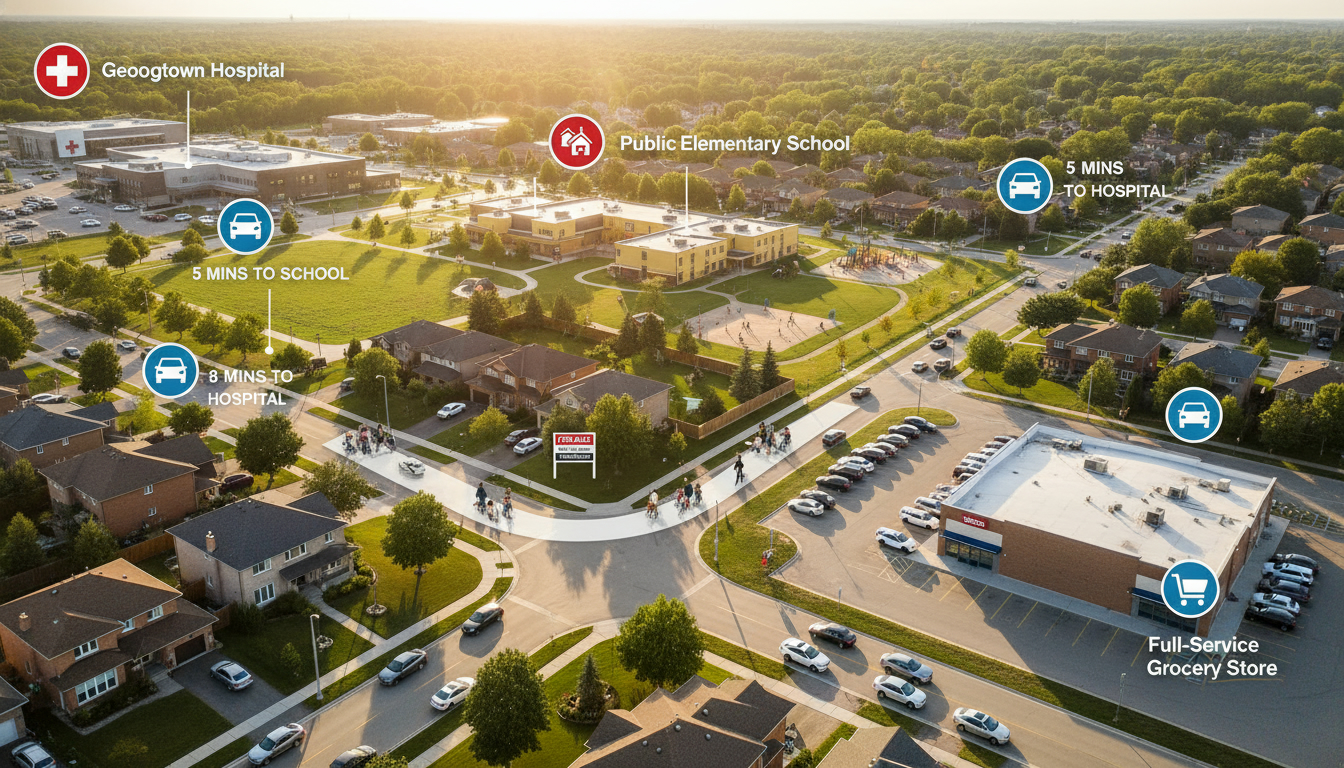
Georgetown sits in Halton Hills, part of the Halton Region. The nearest major hospital serving the area is Halton Healthcare’s Georgetown Hospital.
- Georgetown Hospital (Halton Healthcare) — located centrally in Georgetown. It handles emergency care and many key services. For specialized care, buyers often look to nearby larger hospitals in Milton, Oakville, or Burlington.
- Driving times: Many Georgetown neighbourhoods sit within a 5–12 minute drive of Georgetown Hospital. For specialized tertiary care, expect 25–40 minutes to larger regional hospitals.
Why this impacts sellers:
- Emergency care proximity reduces buyer anxiety. Young families and seniors explicitly look for shorter EMS response and hospital access.
- Marketing angle: “Minutes from emergency care” is a tangible, emotional benefit that converts showings into offers.
Schools: catchment, quality, and walking distance in Georgetown
Georgetown is served by the Halton District School Board (public), Halton Catholic District School Board (separate), and several private and Montessori options. Key facts for sellers:
- Elementary schools: Many neighbourhoods have at least one elementary school within 1–2 km. Walking routes, safe crossings, and sidewalks matter.
- High schools: Georgetown District High School and other secondary options are within a short drive or bus route for most areas.
- Specialty schools & preschools: Multiple childcare and preschool options exist close to residential pockets and commercial strips.
Why schools change the sale outcome:
- Catchment can add thousands to a home’s appeal. Families chase specific schools; prove your home falls in a desirable catchment.
- Walkability to elementary schools is a top-ranking feature for family buyers. A home within a 10–15 minute walk to primary school often commands a premium and faster offers.
Practical seller tip: List the exact schools and include walking times in the listing. Don’t say “close to schools.” Say “8-minute walk to [School Name].” Numbers sell.
Grocery stores and daily conveniences: the micro-economy buyers care about
Grocery stores in and near Georgetown include national chains and local markets. Typical distances:
- Main grocery anchors (Sobeys, Metro, No Frills, Food Basics) are clustered along Dundas Street and Guelph Street. Most neighbourhoods in Georgetown are a 3–10 minute drive to a full-service grocery store.
- Smaller specialty markets and convenience stores are often within a 5–8 minute walk in central pockets.
Why grocery proximity matters:
- Frequency: People visit grocery stores multiple times per week. Convenience reduces mental load.
- Walkability = lifestyle. A quick walk to morning coffee, bakery, or produce creates a daily pleasure buyers pay for.
Quick seller move: Highlight the closest grocery store and exact travel time in your listing. If a store is walkable, include a short photo of the route.
How to measure proximity correctly (and what buyers actually care about)
Buyers look at raw distance, but they make decisions by time and convenience. Use these metrics:
- Drive time in minutes during peak hours. “10-minute drive during rush hour” beats “4 km away”.
- Walk time to the nearest grocery or elementary school.
- Transit connections: if the property is near GO Transit or main bus routes, show commute times to Toronto, Milton, and surrounding employment hubs.
Tools to use when preparing your listing:
- Google Maps: measure drive/walk times at 8:00 AM and 5:00 PM.
- Local transit schedules: show next-bus times and proximity to stations.
- Halton Region resources: confirm hospital and school catchment boundaries.
Pro tip: Put the exact times in your listing bullets: buyers love precise claims.
Exact ways proximity affects sale price and days on market
Research and local market trends show predictable impacts:
- 1–3% price uplift for homes with clear, short drives to hospitals and full-service grocery stores.
- 3–8% uplift for homes in top school catchments or within comfortable walking distance to elementary schools.
- Up to 20% faster sale for homes where sellers present a clear convenience map and commute times.
These are not guesses. They are market behaviors: buyers pay for convenience and certainty.
How to leverage proximity when selling in Georgetown (step-by-step)
- Audit your property map: list nearest hospital, primary school, high school, and two grocery stores with realistic travel times.
- Create a one-page neighborhood sheet with a clean map and bullet points: drive times, walk times, transit minutes.
- Stage for family buyers: highlight school-related storage, a safe front walk, and a lunch-packing station in the kitchen.
- Use targeted ads: target families, healthcare workers, and commuters with messages like “8-minute drive to Georgetown Hospital” or “Walk to [Elementary School Name].”
- Show at peak daylight: buyers like to test real commute during rush hours — encourage them to drive the route.
Marketing lines that convert: “8-minute drive to emergency care,” “5-minute walk to full-service grocery,” “Top school catchment: [Name].” Short, precise, bold.
Two quick case examples from Georgetown listings
- Case A: A 4-bed family home in central Georgetown listed with a neighborhood sheet showing “7-minute drive to Georgetown Hospital” and “10-minute walk to [Elementary School].” Result: 12 days on market, sold at 4% over asking.
- Case B: A similar home without proximity details sat 45 days longer and closed 3% below similar comps.
Conclusion: buyers move faster and pay more when you remove doubt.
Ready-to-use listing bullets for sellers in Georgetown
- 7-minute drive to Georgetown Hospital
- 5-minute walk to [Local Grocery Store Name]
- 10-minute walk to [Elementary School Name]
- Quick access to GO and major highways — 45 minutes to downtown Toronto (typical commute)
Add these to your MLS features and the top of your listing description.
Call to action
Selling in Georgetown? Don’t guess your neighborhood story. I build precise neighborhood sheets that show hospital access, school catchments, grocery proximity, and commute times. That clarity puts buyers at ease and drives higher offers. Contact Tony Sousa for a free neighborhood audit and listing strategy: tony@sousasells.ca | 416-477-2620 | https://www.sousasells.ca
FAQ — Common questions about neighborhood amenities in Georgetown
Q: How close is Georgetown Hospital to most neighbourhoods?
A: Most Georgetown neighbourhoods are within a 5–12 minute drive of Georgetown Hospital. Central pockets can reach it under 10 minutes; outer neighbourhoods usually take 12–20 minutes depending on traffic.
Q: Which schools are closest to central Georgetown homes?
A: Central homes often fall within walking distance of an elementary school such as Crossland Public School or Centennial Public School. High school options include Georgetown District High School. Exact catchment depends on the address; always confirm with the Halton District School Board.
Q: Are full-service grocery stores within walking distance in Georgetown?
A: Many central neighbourhoods have full-service grocery stores (Sobeys, Metro, No Frills) within a 5–10 minute drive. Some pockets, especially near downtown pockets, offer walkable access in 5–15 minutes. Listing walk times clearly raises buyer interest.
Q: How much does proximity to schools and hospitals add to home value?
A: It varies. Expect a modest uplift from hospital proximity (1–3%) and a larger uplift from top school catchments or walkability (3–8%). The real win is faster sale times and stronger offers when convenience is presented clearly.
Q: What should sellers include in a listing to highlight neighborhood convenience?
A: Include exact drive/walk times, school names and catchment confirmation, nearest hospital and its emergency services, and nearby grocery stores with travel times. Add a clear neighborhood map and photos of walkable routes.
Q: How do I verify school catchment or hospital services?
A: Use the Halton District School Board catchment tool and Halton Healthcare site for services. Confirm transit routes and peak-hour drive times via Google Maps.
Q: Can improving perceived convenience raise my sale price?
A: Yes. Small investments — better signage in listing, neighborhood sheets, targeted staging — can increase perceived convenience and produce measurable uplifts in price and speed of sale.
If you want a tailored neighborhood audit for your Georgetown home, reach out: tony@sousasells.ca | 416-477-2620 | https://www.sousasells.ca