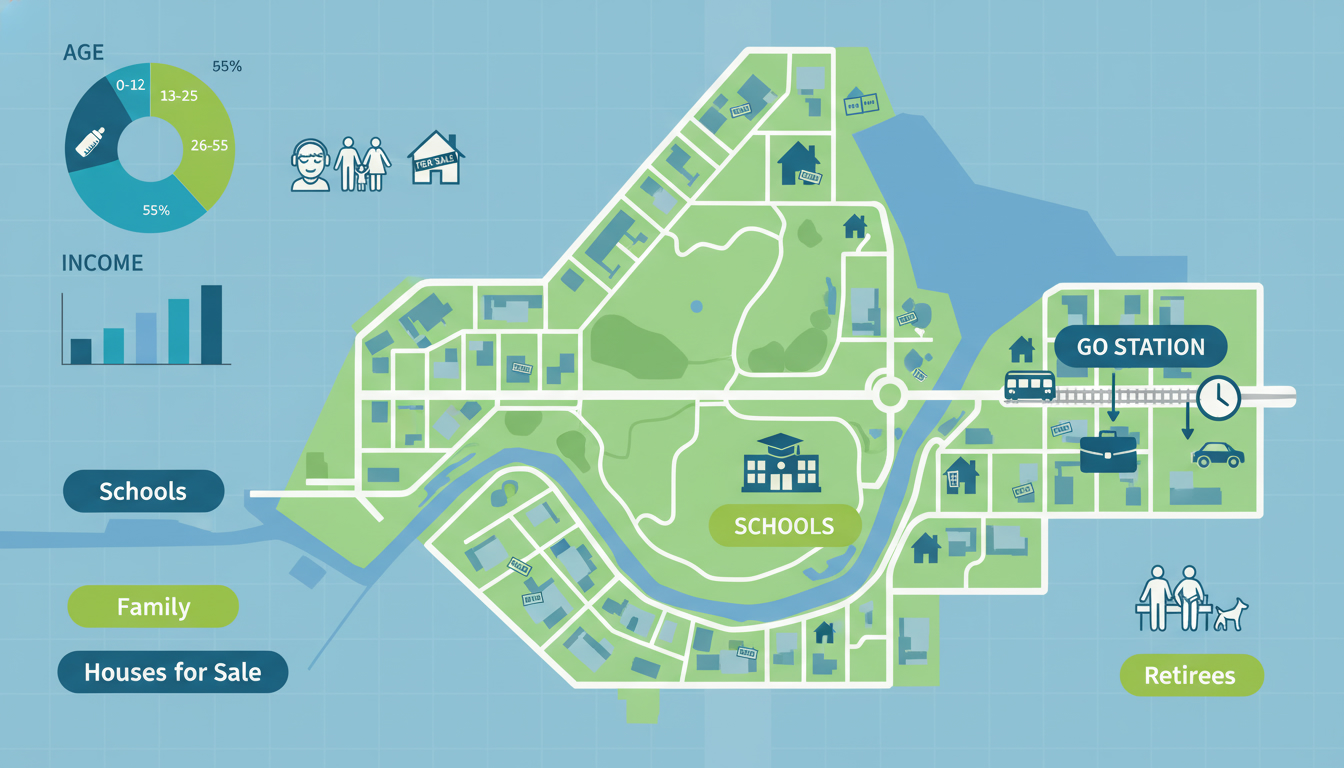
How do I research the demographics of a neighborhood?
“Who lives next door — and how to use that info to sell your Georgetown home faster?”
Why demographics matter when selling your home in Georgetown, ON
If you want top offers, you must know who buys in your area. Demographics tell you who shops, who moves, and what buyers value. For Georgetown home sellers, that means pricing, staging, and targeting the right buyers—quickly.
This guide gives clear, actionable steps to research Georgetown, Ontario demographics. No fluff. Do this and you’ll know: who your buyers are, what they want, how to market your home, and where to list it to get the best offers.
Quick roadmap — do this in order
- Pull official Census data for Georgetown (Halton Hills).
- Check municipal and regional demographic reports.
- Use real estate sales data and MPAC for property-level insights.
- Scan school, commute, and amenity stats.
- Validate with field research: listings, open houses, social groups.
- Build a buyer profile and tailor your marketing.

Step 1 — Start with Statistics Canada: the foundation
Why: Census data gives facts you can’t argue with: age distribution, household size, income bands, family composition, languages, and immigration status.
How (fast):
- Go to Statistics Canada > Census Profile. Search “Halton Hills” and the specific dissemination area for Georgetown neighborhoods.
- Export tables for age groups, household types, median income, and dwelling types.
What to note for sellers in Georgetown:
- Median age: helps you decide staging and amenity emphasis (family-ready vs. downsizer-friendly).
- Household size and children at home: prioritize bedrooms, schools, yard features in listing copy.
- Language and immigrant communities: tailor marketing copy and choose the best ad channels.
Action: Download the 2016 and 2021 Census profiles. If 2026 is out, use it. Compare trends — growth, aging, rising incomes.
Step 2 — Use local government and regional reports
Why: Town and region data add nuance: planned developments, transit, zoning changes, and community forecasts.
Where to look for Georgetown:
- Town of Halton Hills website: community profiles, growth strategy, and official plan updates.
- Regional Municipality of Halton: maps, transportation plans, services, and economic reports.
- Halton Hills Economic Development: business profiles and investment highlights.
What to pull:
- New housing builds and condo projects.
- Zoning or commercial changes that affect buyer demand.
- Transit projects that shorten commutes to Toronto or surrounding employment hubs.
Action: Save PDFs and screenshots. Note timelines — if a transit link or school expansion is opening soon, use that in your listing copy as a value driver.
Step 3 — Real estate data and MPAC: price + property intelligence
Why: Demographics tell “who.” Real estate data tell “how much” and “what sells.” MPAC gives assessed values and property features.
Sources:
- MLS sold data (use a realtor or tools like CREA and local boards).
- Municipal Property Assessment Corporation (MPAC) for assessed values.
- Local market reports from REALTORS®.
How to use it:
- Track sold prices by property type and sub-neighborhood in Georgetown.
- Look at list-to-sale ratios and days on market for family homes vs condos.
- Compare assessed value vs recent sale prices to find pricing strategies.
Action: Build a 12-month sold-comps list for your street and similar streets within Georgetown. That becomes your pricing backbone.
Step 4 — Schools, commute times, and amenities: what buyers care about
Why: These practical items often decide which neighbourhood a buyer chooses.
Where to get fast answers:
- Halton District School Board and Halton Catholic District School Board for school rankings and catchment info.
- Google Maps: measure commute times to major job centers (Georgetown GO Station, Highway 7/401 connection points, Toronto). Use peak-hour times.
- Local directories and community Facebook groups for parks, rec centres, shopping, and healthcare.
How this influences the sale:
- Proximity to high-performing schools sells family homes faster.
- Short commutes and transit access increase buyer pool and justify stronger pricing.
- Nearby amenities can be used as bullets in your listing and ad creative.
Action: Create a one-page “neighbourhood snapshot” for your listing: top schools, commute times to common jobs, nearest parks, and grocery stores.

Step 5 — Social listening and field research: validate the numbers
Numbers tell a lot. Walking the streets and scanning social channels fills gaps.
Field checks:
- Visit open houses in Georgetown. Note buyer profiles and questions agents ask.
- Drive the neighbourhood at different times: noise levels, traffic, foot traffic near shops.
- Check community Facebook groups, Nextdoor, and neighbourhood forums for sentiment — complaints, pride points, or active buyer interest.
Online checks:
- Instagram and TikTok tags for #GeorgetownON to see lifestyle posts.
- Local business reviews to gauge popularity and demographic fit.
Action: Record three direct observations that support your listing angle (example: “young families, many strollers” or “active retirees using the walking trails”).
Step 6 — Build buyer personas and target your marketing
You now have raw data. Turn it into a buyer persona. For Georgetown, common personas often include:
- Growing Family: 30–45, two incomes, need 3+ beds, close to schools and parks.
- Commuter Couple: 28–40, work in GTA, values quick access to GO and highways.
- Empty-Nester/Retiree: 60+, downsizing, values low-maintenance, walkable amenities.
How to use personas:
- Write listing headlines for the top persona. Example: “Perfect family home steps from top-rated school.”
- Allocate ad spend to platforms the persona uses: Facebook/Instagram for families, Google Search for commuters, LinkedIn or community newsletters for professionals.
- Stage the home to match the persona: toys and family zones for families; clean, cozy finishes for retirees.
Action: Create two ad versions targeting different personas and measure performance for two weeks.
Tactical checklist for Georgetown sellers (print this)
- Download Census Profile for Halton Hills.
- Grab municipal growth and planning reports for Halton Hills.
- Pull 12 months of sold comps from MLS.
- Get MPAC assessed value for your property.
- Compile school catchment and commute time notes.
- Visit 3 open houses and join 2 local social groups.
- Build 1-page neighbourhood snapshot and 2 buyer personas.
- Launch 2 ad campaigns targeting your top personas.
How a local expert speeds this up
Doing this alone takes time and risks mistakes. A local realtor who knows Georgetown can:
- Pull hyper-local dissemination areas from the Census so you don’t rely on broad averages.
- Run MLS reports that show micro-markets inside Georgetown.
- Translate zoning and town plans into selling points or risk factors.
If you want a ready-made buyer profile, neighbourhood snapshot, and pricing plan tailored to your house on your street, get a local market audit.
Contact for a free, no-pressure market audit: tony@sousasells.ca | 416-477-2620 | https://www.sousasells.ca
FAQ — Common questions Georgetown home sellers ask about neighbourhood demographics
Q: What demographic data matters most when selling a home in Georgetown?
A: Age distribution, household size, median income, dwelling type, and school catchments. These determine demand, staging, and price sensitivity.
Q: How do census numbers translate into listing strategy?
A: Use age and household size to decide staging and headline. Use income and dwelling type to set price bands and ad targeting. Use growth trends to justify pricing if the area is on the rise.
Q: Can demographic research speed up my sale?
A: Yes. Targeted marketing reaches the right buyers faster. If you avoid broad, generic ads, you cut days on market and increase competitive offers.
Q: Where do I get the most accurate local demographic info for Georgetown?
A: Start with Statistics Canada and Town of Halton Hills. For micro-level accuracy, use dissemination area data and MLS sold reports provided by a local Realtor.
Q: Should I pay for paid data sources?
A: Paid sources (market reports, neighbourhood analytics) speed up research and offer deeper insights. But you can get actionable insights for free using the steps above.
Q: How do school zones affect buyer demand in Georgetown?
A: Greatly. Families prioritize schools. If your home is in a desirable catchment, highlight that in the listing and target family-oriented channels.
Q: How often should I update demographic research?
A: Update before every sale. Major updates after each census cycle or after a municipal plan change or new transit announcement.
Q: Will demographic trends tell me my ideal price?
A: Trends give context. Final price comes from sold comps, condition, and market velocity. Use demographics to set strategy and comps to set price.
Final straight talk
Demographic research turns guesswork into action. For Georgetown sellers, it reveals who’s buying, what they want, and where to find them. Do the six steps above or call a local expert to get it done fast. You’ll price smarter, stage smarter, and sell faster.
Want a custom Georgetown neighbourhood snapshot and buyer profile for your address? Email tony@sousasells.ca or call 416-477-2620. No pressure. Real numbers. Real strategy.
Author: Tony Sousa — Local Georgetown Realtor
Contact: tony@sousasells.ca | 416-477-2620 | https://www.sousasells.ca