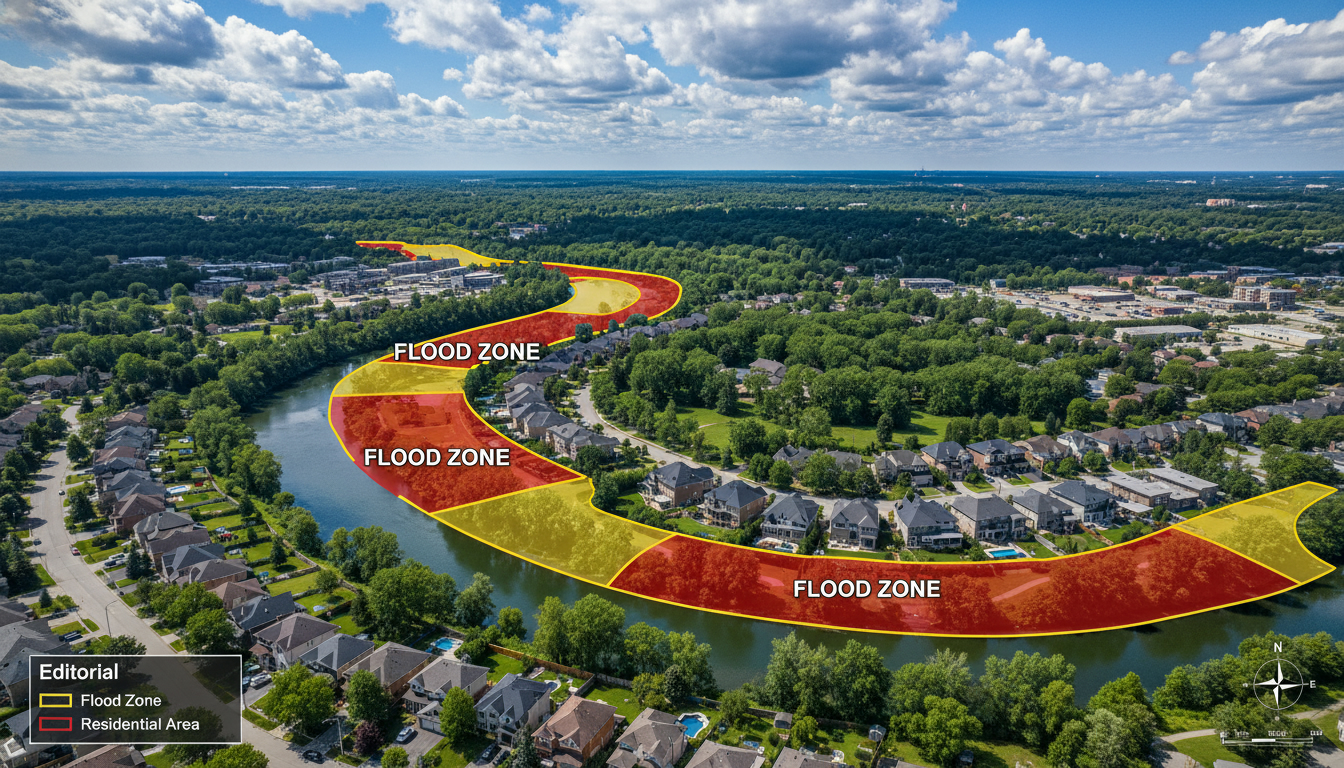
Are there areas in Ontario prone to flooding?
Shocking question: Could your Georgetown home be on a floodplain—and what that means for your sale?
Quick answer up front
Yes — parts of Ontario are prone to flooding. Some areas are repeatedly at risk. Georgetown sits along the Credit River and has pockets of higher flood risk. That doesn’t mean every property is unsafe, but it does change selling strategy, insurance, and buyer demand.
Why flood risk matters for homeowners and sellers
If you’re selling a home in Georgetown or anywhere in Ontario, flood risk affects price, time on market, and buyer confidence. Buyers will ask about flood history, floodplain maps, and insurance costs. Lenders and insurers often require extra documentation or deny coverage for high-risk properties. You need to know where your property sits, what protections exist, and how to package the listing so it sells fast and for top dollar.

How Ontario identifies flood-prone areas
- Provincial and local floodplain mapping: Conservation Authorities, like Credit Valley Conservation (CVC), and municipalities maintain floodplain maps. These maps show regulatory floodlines, 100-year flood zones, and special policy areas.
- Historical flood records: Municipal reports and news archives document past events—spring melt, major storms, ice jams.
- Elevation and topography data: Low-lying properties near rivers, creeks, and drainage channels are most at risk.
- Climate trends: Increased severe storms and heavier rainfall change flood patterns across Ontario.
Search keywords: flood-prone areas Ontario, floodplain map Ontario, Credit River flood risk, Georgetown flood history.
The Credit River and Georgetown: the facts
Georgetown sits in Halton Region on the banks of the Credit River. That’s both an asset and a risk. Rivers create attractive neighborhoods, but they also define flood exposure.
Key points:
- Floodplain zones exist around the Credit River within Georgetown. These are mapped and regulated by Credit Valley Conservation and Halton Region.
- Some low-lying neighbourhoods and properties adjacent to tributaries face higher basement flooding and overland flow risk during severe storms.
- The town has flood mitigation infrastructure in parts, but no place is completely immune to an extreme weather event.
If you live on or near the river, expect questions from buyers about flood history, municipal flood mitigation plans, and whether flood insurance is available and affordable.
How to check your property’s flood risk (practical steps)
- Get the municipal floodplain map: Halton Region and Credit Valley Conservation publish regulatory maps online.
- Order a property-specific flood risk letter: Many conservation authorities provide property screening services or flood risk reports for a fee.
- Review historical Flooding Reports: Search municipal archives or contact the Town of Halton Hills for records specific to Georgetown.
- Elevation certificate or topographic survey: For critical cases, hire a surveyor to confirm finished floor elevation relative to river levels.
- Talk to neighbours: Local experience often reveals repeated basement or yard flooding not captured on official maps.
Keywords: Georgetown flood map, how to check flood risk Georgetown, property flood risk letter Credit Valley.
Real estate implications: buyers, pricing, and disclosure
- Disclosure rules: Sellers and realtors must disclose known material facts. If you know your home flooded or lies in a mapped floodplain, disclose it. Failure to disclose can lead to legal issues.
- Market value impact: Flood-prone properties typically sell for less and take longer to sell unless presented with mitigation and proof of safety.
- Buyer financing and insurance: Some lenders or insurers add conditions or refuse coverage for high-risk properties. This can reduce the buyer pool.
- Staging the property: Emphasize recent upgrades (sump pump, backwater valve, basement waterproofing), finished floor elevation, and municipal floodproofing plans to reassure buyers.
Keywords: flood disclosure Ontario, Georgetown real estate flood risk, sell flood-prone house.

What counts as flood history? Why it matters to buyers
- Minor basement seepage vs. major overland flooding: Buyers react differently. Full basement floods are red flags; settlement-level seepage can be fixed.
- Repeated events: A one-off storm is different from recurring yearly issues.
- Mitigation and repairs: Documentation of professional flood remediation, costs, and warranties reduces buyer anxiety.
Keywords: basement flooding Georgetown, flood remediation documentation.
How to reduce flood risk and increase buyer confidence
- Install proven hardware: sump pumps with battery backup, backwater valves, proper grading away from foundation.
- Waterproofing and repairs: French drains, exterior waterproofing membranes, raised entryways, and proper eavestroughs.
- Get professional inspection reports: A recent engineer or waterproofing contractor report is gold when selling.
- Municipal engagement: Point buyers to Halton Region or CVC plans showing flood management steps taken.
- Offer incentives: Consider seller-paid flood insurance for the first year or credit for mitigation upgrades.
These steps convert a vulnerable listing into a manageable, sellable asset.
Case studies and local examples (realistic framing)
- Example 1: A bungalow near the Credit River had two minor basement incidents in 2017 and 2019. Seller installed a battery-backed sump pump, backwater valve, and obtained a contractor’s warranty. The house sold within 30 days at 98% of list price.
- Example 2: A riverside property in a mapped floodplain required a topographic survey and buyer education. The seller reduced price pre-emptively and accepted an offer after providing a flood risk report and insurance estimates.
These examples show there’s always a strategy to sell—if you plan proactively.
Selling strategy for flood-prone Georgetown homes
- Full transparency: disclose known flood history and provide remediation records.
- Pre-listing mitigation: fix obvious vulnerabilities and get documentation.
- Market the upside: proximity to river, parks, and walkability increases demand—package these with mitigation steps.
- Pricing strategy: realistic list price informed by comparable sales of mitigated properties.
- Target buyers who value the upside: families, professionals seeking lifestyle benefits, buyers who accept mitigation costs.
Keywords: sell Georgetown house floodplain, Georgetown home selling strategy flood.

Why local expertise matters
Flood risk intersects municipal policy, conservation authority maps, insurance underwriting, and buyer psychology. You need a local agent who knows the maps, can get property-specific letters, and who can position the home correctly in listings. That’s where targeted local experience makes the difference between a stale listing and a quick sale.
Final checklist before listing a Georgetown home
- Obtain floodplain map for property
- Get a property flood risk letter from Credit Valley Conservation
- Hire inspection/waterproofing pros and obtain reports
- Complete visible mitigation work and get receipts/warranties
- Prepare a buyer-ready folder with all documentation
- Discuss insurance implications and costs for buyers
Keywords: Georgetown flood checklist, sell house Georgetown flood risk.
FAQ — Flooding Risks, Real Estate, and Neighborhood Considerations in Georgetown
Q: Are there parts of Ontario that flood regularly?
A: Yes. Low-lying river valleys, lakefronts, and poorly drained urban areas flood more often. Climate change has increased heavy rainfall events, so frequency is rising in many regions.
Q: Is Georgetown a flood-prone area?
A: Some parts of Georgetown near the Credit River and its tributaries are mapped as floodplains. Many properties are outside regulatory floodlines but still could experience overland flow during extreme storms.
Q: How do I check if my Georgetown property is in a floodplain?
A: Start with Halton Region’s mapping and Credit Valley Conservation’s regulatory maps. Order a property flood risk letter from CVC or a topographic survey for precise elevation data.
Q: Do I have to disclose past flooding when selling a home in Georgetown?
A: Yes. Sellers must disclose known material facts, including past flooding. Documentation reduces legal risk and builds trust with buyers.
Q: Will my house lose value if it’s in a floodplain?
A: Typically, flood-prone homes sell for less and may take longer to sell. Proper mitigation and proof of repairs can offset value loss.
Q: Can I get flood insurance in Georgetown?
A: Flood insurance options in Canada are limited compared to other countries, but private insurers may offer coverage. Availability and cost depend on flood risk and property details.
Q: What mitigation steps actually work?
A: Sump pumps with battery backup, backwater valves, improved grading, sealed basements, and professional exterior drainage work are effective. Maintain documentation and warranties.
Q: Should I lower my asking price if my home had past flooding?
A: Not automatically. First, assess the severity and mitigation completed. Properly documented repairs and warranties allow you to price competitively without excessive discounting.
Q: How can I reassure buyers worried about flood risk?
A: Provide a flood risk letter, contractor reports, warranty documentation, and examples of neighborhood flood management. Offer to cover first-year flood insurance if needed.
Q: Who can help me navigate flood risk and selling in Georgetown?
A: You need a local expert who knows Credit Valley Conservation, Halton Region policies, insurance contacts, and buyer behavior. They should organize reports, mitigation documentation, and a clear marketing strategy.
If you want a free property flood risk check, a list of mitigation contractors, or help positioning a Georgetown home for sale, call or email now. Local markets move fast. Get the facts, fix what matters, and sell with confidence.
Contact: Tony Sousa — Email: tony@sousasells.ca | Phone: 416-477-2620 | Website: https://www.sousasells.ca
Disclaimer: This post is for informational purposes and does not replace professional flood risk assessments, legal advice, or insurance counseling.