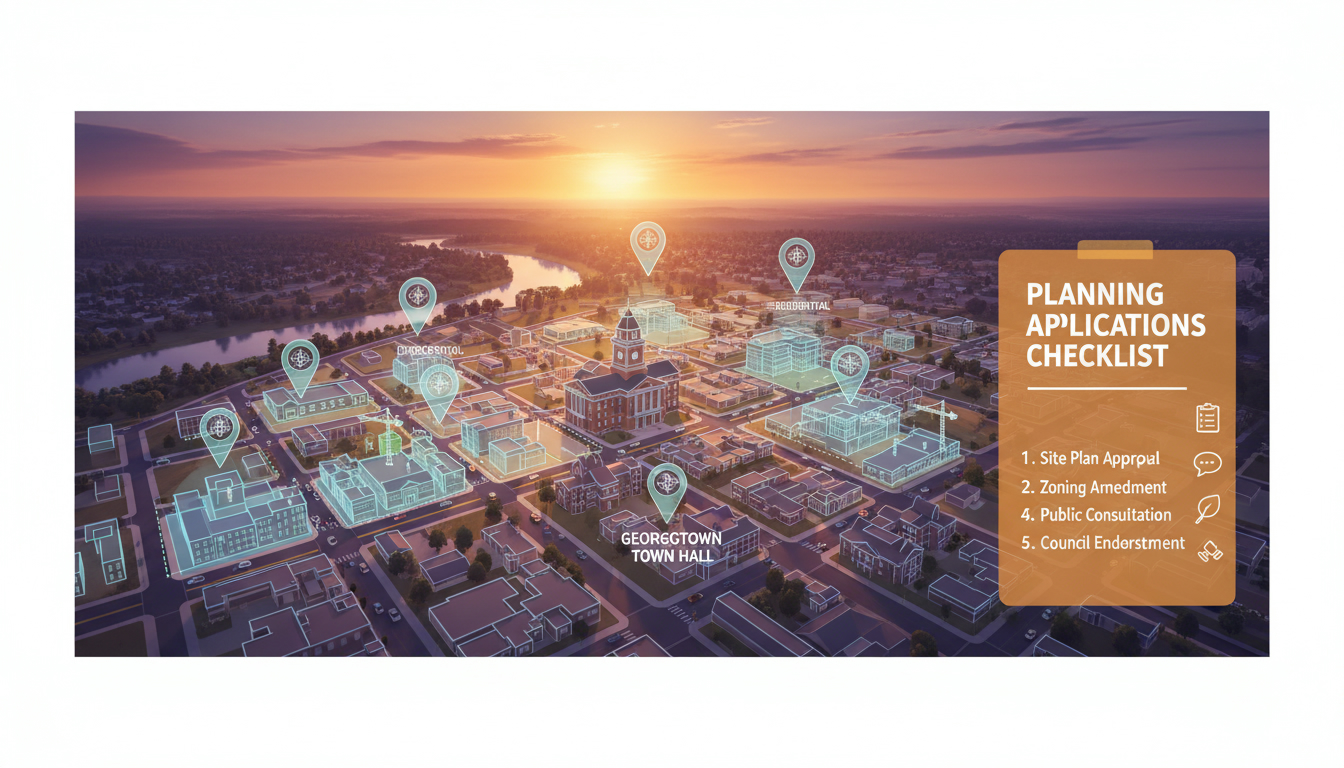
How do I find upcoming urban development plans?
Want to uncover every upcoming urban development plan in Georgetown, ON — before your neighbour does?
Find Every Upcoming Urban Development Plan in Georgetown, ON — Before It Changes Your Home Value
If you sell a home in Georgetown, ON, and you don’t know what developments are coming, you leave money on the table. This guide gives you an exact, practical playbook to find upcoming urban development plans in Georgetown, Ontario — fast. No fluff. No theory. Real steps, local resources, and a seller-focused game plan.
Why this matters for home sellers
- Upcoming developments change demand and comps. New condos or commercial nodes can push values up or down.
- Zoning changes and intensification plans affect who will want your home.
- Major infrastructure (transit, schools, roads) alters buyer priorities and time-on-market.
If you plan to sell in the next 6–24 months, you must know what’s moving through the planning pipeline.
Quick overview: where development info lives (Georgetown-specific)
- Town of Halton Hills — Planning & Development pages (current planning applications, public notices, council agendas).
- Halton Region — regional planning documents and infrastructure plans.
- Town Council agendas & minutes — decisions on Official Plan amendments and major projects.
- Committee of Adjustment / Planning Committee reports — minor variances and significant applications.
- Ontario’s Planning Act & public consultation notices — required public meetings and timelines.
- Local news outlets and Facebook community groups — early community reactions and project leaks.
Each source gives a different piece of the puzzle. Use them together.
Step-by-step action plan: Find upcoming development plans in Georgetown, ON
Follow this checklist. It’s step-by-step and built for sellers who need answers now.
1) Start with the Town of Halton Hills website
- Go to the Planning & Development section. Look for “Current Applications” or “Development Applications.”
- Download or bookmark the list and map. Town lists include file numbers, applicant names, project type, and status.
- Note application types: Official Plan amendments, zoning by-law amendments, plans of subdivision, site plan controls, and condominium applications.
Why: The town is first-party. These are the files that will become approvals or public hearings.
2) Check Council agendas and planning committee minutes
- Find the Council agenda archive on the Town site. Search for “Georgetown” or project addresses.
- Agenda reports include staff recommendations, timelines, and conditions that affect approvals.
- Mark public meeting dates and appeal windows on your calendar.
Why: Public meetings are where changes happen and where sellers should pay attention.
3) Use Halton Region planning resources
- Halton Region reviews many applications for servicing and regional policy alignment.
- Check their mapping tools and infrastructure projects list. Regional sewer, transit, or major road work can reshape neighbourhood demand.
Why: Region-level infrastructure can influence where buyers look and how quickly projects move.
4) Search the Ontario Land Registry & Planning Act notices
- Public notice requirements are governed by the Planning Act. Developers must publish notices for official plan and zoning changes.
- Check municipal notice boards, local newspapers, and the Town’s public notice page.
Why: Formal notices give you legal timelines and appeal windows.
5) Monitor Committee of Adjustment and Site Plan Control submissions
- Minor variances and site plan submissions often signal infill or multi-unit midrise builds.
- These applications can be found on the Town site or by contacting the Planning department.
Why: Small projects cluster and often precede larger redevelopment waves.
6) Use the mapping tools and GIS layers
- The town and region often have interactive maps showing planning designations, development applications, and environmental constraints.
- Use these maps to see which properties near yours are slated for change.
Why: Visual context helps you estimate scope and impact.
7) Follow local media, community groups, and realtor networks
- The Independent & Free Press and community Facebook groups often report early and include resident feedback.
- Realtors and planners share tips in localized MLS remarks and association newsletters.
Why: Community sentiment affects buyer interest; early buzz can be an advantage for pre-marketing.
8) Call the planning department — ask direct questions
- Get the planner assigned to specific applications. Ask about timelines, outstanding studies, and likely conditions.
- Ask: “Will this affect parking, traffic, schools, or shadowing for nearby homes?”
Why: Direct answers cut through vague public notes.
How to use this information to sell smarter in Georgetown
1) Reprice with foresight
- If a new intensification corridor is approved near your home, price competitively to capture demand.
- If a commercial rezoning is likely to reduce residential appeal, adjust expectations or highlight countervailing benefits.
2) Time your listing
- If a major approval is pending, consider delaying 3–6 months if approval will raise values.
- If negative impact is imminent, accelerate your timeline and focus on target buyers who value the neighbourhood now.
3) Market with local context
- Use development info in your marketing: “Near future mixed-use redevelopment” or “steps from upcoming transit investment.” Be factual and cite public sources.
- Buyers who want investment upside will react to accurate, sourced statements.
4) Disclose appropriately
- Follow legal obligations for disclosure. If asked directly about nearby applications, provide facts and links to public notices.
5) Stage for new buyer profiles
- Anticipate buyer types: condos attract investors and downsizers; new retail attracts younger buyers who want walkability. Stage rooms to match.
6) Negotiate contract terms around uncertainty
- Use shorter closing periods if a nearby approval could change comps. Or include protection clauses tied to specific development milestones.
Local signals to watch in Georgetown
- Intensification along major corridors and near GO/transit.
- Site plan control applications in downtown Georgetown.
- New medium- to high-density condo applications within 1–2 km of downtown or transit.
- Infrastructure projects from Halton Region (roads, sewers).
- Changes to the Halton Hills Official Plan or local zoning by-laws.
Each signal should change your pricing, marketing, or timing strategy.
Tools & quick links (bookmark these)
- Town of Halton Hills — Planning & Development (search: “Halton Hills planning applications”)
- Halton Region Planning — maps and infrastructure projects
- Town Council agendas & minutes — public meeting schedules
- Ontario Planning Act information — public notice rules
If you want direct links and I’ll create a one-page packet with the exact application file numbers near your address.
Why work with a local expert who tracks this daily
Knowing where to click isn’t the same as knowing what matters. I monitor Georgetown planning files daily. I translate planning code into market action: what to price, when to list, how to message buyers. For sellers, this turns risk into strategy.
Tony Sousa is a Local Realtor in Georgetown, ON, who specializes in neighborhood and location intelligence. Contact Tony for a tailored development impact report and a seller strategy: tony@sousasells.ca | 416-477-2620 | https://www.sousasells.ca
FAQ — Urban development plans and selling your home in Georgetown, ON
Q: Where can I find official planning application documents for Georgetown?
A: Start with the Town of Halton Hills Planning & Development pages. Look for “Current Applications” or “Development Applications.” Council agendas and planning committee reports give details and staff recommendations.
Q: What is the difference between the Town and Halton Region planning documents?
A: The Town handles local zoning and site plan control. Halton Region manages regional infrastructure and policies that affect servicing and long-term growth. Both matter for home values.
Q: How will a new condo near downtown affect my house price?
A: It depends. New condos can attract buyers and raise demand, or they can shift buyer preferences away from standalone homes. Evaluate scale, timing, and the buyer profile for the new development.
Q: How far in advance are developers’ plans visible to the public?
A: Developers must submit public notices for certain application types. You can see many applications months to years before construction. Major infrastructure notices are posted early in the planning process.
Q: Should I delay selling until a nearby development is complete?
A: Not always. If approval will likely increase values and you can wait, delaying can help. If a project creates uncertainty or makes your property less desirable, selling before construction can be smarter.
Q: Can a buyer back out if a development near my home is approved after offer?
A: Buyers and sellers negotiate terms. Approval alone doesn’t void a sale. But buyers can include clauses tied to development milestones. Work with your realtor and lawyer to manage risk.
Q: How accurate are town mapping tools?
A: They are accurate for planning designations and applications but don’t predict final approvals. Use maps with agendas and staff reports for full context.
Q: How can I get a custom development impact report for my property?
A: Contact Tony Sousa — he will pull current planning applications, timelines, and likely market impact for your exact address.
If you want the exact planning applications near your address and a seller’s strategy built off those files, email tony@sousasells.ca or call 416-477-2620. I’ll deliver a one-page impact report with file numbers, timelines, and a suggested listing plan.