
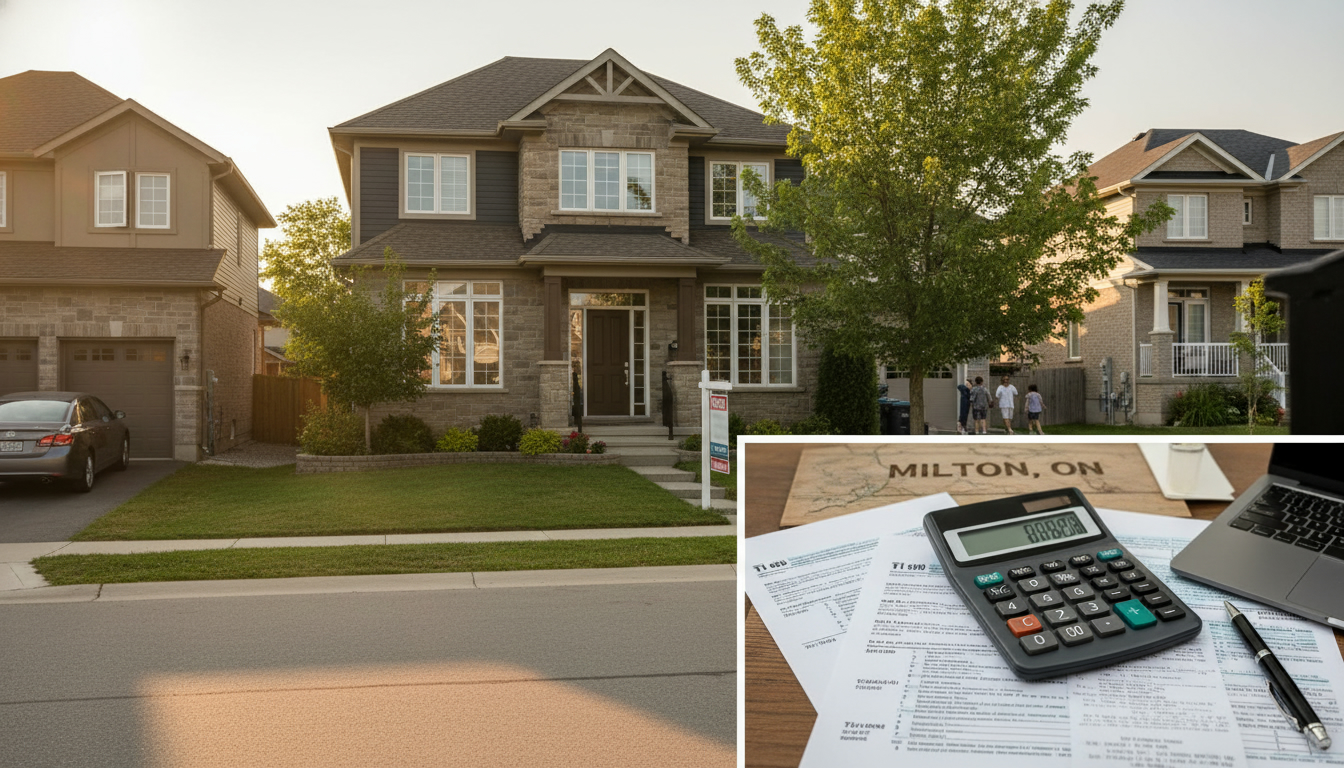
How are investment properties taxed?
How are investment properties taxed? — Milton investors, read this before your next purchase.
Quick answer
Investment properties are taxed as income by the Canada Revenue Agency (CRA). You report rental income, deduct eligible expenses, and pay tax on the net income. When you sell, you generally pay tax on 50% of the capital gain. In Ontario you also face Land Transfer Tax at purchase, municipal property taxes while you own the asset, and special rules for HST, non-resident sellers, and change-of-use situations. This guide focuses on what matters for investors in Milton, Ontario — practical, local, and actionable.
Why Milton matters
Milton is growing fast. Rapid appreciation, new builds, and rental demand change the math. That growth creates tax traps and opportunities: higher MPAC assessments, development charges baked into prices, and frequent purchases of new homes (which triggers HST). Know the local rules and plan before you sign.

Rental income: what to report and how
- Report gross rent on your T1 using form T776 (Statement of Real Estate Rentals).
- Include all amounts received: monthly rent, lease deposits applied to rent, tenant-paid utilities you collect, and other services tied to the property.
- Do not forget incidental income: parking fees, late fees, laundry revenue.
Tax point: keep clean records. The CRA expects clear backup. If you can’t prove an expense, you won’t get the deduction.
Legit deductible expenses (what reduces taxable rental income)
Claim everything reasonable and directly related to earning rental income:
- Mortgage interest and bank charges (interest portion only)
- Property taxes (municipal + education portions shown on your bill)
- Insurance premiums for the rental
- Repairs and maintenance (routine fixes; not major renovations)
- Utilities you pay (heat, hydro, water)
- Property management fees and advertising
- Accounting, legal and professional fees
- Strata or condo fees for condos
- Office expenses and vehicle costs if used to manage the rental
Note: Major improvements are capital in nature and not deductible as repairs. They add to the capital cost and affect CCA calculations.
Capital Cost Allowance (CCA) — use it carefully
CCA lets you claim depreciation on the building and certain capital items to reduce taxable income now. But don’t auto-claim CCA:
- Claiming CCA lowers taxable income while you hold the property.
- When you sell, any CCA claimed is subject to recapture (taxed as income).
- If you want to minimize immediate tax and keep a clean long-term capital gains profile, sometimes it’s better not to claim CCA.
Rule of thumb: if you plan to sell soon or convert the property back to personal use, talk to your accountant before claiming CCA.
Selling the property — capital gains and non-resident rules
- Capital gains: 50% inclusion rate in Canada. Gain = sale price minus adjusted cost base (ACB) and selling costs.
- Principal residence exemption does not apply to rental properties unless the property was your principal residence for all or part of the period. Declaring part-time principal residence periods requires careful math (change-of-use rules apply).
Non-resident sellers: buyers must withhold a portion of the sale proceeds (usually 25%) unless the seller gets a Certificate of Compliance from CRA. This is a big cash-flow shock for foreign investors. Plan the sale with a tax lawyer or accountant.

Land Transfer Tax and buying in Milton
- Ontario Land Transfer Tax applies to all purchases and is calculated on a sliding scale based on purchase price.
- Toronto charges an extra municipal LTT; Milton does not. That makes Milton cheaper on closing costs than Toronto.
- Budget for LTT, legal fees, and adjustments at closing.
Property assessment, MPAC, and municipal property taxes in Milton
- MPAC (Municipal Property Assessment Corporation) sets assessed values in Ontario. Municipal tax rates are applied to the assessed value to produce your property tax bill.
- Milton’s tax bill includes municipal and education portions; Halton Region may have levies that appear on your bill.
- If you believe your assessment is too high, file a complaint with MPAC within deadlines.
Local factor: rapid growth often leads to upward reassessments in Milton. Rising assessments drive tax bills up even if your rate stays constant.
HST, new builds, and short-term rentals
- HST applies to new residential properties (new builds) and to short-term accommodation (like Airbnb) in most cases.
- Buying a resale residential property is typically HST-exempt. Buying a new build often exposes you to HST; a partial rebate may be available for eligible purchasers.
- Short-term rentals are treated more like a business. If your HST-taxable supplies exceed the registration threshold (or you choose to register), you must collect and remit HST and may claim input tax credits.
Local action: check Milton bylaws for short-term rental licensing and zoning. The municipal rules can change your tax and compliance burden dramatically.
Corporations vs personal ownership
- Owning rental property inside a corporation changes taxation:
- Rental income taxed at corporate rates (which may be higher or lower depending on structure).
- Capital gains inside a corporation don’t get the capital gains exemption available to individuals.
- Extracting profits (dividends) creates additional personal tax.
- Corporations can make sense for scale or for liability/isolation purposes. They add complexity and costs.
Decision trigger: if you own multiple properties or are building a portfolio, model both structures with your CPA.

Unique Milton financial considerations
- Rapid appreciation and development mean higher future MPAC reassessments.
- New subdivisions and builders often include HST for new builds and higher development charges.
- Commuter demand (to Toronto) affects rental yields and vacancy cycles — plan for volatility in occupancy.
Simple tax strategies that actually work
- Keep meticulous records. Use accounting software and keep receipts.
- Claim all legitimate expenses. Don’t miss property taxes, legal fees, and management costs.
- Delay claiming CCA unless you understand the recapture risk.
- Consider a cost-segregation-like approach: identify assets that can be depreciated faster for short-term shelter of income (work with your accountant).
- If you’re non-resident or buying with foreign partners, get specialized tax advice before closing.
Action checklist for Milton investors (do this now)
- Get an up-to-date MPAC assessment and compare to recent sales.
- Ask your lawyer to estimate Ontario Land Transfer Tax before offer acceptance.
- Confirm HST exposure on new builds and short-term rental rules for Milton.
- Decide early if you’ll claim CCA; document your choice.
- Keep a separate bank account and detailed records for each property.
- Consult a Milton-based CPA to model after-tax cash flow for your deal.
FAQs — quick answers every Milton investor needs
Do I pay tax on rental income in Milton?
Yes. Rental income is taxable to the owner and must be reported on your Canadian income tax return (T776).
Can I deduct mortgage principal payments?
No. You can claim the interest portion of mortgage payments as an expense, not the principal.
Is HST charged when I buy a rental property in Milton?
If it’s a resale residential property, it’s generally HST-exempt. New builds and short-term rental services may trigger HST. Always confirm with your lawyer and accountant.
What about Land Transfer Tax in Milton?
Ontario Land Transfer Tax applies on purchase. Milton does not charge a municipal LTT (unlike Toronto). Budget for the provincial LTT at closing.
How does MPAC affect my taxes?
MPAC sets assessed value. Your municipal tax bill = assessed value × tax rate. If the assessed value rises, your taxes rise even if the rate stays the same.
Should I claim CCA every year?
Not automatically. CCA reduces taxable income now but causes recapture on sale. If you plan to sell or switch to personal use, consult your accountant.
I’m a non-resident. Do special rules apply when selling?
Yes. Buyers may be required to withhold part of the sale proceeds unless the seller obtains a CRA Certificate of Compliance. Get expert help before selling.
Is it better to hold property personally or in a corporation?
It depends. Corporations offer liability separation and tax planning options but complicate extraction of profits and remove access to the capital gains exemption. Run the numbers with a CPA.

Final word — don’t guess with taxes
Milton’s market moves fast. One wrong tax decision can erase a year of rent. Be proactive: model your after-tax cash flow, lock in advice before closing, and use local experts who know Milton’s municipal rules and MPAC patterns.
Tony Sousa is Milton’s local real estate advisor who pairs market experience with tax-aware investing. If you want a quick consult on a property, email tony@sousasells.ca or call 416-477-2620. Visit https://www.sousasells.ca for listings and local insights.
If you want a checklist emailed or a quick property tax estimate for a Milton address, reach out — I’ll get you the numbers, fast.