How do I research local crime statistics?
Want to check Milton crime stats in 10 minutes and know if a neighbourhood is safe? Here’s the exact playbook.
Why researching Milton crime statistics matters
You want to buy a home, rent, or move a family. Numbers beat feelings. Crime stats give context. They show patterns. They help you ask the right questions. This post cuts the chase. Follow the steps and you’ll know how safe a Milton street really is.
Who this guide is for
- Home buyers and sellers in Milton, Ontario
- Renters choosing a neighbourhood
- Investors tracking risk and resale value
- Neighbours curious about trends
If you want clear, actionable steps — keep reading.
The concise plan (read this first)
- Start with Halton Regional Police Service (HRPS) online tools.
- Pull official data from Statistics Canada for context and rate comparisons.
- Use local open-data maps and crime heatmaps for street-level view.
- Compare timeframes and rates per capita, not just raw counts.
- Validate with community sources and call HRPS for specifics.
Do those five things and you’ll know more than most buyers.
Step 1 — Official source: Halton Regional Police Service
Go to the Halton Regional Police Service website. They publish annual reports, monthly stats, and sometimes interactive maps. Why start here? Because this is the primary reporting agency for Milton. It’s the nearest-to-source data.
What to pull:
- Police-reported incident counts by type (violent, property, drug, traffic).
- Monthly or yearly trend charts.
- Public safety notices and community alerts.
How to use it:
- Look at the last 12–24 months.
- Identify spikes. Ask what caused the spike: policing changes, reporting drives, or real events.
- Note the boundaries used. Police divisions don’t always match real estate neighbourhoods.
Step 2 — Stats Canada: crime rates and the Crime Severity Index
Statistics Canada publishes the Uniform Crime Reporting (UCR) Survey and Crime Severity Index (CSI) by police service and sometimes by municipality.
Why this matters:
- CSI weights crimes by seriousness. It helps you understand risk quality, not just quantity.
- Rates per 100,000 population let you compare Milton to other communities.
How to use it:
- Pull Milton or Halton Region CSI for the last 3–5 years.
- Compare Milton’s CSI to nearby cities and provincial averages.
- If CSI drops while totals rise, less serious crimes drove the increase.
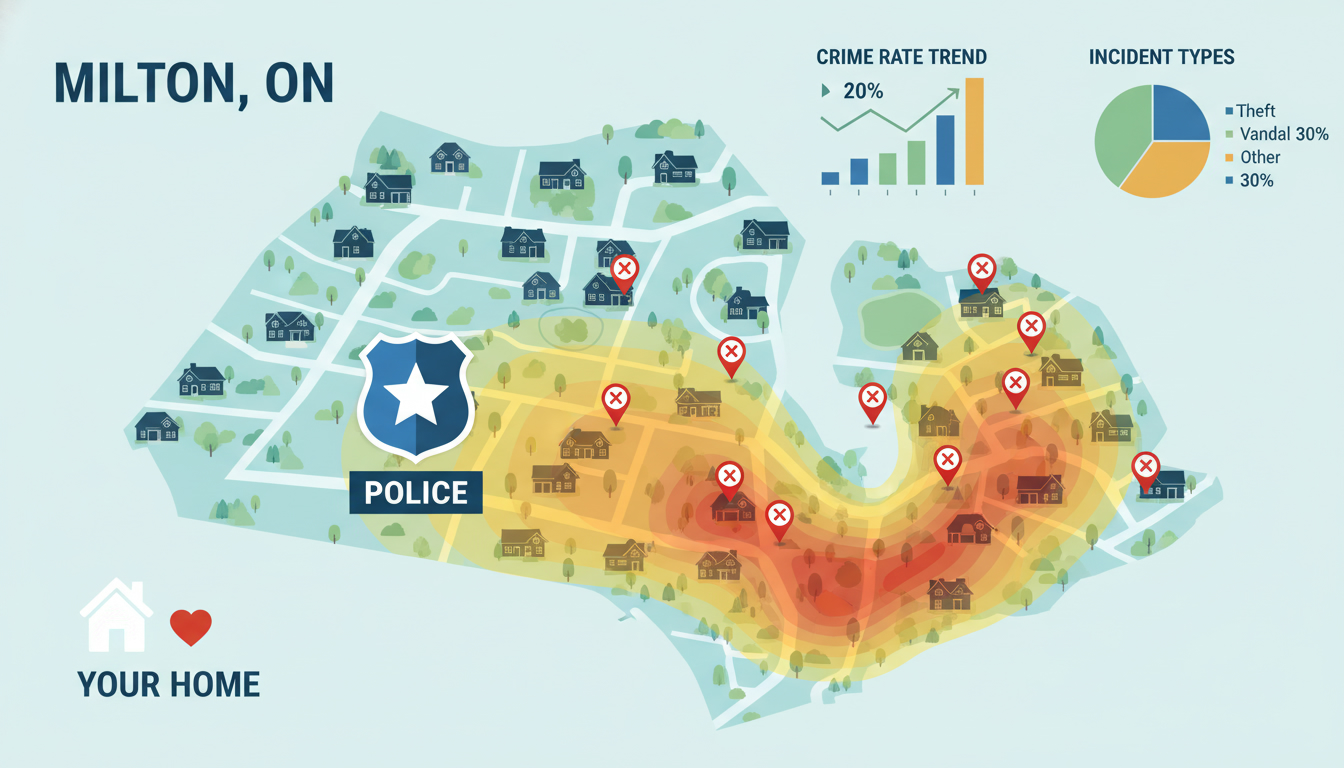
Step 3 — Use crime maps and open-data portals for street-level insight
A neighbourhood-level picture beats a town-wide stat when you care about a street or block.
Where to look:
- Halton Regional Police Service crime map or incident map (if available).
- Halton Region or Town of Milton open data portals for local calls-for-service.
- Third-party map sites that aggregate police reports (use cautiously and verify).
How to read maps:
- Zoom to postal codes (forward sortation areas) or major intersections.
- Check both points and heatmap layers.
- Look for repeated pins near parks, transit hubs, and commercial zones.
What to watch for:
- Clusters that persist over months.
- Seasonal patterns (vacations can drive break-ins, winter can change patterns).

Step 4 — Interpret metrics correctly: counts vs rates vs trends
Raw counts lie. A small neighbourhood with 10 incidents has different risk than a city with 100.
Key metrics:
- Counts: raw number of incidents. Good for volume.
- Rates per 100,000 residents: adjust for population size.
- Crime Severity Index: weights by seriousness.
- Year-over-year percentage change: shows trend.
Rule of thumb:
- Prioritize trends and rates over absolute counts.
- Look at the last 3–5 years for context.
- Ask whether changes are due to reporting practices or actual safety shifts.
Step 5 — Verify with community sources and on-the-ground checks
Numbers don’t tell everything. Talk to real people.
Who to ask:
- Local community associations.
- Neighbourhood Facebook groups and Nextdoor (read posts, not just headlines).
- Local businesses and schools.
- Realtors who work in Milton daily.
What to verify:
- Whether a spike was a one-off event.
- Whether police presence or community programs reduced risk.
- How safe streets feel after dark.
Step 6 — Request detailed data when you need it
If you need deeper granularity, file a request.
Options:
- Contact HRPS for neighbourhood-level breakdowns.
- Use Ontario’s open data portals.
- Make a Freedom of Information (FOI) request for detailed files if needed.
Be specific: dates, types of incidents, and geographic boundaries.
How to use this intel when buying or renting in Milton
- Focus on 3–5 years of trends, not 12 months alone.
- Compare similar neighbourhoods on a per-capita basis.
- Use local crime patterns to choose streets with fewer late-night hotspots (bars, transit nodes).
- Ask the seller or listing agent for incident history for the property and immediate block.
If you want a tailored neighbourhood safety report, I provide it free to serious buyers. Contact me at tony@sousasells.ca or 416-477-2620.
Common pitfalls and how to avoid them
- Mistaking higher reporting for higher crime. Increased reporting can be a sign of more community engagement.
- Relying on a single year of data.
- Trusting third-party map sites without cross-checking official sources.
Quick checklist to research Milton crime stats (10-minute version)
- Open Halton Regional Police Service site: scan latest monthly report.
- Pull Statistics Canada CSI for Halton/Milton.
- Load an open-data crime map and zoom to the street you care about.
- Compare rates per 100,000 for similar neighbourhoods.
- Check local community group posts for recent context.
- Call HRPS non-emergency line with specific questions.
Do this and you’ll move faster and smarter.
Why local expertise matters
Numbers are tools. Interpreting them requires local context. I’ve worked with dozens of Milton buyers and sellers. I translate stats into real decisions: where to buy, which streets to avoid, and how safety affects resale. If you want the report done for you, email tony@sousasells.ca or call 416-477-2620.
FAQ — Researching crime data in Milton, ON
Q: Where do I find official Milton crime statistics?
A: Start with Halton Regional Police Service. Supplement with Statistics Canada (UCR and CSI) and the Halton/Milton open data portals.
Q: What is the Crime Severity Index (CSI) and why use it?
A: CSI is a StatsCan metric that weights crimes by seriousness. Use it to compare the quality of crime over time and across regions.
Q: Can I see crime incidents on a map for Milton?
A: Yes. Use HRPS incident maps if available and the municipal open-data portal. Third-party maps exist but always verify against official sources.
Q: How do I compare neighbourhoods fairly?
A: Use rates per 100,000 residents and look at 3–5 year trends. Compare similar-sized areas and account for population density.
Q: Are online crime maps always accurate?
A: No. Some third-party aggregators can lag or misclassify incidents. Always cross-check with HRPS or Statistics Canada.
Q: How often is crime data updated?
A: It varies. Police services may update monthly; StatsCan updates annually. Open-data portals can be more frequent.
Q: Should I worry about small spikes in crime?
A: Not necessarily. Look for sustained trends. One-time spikes may be isolated incidents.
Q: Can I request detailed crime files for a specific address?
A: You can request data from HRPS. For confidential or sensitive details, FOI processes may apply.
Q: How does crime affect property values in Milton?
A: Long-term higher crime rates can pressure values. Short-term spikes usually have a limited effect unless they signal a persistent trend.
Q: What else matters besides crime stats?
A: Street lighting, foot traffic, nearby commercial activity, school quality, and community programs all affect real safety.
If you want a custom Milton neighbourhood safety report, I’ll pull the HRPS data, StatsCan context, and a street-level map — and explain what it means in plain language. Contact me: tony@sousasells.ca | 416-477-2620 | https://www.sousasells.ca
I don’t do fluff. I give the facts, the interpretation, and the decision steps. Use them to buy or move with confidence.