How close are essential services like hospitals and grocery
stores?
How close are essential services like hospitals and grocery stores? The blunt truth you need before you sell.
Sell Faster in Milton: Proximity Sells Homes
If you want offers, stop hoping buyers will find the value. Show it. In Milton, ON, where growth is fast and buyers are picky, how close your home is to hospitals, grocery stores, pharmacies and schools changes everything. I’ll cut through the fluff and give you clear facts, marketing moves, and pricing insights you can use this week.
Why proximity matters more than curb appeal alone
Buyers don’t buy paint. They buy convenience, safety, and a lifestyle they can picture quickly. Proximity to essential services turns a house into a practical, low-stress choice.
- Emergency access = peace of mind. When Milton District Hospital or urgent care is nearby, families and older buyers pay for that peace.
- Daily convenience = repeat value. Grocery stores, pharmacies, and schools reduce daily friction. That translates to higher demand.
- Commuter time + local services = math buyers use. If your home saves 10–20 minutes per trip, that adds up. Buyers do the math.
Make this simple in your listing: distance, drive time, and a map. Buyers read numbers. They act on them.
Milton reality: Where are hospitals and groceries, really?
Milton has grown rapidly. That growth brought services into many neighborhoods, but proximity varies by area.
- Milton District Hospital: the main acute-care facility serving Milton. For most central and western neighbourhoods, expect a 5–15 minute drive. Newer developments on the town’s edges can be 15–25 minutes away by car.
- Grocery stores: Major chains (Loblaws, Metro, Sobeys, No Frills) and local markets are distributed across town. In central Milton and newer mixed-use hubs, you’ll usually find a full-service grocery within 5–10 minutes. Edge neighborhoods commonly have smaller supermarkets or quick marts within 5–10 minutes, and a larger supermarket within 10–20 minutes.
- Pharmacies, urgent care clinics, and family doctors: Most are clustered near commercial corridors and plazas. In older neighbourhoods and near downtown, you can walk to many services. In outer subdivisions, these services are typically a short drive.
These are averages. Exact times depend on traffic, time of day, and your street. Use Google Maps and local traffic apps to confirm commute times for your listing.
What sellers in Milton must show in listings
Buyers want clarity. Give it to them.
- Exact drive times in minutes, not vague claims. (“Milton District Hospital — 9 minutes drive”)
- Walk score and transit options for nearby buses and GO service.
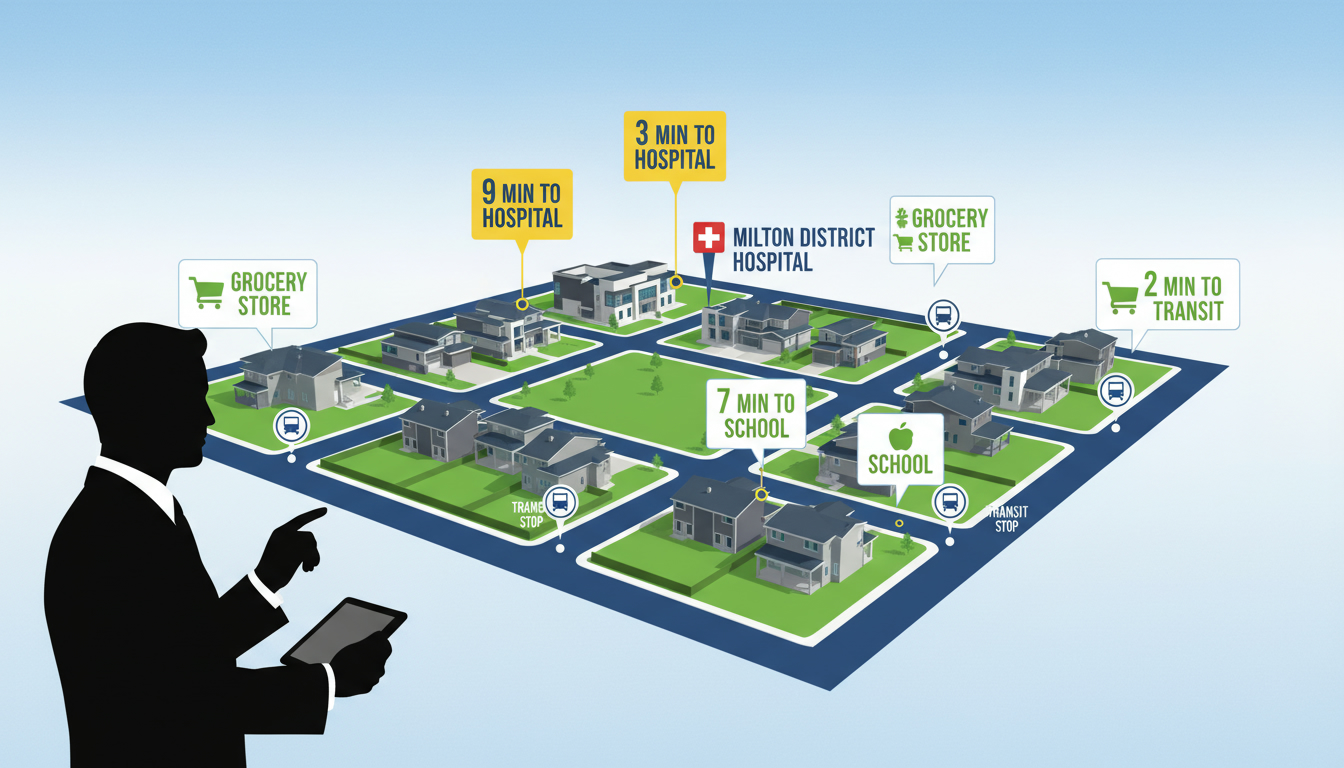
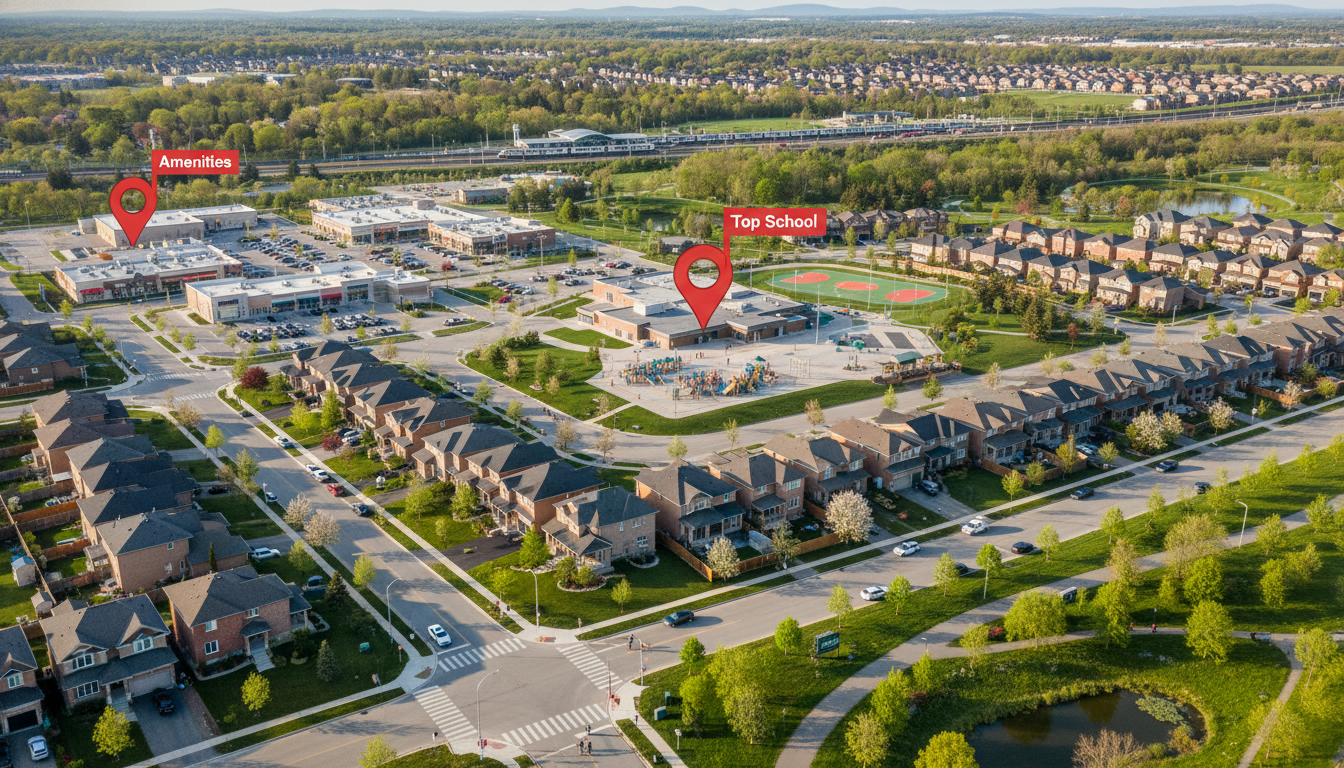
- Neighborhood map with icons for hospital, grocery, school, pharmacy.
- Photos of the nearest grocery/strip plaza and quick note about parking and hours.
Listings that put distance up front outrank and outsell those that hide it. People scan — numbers win.
Price impact: proximity is measurable value
How much is proximity worth? It depends on buyer type.
- Families with young kids: proximity to elementary schools and grocery stores can increase buyer demand and push offers higher by narrowing competition.
- Seniors and empty-nesters: proximity to hospitals, clinics, and accessible shopping is often a top priority. These buyers will pay a premium.
- Commuters: if a nearby grocery means less time running errands, the property becomes more attractive—even if the premium is smaller.
The practical way to quantify this: compare recent sales in your neighbourhood with similar homes that are closer to services. When listings are similar, being 5–10 minutes closer to a hospital or grocery can mean thousands in extra sale price because buyers simplify choices.
Neighborhood quick guide for sellers (what to highlight)
- Downtown/Old Milton: Walkable. Highlight walking distance to shops, restaurants, and the local grocery. Emphasize quick hospital access.
- New developments (east/west growth pockets): Emphasize modern amenities, planned commercial nodes, and actual drive times to the hospital and supermarkets.
- Suburban edges: Emphasize ample parking, larger grocery options within a short drive, and lower traffic. Be honest about drive times and offer a value trade: bigger yard or price per square foot.
Honesty builds buyer trust. Don’t overpromise walkability if it’s a 20-minute walk.
Tactical marketing moves that create urgency and higher offers
- Add a “Local Services Map” image in every MLS and social ad. Show hospital, grocery, schools, transit stops — with minute-based callouts.
- Lead with numbers in headlines: “9-minute drive to Milton District Hospital — Four beds, 2 baths.” Numbers stop the scroll.
- Target ads to the right buyer: families, seniors, or commuter groups. Use the service proximity as the filter.
- Use open houses to show convenience: park at the nearest plaza and walk buyers through the 3-minute grocery or pharmacy run. Make it tangible.
- Prepare a one-page “neighborhood benefits” sheet: distances, transit times, weekend farmer’s market info. Leave it at showings.
These moves take little time and lift perceived value immediately.

Preparing for buyer questions — what to have ready
- Verified drive times for peak and off-peak hours.
- Names and hours of nearest grocery stores and pharmacies.
- Wait times and hours for the local hospital’s emergency department (link to Halton Healthcare info).
- Local transit schedules and GO train/bus options if buyers commute to Toronto.
If you don’t have these, your buyer will ask — don’t guess. Verify and present.
Negotiation edge: proximity as leverage
If you have true proximity advantages, use them when buyers haggle:
- Present documented drive times and local service availability to justify firm pricing.
- Offer a small concession with a package: e.g., include a list of preferred nearby services or a one-year grocery gift card to emphasize daily convenience.
- If your home lacks nearby services, highlight compensating factors (lot size, schools, future commercial development).
Buyers negotiate with emotion and facts. Proximity supplies both.
Quick checklist for sellers in Milton
- Verify and list drive times to Milton District Hospital and nearest supermarket.
- Create a neighborhood services map for your marketing package.
- Target ads by buyer persona (families, seniors, commuters).
- Show real photos of nearby amenities in listings and social posts.
- Keep disclosures honest about walkability and traffic.
Final direct advice
If you’re selling in Milton, proximity to essential services is one of the strongest differentiators in today’s market. Use clear numbers. Use maps. Use evidence. Buyers reward clarity. That’s how you get faster offers and better prices.
If you want a quick, no-fluff analysis of your home’s proximity value and a one-week marketing plan to showcase it, email tony@sousasells.ca or call 416-477-2620. I provide a neighborhood services packet that sellers use to convert lookers into buyers.

FAQ — Common seller questions about neighborhoods, essential services, and Milton real estate
How close is the main hospital to most Milton neighbourhoods?
Milton District Hospital serves most of the town. For central neighbourhoods, expect 5–15 minutes by car. For outer subdivisions, expect 15–25 minutes. Exact times vary with traffic and time of day. Always verify with a live map for your listing.
Which Milton neighbourhoods are most walkable to groceries and pharmacies?
Older and central neighbourhoods around downtown are the most walkable. Newer mixed-use developments also offer nearby shopping. Outer suburban areas usually require a short drive. Check walk score data and be honest in listings.
Does being close to a hospital or grocery store raise my home’s value?
Yes. Proximity increases buyer demand for certain buyer types (families, seniors). The exact premium depends on local comparables. In active markets like Milton, closer proximity often improves sale speed and can raise final sale price.
How should I show proximity in my listing?
Use precise drive times, a local services map, and photos of nearby stores and clinics. Lead with numbers in your headline. Include transit options and walk scores if relevant.
What if my home is farther from services?
Be honest. Emphasize compensating benefits: larger lot, lower price per square foot, quieter streets, or planned nearby commercial development. Offer a clear commute and errand time comparison to competing listings.
Should I pay for professional maps or just use Google Maps screenshots?
High-quality custom maps look better and convert higher. A simple Google Maps screenshot works if annotated clearly with drive times. Consider a branded one-page map for print and online.
Does proximity to services matter for investment buyers?
Yes. Tenants value convenience. Properties closer to hospitals, grocery stores, and transit often have lower vacancy and can command higher rents.
How do future developments affect proximity value?
Planned commercial development can increase value over time. Confirm municipal plans and timelines, and present them as documented future benefits rather than promises.
Who should I contact for a detailed neighborhood analysis?
For a practical, data-driven neighborhood analysis and a seller marketing plan that highlights proximity benefits, email tony@sousasells.ca or call 416-477-2620. I’ll show you comparable sales, local service drive times, and a one-week plan to increase buyer interest.