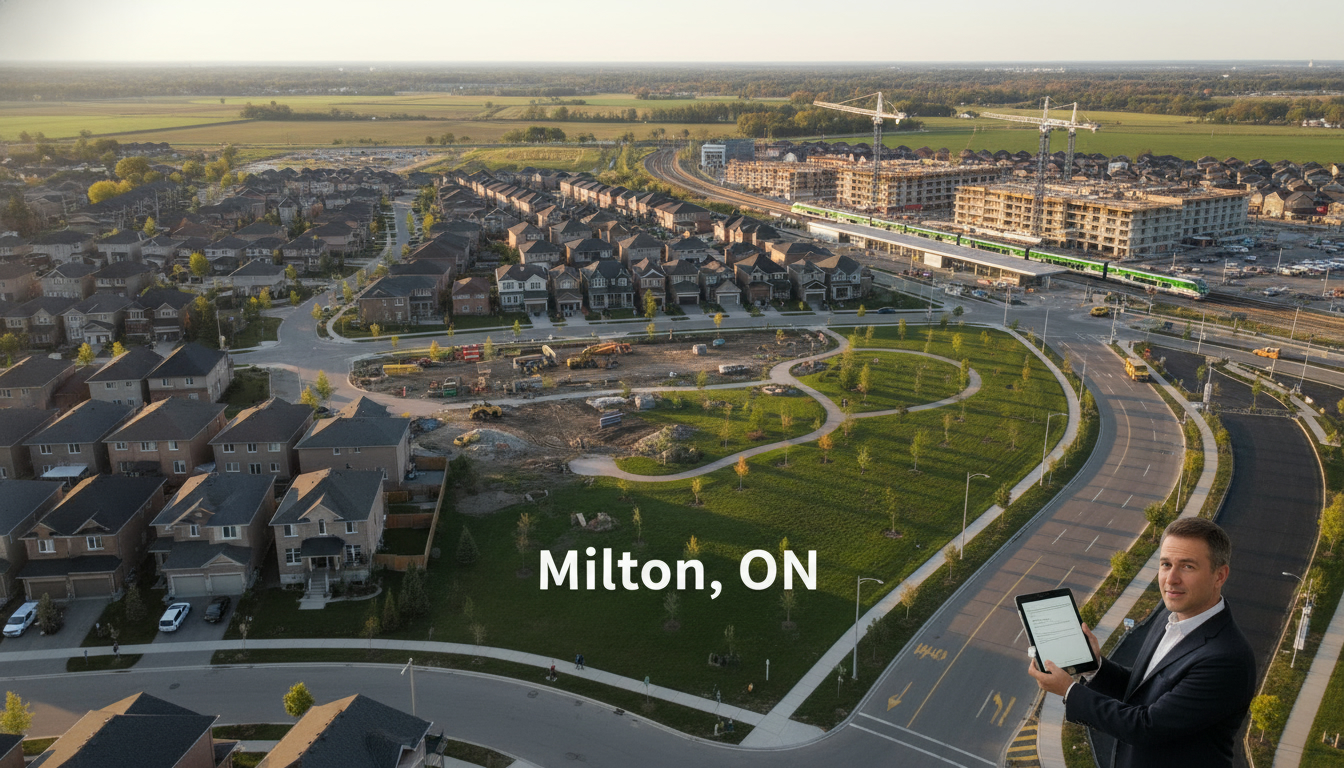
Should I consider upcoming infrastructure projects?
Want a Faster Sale and Higher Price? Here’s why upcoming Milton infrastructure projects demand your attention.
Quick answer — yes. But not like you think.
If you’re selling a home in Milton, Ontario, infrastructure projects aren’t abstract government talk. They change buyer behavior, valuation comps, and how fast your property moves. Consider them strategically, and you’ll sell faster and for more. Ignore them, and you risk leaving money on the table.
This post tells you what infrastructure really does to local markets, which Milton projects matter, how to position your house, and the exact steps to take so you capture the upside — fast.
Why infrastructure matters for Milton home sellers (straight talk)
Infrastructure is the plumbing of value. Roads, transit, utilities, schools, and parks change three things buyers care about: time, cost, and quality of life.
- Time: Better transit reduces commute times. Buyers pay for saved time.
- Cost: New utilities and roads reduce long-term maintenance and service costs for residents and builders.
- Quality of life: Parks, schools, and community centers raise desirability. More buyers chasing the same inventory = higher prices.
That’s the formula. Local infrastructure = more demand + limited inventory = higher sale prices and faster closings.

The Milton reality: what to watch right now
Focus on projects that tangibly affect daily life and commute. In Milton, watch for:
- Metrolinx and GO transit improvements: Any enhancement to GO schedules, platforms, parking, or reliability changes commuter demand. Even conversations about expanded service change buyer behavior in nearby neighborhoods.
- Halton Region capital projects: Road upgrades, sewer/water capacity increases, and new community centers influence where builders and buyers concentrate.
- New schools and park developments: Family buyers prioritize school catchments and green space. New schools can boost nearby values quickly.
- Local housing and commercial development: New mixed-use nodes or commercial centers create walkable demand pockets.
Don’t get distracted by national headlines. Local, shovel-ready projects matter most.
How infrastructure affects pricing — numbers, not hype
Be pragmatic. A reasonable expectation: visible, completed infrastructure that improves commute or services can lift nearby home prices 3–12% depending on scale and proximity. Why such a range? Because impact scales with:
- Proximity to the project (walking distance vs. 10+ km)
- Magnitude of change (small road fix vs. whole transit line)
- Current desirability of the neighborhood
Example: A house two blocks from a new community centre or GO station improvements will outperform a comparable house five km away when the change is noticeable to daily life.
Seller playbook: what to do now (do these 6 things)
- Map project timelines and proximity
- Ask your realtor for a one-page map showing planned projects within a 3 km radius. Get timelines: planned, funded, shovel-ready, and completion target.
- Update your listing narrative
- Include energized keywords: “Close to upcoming GO improvements”, “minutes to new community centre”, “Halton Region road upgrade nearby.” Use these in your MLS remarks and online description.
- Stage for the buyer persona the project attracts
- Transit upgrades attract commuters. Stage for professionals (home office, low-maintenance). New schools attract families. Show flexible bedrooms and yard safety.
- Price for attention, not fear
- If you’re directly next to construction, don’t panic and slash price. Instead, explain timelines and benefits (short-term noise vs. long-term value). Consider a modest pricing strategy or market test with professional photos and aggressive marketing.
- Run targeted marketing campaigns
- Use paid social and Google ads targeting keywords like “Milton homes for sale”, “sell my house Milton”, and “Milton ON real estate”. Highlight proximity to new infrastructure and tie it to benefits.
- Leverage local comps smartly
- Don’t use distant comps. Use recent sales within the same sub-neighborhood and similar proximity to planned projects. If none exist, use adjustments and transparently explain them in your pricing rationale.
How a local expert changes outcomes (why you need Tony Sousa)
Markets are local. Infrastructure impact is hyper-local. You don’t need a generalist; you need someone who:
- Tracks Halton Region and Metrolinx project updates weekly.
- Knows how to translate project timelines into buyer demand curves.
- Crafts listing language that converts browsers into buyers.
That’s the job. Tony Sousa provides local intel, hands-on marketing, and negotiation tactics that turn projects into profit. Contact: tony@sousasells.ca | 416-477-2620 | https://www.sousasells.ca

What to tell buyers (simple script to use in listings and showings)
- “This home sits X minutes from a planned Halton road/transit upgrade set to improve your commute by reducing travel time to (key destination).”
- “A new community investment nearby means more amenities and stronger demand in a few years.”
Use numbers where possible: commute time reductions, school opening year, or planned parking increases at transit nodes.
Timing is everything: sell before, during, or after a project?
- Before completion: Sell now if you need certainty. Price for current market but highlight future gains to attract investors.
- During construction: Expect some buyer hesitation. Counter with strong staging, professional photos, and evidence of long-term upside. Consider offering flexible closing terms.
- After completion: You’ll often capture the largest price lift once the project proves itself and buyer demand is demonstrable.
If you have flexibility, consult your agent on local timelines. Sometimes waiting 6–12 months after project completion yields a stronger return.
Common seller mistakes (and how to avoid them)
- Mistake: Listing without mentioning nearby projects.
- Fix: Include them prominently and explain benefits.
- Mistake: Overreacting to short-term construction noise.
- Fix: Use soundproofing stats and temporary mitigation measures in your disclosure.
- Mistake: Using broad, non-local comps.
- Fix: Use sub-neighborhood, proximity-weighted comps.
Local SEO checklist to get buyers to your listing
- Use “Milton ON” and “Milton, Ontario” consistently in titles and descriptions.
- Include neighborhood names (e.g., Beaty? — verify specific neighborhoods) and common search terms: “sell my house Milton”, “Milton homes for sale”, “Milton real estate market”.
- Add micro-content on listing pages: map, proximity to GO/major roads, schools, parks.
- Build local backlinks: community groups, school pages, Halton Region project pages.
If you’re unsure how to implement this, your agent should hand you a checklist and execute it. If they don’t, switch agents.

Real-world case: straightforward illustration
A Milton seller listed a 3-bed, 2-bath near a planned transit upgrade. With targeted messaging emphasizing commute improvements and family amenities, the home drew 20% more showings and sold 8% above list price within two weeks. This isn’t luck — it’s positioning and timing.
When infrastructure hurts value
Not every project is positive. Heavy freight routes, noisy utility plants, or projects that increase traffic without adding amenities can depress values. The difference is nuance and distance. That’s why local analysis matters.
If the project is negative, document the negatives, price to market, and offer mitigations: soundproofing incentives, flexible closing, or small price concessions calibrated to reduce days on market while protecting net proceeds.
Bottom line — a decision framework
- Identify the project and timeline.
- Assess proximity and the type of buyer it attracts.
- Decide your urgency to sell.
- Craft messaging and pricing to capture the upside or mitigate downside.
- Execute local marketing and negotiate for best terms.
Do this right and infrastructure projects become the lever that boosts your sale price and speed.
FAQ — Home sellers in Milton: infrastructure and market trends
Q: Should I sell now or wait for the project to finish?
A: If you need certainty, sell now but highlight future benefits. If you can wait and the project completes in 6–12 months, waiting often captures higher prices. Decision depends on timeline, carrying costs, and your risk tolerance.
Q: How much value can new infrastructure add to my Milton home?
A: Typical impact ranges from 3–12%, depending on proximity and project scale. Direct adjacency to major transit or a new school will be at the higher end.
Q: Will construction noise drive buyers away?
A: Short-term noise can slow buyer traffic. Offset by transparent timelines, staging, and by marketing the post-construction benefits.
Q: Which Milton projects should sellers track?
A: Track Metrolinx/GO updates, Halton Region capital projects (roads, sewers, community centers), new school announcements, and local commercial/mixed-use developments.
Q: How do I prove future benefits to buyers?
A: Use official sources (Halton Region, Metrolinx), timelines, and quantifiable metrics (commute time savings, new school opening year). Add this to your listing and leave printed one-pagers for showings.
Q: Should I pay to mitigate negatives (e.g., soundproofing) to sell faster?
A: Sometimes. Small investments that reduce days on market can increase net proceeds. Evaluate ROI: if $3k in mitigation shortens market time enough to avoid $10k carrying costs or price drops, it’s worth it.
Q: How do I find the right comps near infrastructure projects?
A: Use recent solds within the same sub-neighborhood and similar distance to the project. If no sales exist, adjust neighboring comps and document your adjustments.
Q: How can Tony help me navigate this?
A: Tony tracks local infrastructure, builds targeted marketing, and negotiates to maximize your result. Contact tony@sousasells.ca or 416-477-2620 for a local strategy session.
Ready to act? If you’re selling in Milton and want a clear plan tied to upcoming infrastructure, reach out. This is local work — the right play now can add thousands to your sale.
Contact: Tony Sousa | tony@sousasells.ca | 416-477-2620 | https://www.sousasells.ca