How do I research the demographics of a neighborhood?
Want to know exactly who lives in a Milton neighborhood — and use that info to buy, sell, or invest with confidence?
Why knowing neighborhood demographics matters
If you market a home, invest in rental property, or choose where to raise a family, demographics decide the outcome. They tell you who’s moving in, what they can afford, how long they’ll stay, what schools they want, and which amenities matter. Milton, Ontario is growing fast. That growth changes value, demand, and risk — and you must know the data, not guess.
This guide gives a step-by-step, no-fluff system to research neighborhood demographics. It uses free and paid tools. It explains how to apply each step to Milton, ON. Follow it and you’ll have an accurate snapshot you can use the same day.
The 7-step system to research neighborhood demographics
1) Define your question
- Are you selling to young families, investors, empty nesters, or first-time buyers? Each target needs different data (household size, income, renter rate, school catchments, commute patterns).
- Example for Milton: Are you evaluating single-family resale vs. condo near Milton GO Station? That splits buyers by commute tolerance and price.
2) Locate the exact geography
- Get the neighborhood name, postal code(s), or a specific address. Use Google Maps to draw a rough boundary.
- Match that boundary to census geographies (dissemination areas or census tracts) using CensusMapper or the Statistics Canada mapping tools.
- Why: Census tracts give reliable demographic data. Neighborhood names don’t always match statistical areas.
3) Pull base metrics from Statistics Canada
- Use the Census Profile pages for population, age distribution, household size, median household income, language, immigration status, and dwelling type.
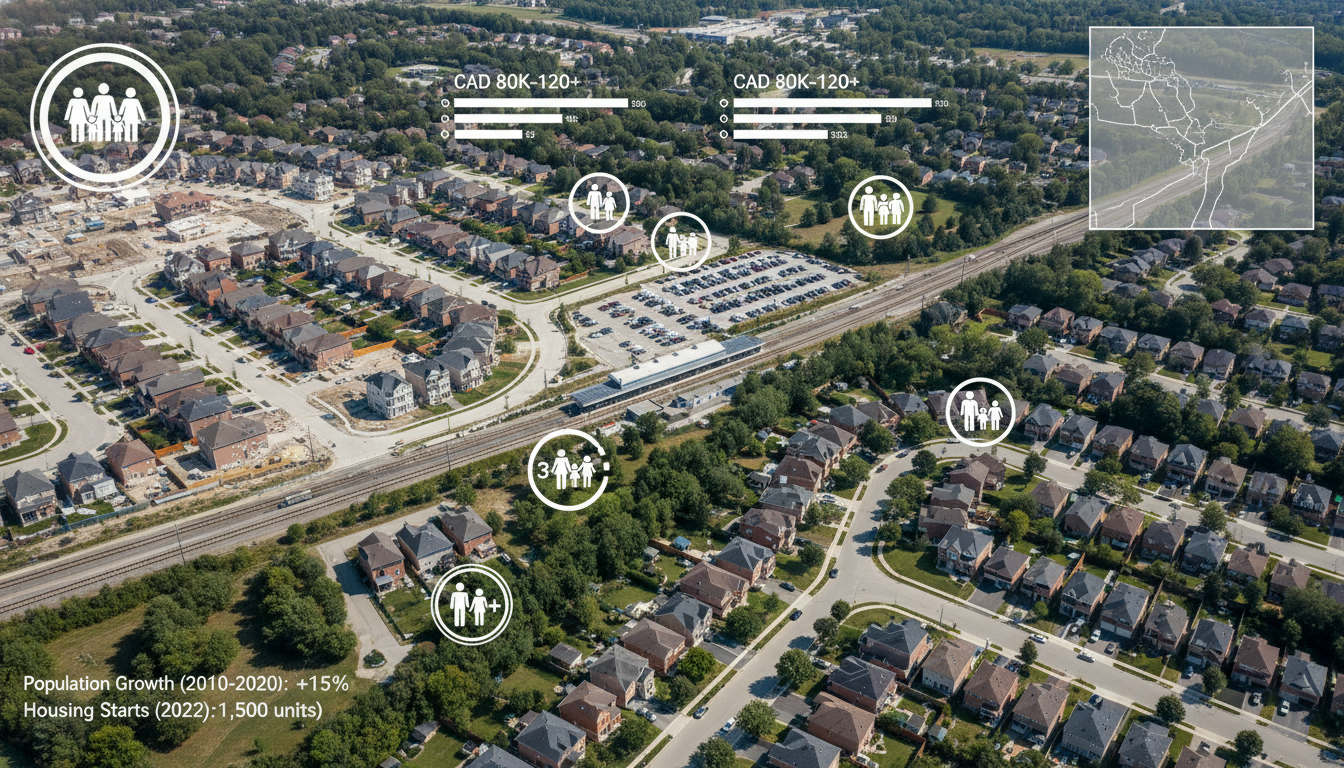
- For Milton research, check both the Town of Milton profile and the census tracts covering Beaty, Old Milton, Timberlea, and Milton Heights. Milton’s growth shows up in younger median ages and larger household sizes in new subdivisions.
4) Add housing and market context (CMHC + MLS)
- CMHC rental market reports and housing starts show rental supply, vacancy, and new construction trends — crucial for investors.
- Use REALTOR.ca and local MLS to collect current asking prices, days-on-market, and inventory by property type.
- For Milton: compare single-family listings in growth areas (Countryside, Dempsey) vs. condos near the GO station. Expect shorter days-on-market for family homes in school-focused zones.
5) Use local government and planning sources
- Town of Milton, Halton Region, and Milton Economic Development publish population growth forecasts, building permits, and major infrastructure projects.
- Building permit trends reveal where new housing will appear and where supply may depress rents or prices.
- For Milton: look for new subdivisions, commercial nodes, and transit improvements that shift demand.
6) Check amenities, schools, and commute patterns
- Use Walk Score, Google Maps, and local transit (GO Transit schedules, Milton Transit routes) to assess access to transit, shops, and parks.
- School catchment and performance (Halton District School Board, Halton Catholic) influence family demand.
- Census Journey-to-Work data shows commute modes and typical travel times. Milton commuters often head to Toronto via Highway 401/407 or GO — this impacts condo vs. house appeal.
7) Verify safety, livability, and neighborhood tone
- Consult Halton Regional Police Service crime maps for incidents and trends. Look for patterns, not single events.
- Use social channels, local community groups, and in-person observation to confirm vibes (quiet streets, busy nodes, family parks).

Tools and sources—exact places to pull data
Free sources
- Statistics Canada: Census Profile and National Household Survey
- CensusMapper (visualize census tracts)
- Town of Milton official site: planning and demographic reports
- Halton Region Open Data
- CMHC: Rental Market Reports
- REALTOR.ca and local MLS portals
- Halton Regional Police Service crime maps
- Halton District School Board / Halton Catholic School Board
- Walk Score and Google Maps
Paid or subscription sources (worth it for deep work)
- Environics Analytics or PRIZM (consumer segmentation)
- Social Explorer or Esri Community Analyst (mapping and detailed layers)
- CREA / Local MLS advanced reports
How to analyze the numbers — what to look for and why
- Population growth rate: rapid growth means opportunity but also new supply. Milton’s growth historically outpaces Ontario average. Use growth to justify holding for appreciation.
- Median age: lower median age = young families and demand for schools, larger homes. Higher median age = downsizers and condo demand.
- Household income: use to price marketing and expected purchase power. High household income supports higher price per square foot.
- Ownership vs. renter rate: investors want high renter shares; flippers prefer owner-occupied areas.
- Dwelling types and new builds: concentration of rowhouses and condos signals entry-level inventory; single-family clusters show family markets.
- Commute patterns and transit access: neighborhoods within easy GO drive to Toronto and attract commuters; those farther out need local jobs or remote-work appeal.
Apply to Milton: If an area has a high share of family households, strong school ratings, and low rental supply, it’s a seller’s market for 3+ bedroom homes. Near Milton GO and downtown, expect stronger condo demand and more renters.
Quick, repeatable checklist you can use in 30–90 minutes
- Step 1: Enter an address or postal code into CensusMapper or StatsCan — export the census tract data.
- Step 2: Pull age, income, household size, dwelling type, and ownership rate.
- Step 3: Scan REALTOR.ca for 30 recent comparable listings and record asking price, type, DOM.
- Step 4: Check CMHC rental report for vacancy and average rent.
- Step 5: Look at Town of Milton building permits for last 12 months.
- Step 6: Map schools and transit lines; verify school catchment.
- Step 7: Check police crime map and local community forums for red flags.
Do this regularly. Markets shift.
Interpreting results — three Milton scenarios and what to do
1) High-growth subdivision (new builds)
- Indicators: high building permits, rising population, younger median age, many new single-family homes.
- Strategy: buy and hold; market to young families; highlight schools and parks.
2) Transit-oriented node (near Milton GO)
- Indicators: more condos, higher renter share, commuters predominant.
- Strategy: price for commuting convenience; promote short-term rental demand carefully; investors focus on yield and tenant turnover.
3) Established core (Old Milton)
- Indicators: older housing stock, mixed ages, stable ownership.
- Strategy: target renovations to add modern features; market to downsizers and professional couples.

Mistakes people make and how to avoid them
- Mistake: Relying on anecdotes. Fix: Always confirm with data (census, CMHC, MLS).
- Mistake: Using town-wide averages for a micro neighborhood. Fix: Use census tracts or DAs to get granular.
- Mistake: Ignoring new supply. Fix: Check building permits and subdivision plans.
Local insights about Milton, ON you won’t read in a brochure
- Milton’s growth isn’t uniform. New subdivisions bring young families who value larger yards and Halton schools. That keeps demand high for 3+ bedroom homes in established and new neighborhoods.
- Proximity to Milton GO reshapes the market: condos and townhomes near the station trade differently than suburban family homes.
- Infrastructure projects in Halton Region and Town of Milton maps can shift micro-markets quickly. New schools, parks, or retail can lift nearby home values within two years.
How a local realtor adds value (and where to get help now)
A local realtor who tracks local permits, school changes, and MLS patterns saves you hours and reduces risk. If you want a custom neighborhood demographic packet for any Milton address — with census data, comparable sales, rent vs. buy analysis, and a 12-month trend — get a local expert to deliver it.
To get a custom Milton neighborhood demographic report and recommendations, contact Tony Sousa: tony@sousasells.ca | 416-477-2620 | https://www.sousasells.ca
FAQ — quick answers about researching neighborhood demographics (Milton-specific)
Q: What’s the fastest way to find a Milton neighborhood’s demographics?
A: Use an address or postal code in CensusMapper or Statistics Canada to find the matching census tract. Pull age, income, household size, and dwelling type.
Q: How often is census data updated?
A: Canada’s census runs every five years. Use it as a base, then update with CMHC, building permits, MLS, and local planning reports for current trends.
Q: Where do I find Milton-specific building permit and growth data?
A: Town of Milton planning and building pages, and Halton Region Open Data provide permits, population projections, and infrastructure plans.
Q: How do schools affect Milton home demand?
A: Strong school catchments attract families. Check the Halton District School Board catchment maps and school rankings for demand signals.
Q: How to compare two Milton neighborhoods quickly?
A: Pull key metrics for each census tract: median income, median age, ownership rate, % of 3+ bedroom homes, and recent sales price per square foot. Then compare supply (listings) and demand (days-on-market).
Q: Can I use Google Maps for demographic research?
A: Yes for amenities, transit, and walkability. But combine with census and MLS data for accurate demographics.
Q: Is Milton good for rental investment?
A: Many parts of Milton have strong rental demand, especially near transit and closer to employment nodes. Check vacancy rates in CMHC reports and rental yields via local listings.
Q: How do new subdivisions affect existing neighborhoods in Milton?
A: They raise supply, shift school demand, and can change traffic patterns. Monitor building permits and town planning notices.
Get the data. Make the decision. Move with confidence.
Need a custom Milton neighborhood demographic report with comparable sales and a rent-vs-buy model? Contact Tony Sousa at tony@sousasells.ca or 416-477-2620. Visit https://www.sousasells.ca