What websites provide accurate real estate
data?
“Which websites actually give accurate real estate data for Milton, Ontario?” — Read this first if you want answers that move deals.
Why accurate real estate data in Milton, ON matters right now
If you’re buying, selling, or advising in Milton, Ontario, bad data costs money. Not maybe — guaranteed. Milton’s market moves fast. New developments, commuter demand, and shifting inventory change values block-by-block. You need sources that are current, local, and proven.
This guide strips the noise. No fluff. No hype. You’ll get the websites that deliver real, usable data for Milton, how they differ, and how to use each to make smarter decisions.
Quick summary (read if you’re short on time)
- Realtor.ca / MLS®: The official, primary source for live listings and sold data accessible by Realtors.
- TRREB (Toronto Regional Real Estate Board): Regional market stats and reports covering Milton within the GTA.
- HouseSigma: Fast AVMs, sold history, and neighborhood analytics for Milton homes.
- GeoWarehouse (Teranet): Land registry and historical deed-level data (paid, professional-grade).
- MPAC: Assessed values used for property taxes in Ontario — useful for trends and appeal context.
- CMHC & Statistics Canada: Macro reports with rental, vacancy and demographic trends that affect Milton demand.
- Local municipal and planning portals (Town of Milton, Halton Region): Development data, new builds, and zoning that change supply.
The hierarchy of data you should trust
Not all data is equal. Here’s how I rank sources for Milton, from strongest to weakest:
- MLS® / REALTOR.ca (via a licensed Realtor)
- TRREB local reports and broker market stats
- Land registry & GeoWarehouse (transaction-level accuracy)
- HouseSigma, Zolo, Zoocasa (good AVMs and trends)
- MPAC assessed values (use with context)
- CMHC, Statistics Canada (macro lens)
- Public portals with scraped data (use cautiously)
Why the ranking? Because the MLS contains live listings, price history and sold data verified by agents. Public portals often lag, scrape, or estimate. Use them, but know their limits.

Deep dive: What each site provides and how it applies to Milton
REALTOR.ca / MLS®
- What it is: The official consumer portal fed by MLS listings.
- Why it matters: Live inventory, historic solds (when available), photos, detailed property features.
- Milton value: For current Milton listings and immediate comparables, nothing beats this. Agents pull accurate Days-on-Market (DOM), price changes, and offer dates from MLS.
- How to use it: Work with a Realtor for full access to sold data and neighborhood reports. Public REALTOR.ca is great, but the agent’s MLS interface gives the depth you need.
TRREB (Toronto Regional Real Estate Board)
- What it is: The board that aggregates transaction data across the GTA.
- Why it matters: Provides credible monthly market reports and statistics.
- Milton value: Milton sits in the TRREB zone. Their reports show region-wide trends — price direction, inventory trends, and sales-to-new-listings ratios that drive Milton pricing.
- How to use it: Watch TRREB releases for trend signals (market heating/cooling) and comparative performance within Milton vs. neighboring municipalities.
HouseSigma
- What it is: An Ontario-focused property analytics platform delivering AVMs, sold history, and neighborhood stats.
- Why it matters: Fast, user-friendly, with sold price tracking and predictive value ranges.
- Milton value: Great for instant comps in Milton neighbourhoods and visual price heatmaps. Use it to qualify leads or set initial listing ranges.
- How to use it: Use the AVM range as a sanity check alongside MLS and GeoWarehouse.
GeoWarehouse (Teranet)
- What it is: A paid platform providing land registry, deed history, and exact transaction records.
- Why it matters: Transaction-level accuracy — the gold standard for historic sales data.
- Milton value: When you need chain-of-title, exact sale dates, or past transaction amounts for Milton properties, GeoWarehouse is unbeatable.
- How to use it: Use for due diligence, probate, portfolio analysis, or when a single historic sale changes valuation.
MPAC (Municipal Property Assessment Corporation)
- What it is: Ontario’s property assessor used for taxation purposes.
- Why it matters: Provides assessed values and property characteristics used for taxes.
- Milton value: MPAC assessments help you understand municipal valuation trends. They are not market prices, but they matter for tax appeals and municipal planning.
- How to use it: Compare MPAC values to MLS and AVMs to spot discrepancies worth investigating.
CMHC & Statistics Canada
- What they are: Federal agencies providing housing, rental, demographic, and economic data.
- Why they matter: They reveal macro trends that influence Milton — migration, household formation, rental demand.
- Milton value: Use these sources when you’re analyzing long-term demand drivers: commuting patterns, population growth, or rental market viability.
- How to use it: Combine macro indicators with local supply signals from TRREB and municipal feeds.
Local municipal portals: Town of Milton & Halton Region
- What they are: Planning, building, and development data published by local governments.
- Why they matter: Inventory in Milton is heavily affected by new subdivisions, zoning changes, and infrastructure projects.
- Milton value: These portals tell you where new supply is coming from, when new schools or transit open, and which neighbourhoods are primed for appreciation.
- How to use it: Monitor planning applications, subdivision approvals, and building permit pipelines.
How to cross-check and validate Milton data (a quick framework)
- Start with MLS/REALTOR.ca for live comparables.
- Verify historic solds on GeoWarehouse or HouseSigma.
- Check TRREB for regional trend confirmation.
- Confirm supply-side changes on the Town of Milton planning portal.
- Validate valuation anomalies with MPAC and municipal tax records.
- Use CMHC/StatsCan for broader demand insights.
Do this every time you write a CMA, price a listing, or make an investment decision.
Common pitfalls when using public real estate websites
- Relying solely on AVMs for pricing a home. AVMs are estimates — good for screening, bad for final pricing.
- Ignoring days-on-market and price-change history. These reveal true seller motivation.
- Confusing assessed value with market value. MPAC ≠ market price.
- Using national portals without local context. Milton is part of the GTA, but local infrastructure and new development patterns matter.
Real-world Milton example (how an agent should use the sources together)
Scenario: You need a listing price for a 3-bed semi-detached in central Milton.
- Pull active and pending comparables from MLS (sorted by DOM and recent price changes).
- Check sold history on GeoWarehouse to confirm exact sale prices and dates.
- Run the address through HouseSigma for an AVM range and neighbourhood trendline.
- Compare with TRREB monthly averages and new list-to-sales ratio for Milton.
- Look at Town of Milton permit records to confirm whether new supply will hit the market soon.
- Present a price range to the seller based on verified MLS comps and GeoWarehouse evidence, not on a single website.
That’s how you eliminate surprises and offset negotiation risk.

Why a local expert still wins
Data is power. But power without context is noise. The difference between a good listing price and a great one is local insight: which developments are selling first, which streets command premiums, how buyers from Toronto are influencing Milton demand.
Tony Sousa (Realtor) uses MLS, GeoWarehouse, HouseSigma, TRREB, MPAC and municipal feeds every day. He translates raw data into tactical moves: timing, pricing, and marketing that outperform the market.
If you want a CMA built from the most accurate Milton data and applied to sell faster or invest smarter, contact Tony at tony@sousasells.ca or 416-477-2620. Visit https://www.sousasells.ca for immediate help.
FAQ — Milton, ON real estate data sources (short, direct answers)
Q: Is REALTOR.ca the most accurate public website for Milton listings?
A: Yes for current listings. The agent’s MLS interface is richer and more reliable for solds and history.
Q: Can I trust AVMs like HouseSigma or Zolo for pricing?
A: Use AVMs as a starting point. They’re fast and useful for screening. Always verify with MLS and deed records.
Q: Where do I find exact past sale prices for Milton homes?
A: GeoWarehouse (Teranet) and the land registry provide deed-level sale prices. Realtors can access detailed MLS sold data too.
Q: How do municipal assessments (MPAC) affect market value?
A: MPAC is for taxes. It influences appeals and perceived value, but it’s not a direct market price.
Q: Which reports show Milton’s market direction?
A: TRREB monthly reports, combined with MLS inventory and Town of Milton development feeds, give the clearest picture.
Q: Are national sites like Zillow useful in Milton?
A: They can help but often lack local completeness. Prefer Ontario-focused tools and MLS-based data.
Q: How often should I check Milton real estate data?
A: If you’re actively buying or selling: daily for listings, weekly for market trends, monthly for macro reports.
Final takeaway — what to do now
Stop guessing. Use this short stack: MLS/REALTOR.ca + GeoWarehouse + HouseSigma + TRREB + Town of Milton planning. Cross-verify every number.
If you want a professional market analysis for Milton that uses the best data and applies it to your property, reach out. Tony Sousa integrates these sources daily to create pricing and marketing strategies that work.
Contact: tony@sousasells.ca | 416-477-2620 | https://www.sousasells.ca
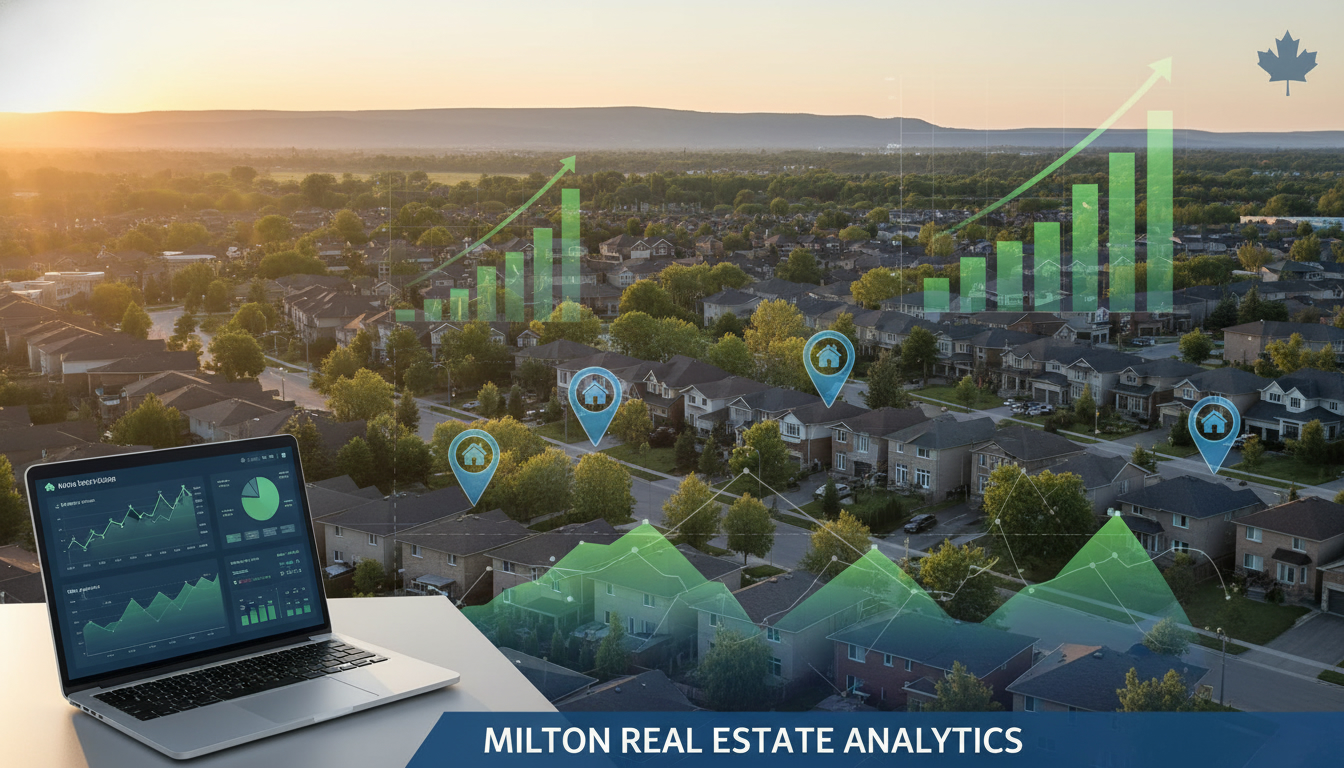
Image credits: Data visualization for illustrative purposes. All trademarks belong to their respective owners.