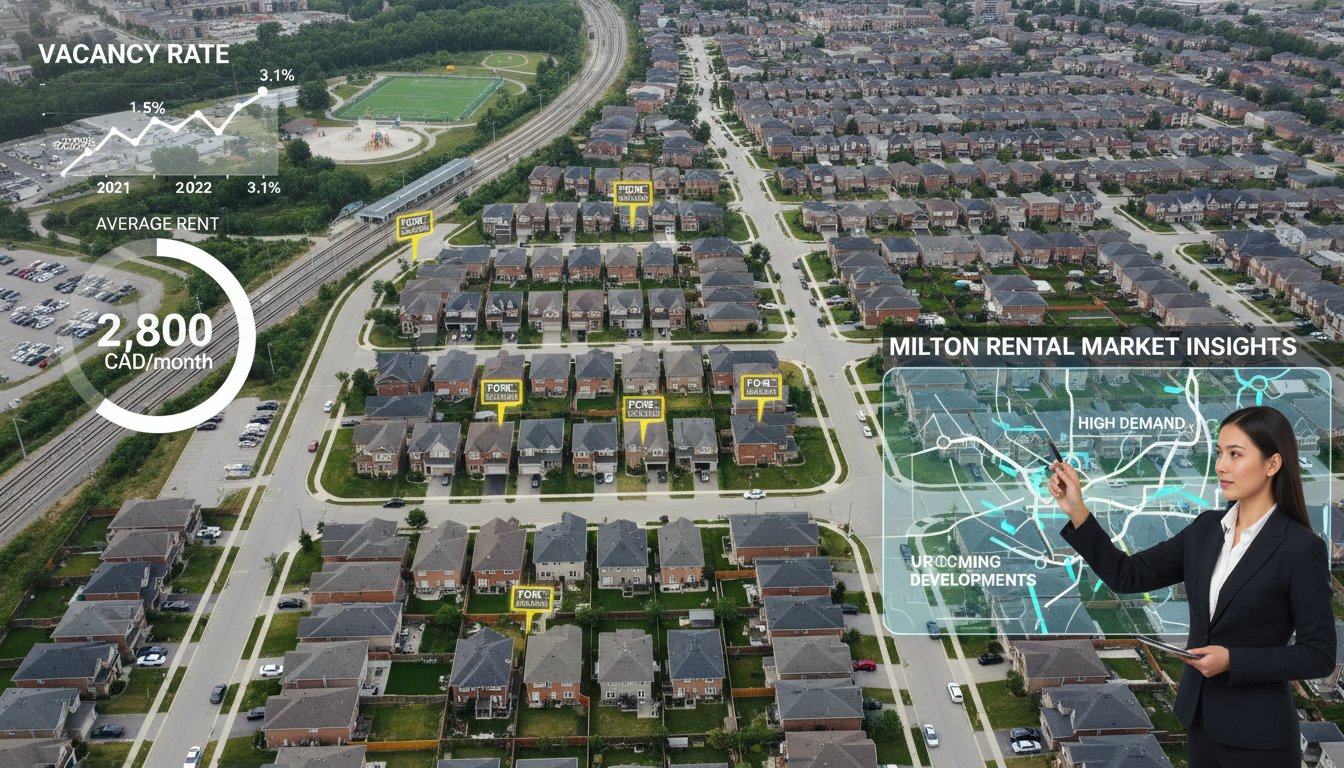
How do I assess neighborhood rental demand?
Want to know if your Milton neighbourhood will rent fast? Read this checklist and decide in 30 minutes.
Why this matters now
If you plan to buy in Milton, Ontario to rent or to flip later, neighborhood rental demand drives both cash flow and resale value. Miss the demand signals and you’ll end up with months of vacancy, a property that underperforms, or a house that’s hard to sell. Get this right and you own a predictable income stream and a property that buyers compete for when you sell.
Quick truth: data beats gut
Investing is simple: buy where demand exceeds supply and prices rise. The work is collecting the right signals and turning them into a decision. Below is a step-by-step, no-fluff system to assess neighborhood rental demand in Milton.

7-step checklist to assess neighbourhood rental demand in Milton, ON
- Check population and job growth
- Look at recent population growth in Milton and Halton Region. Strong growth means more renters.
- Track commuting patterns: proximity to GO station and major highways (easy commute to Toronto) boosts rental demand from commuters.
- Use reliable rental market data sources
- CMHC Rental Market Reports for vacancy rates and rent trends in Halton Region.
- MLS and Realtor.ca for listings and days-on-market data for rental properties in Milton.
- Rental listing sites (Zumper, PadMapper, Kijiji, RentSeeker) to see asking rents and how fast listings vanish.
- Measure current vacancy and absorption
- Vacancy rate under 3% signals tight market. 3–5% is balanced. Above 5% shows oversupply.
- Track how quickly new rental listings are leased (absorption). Fast leasing = strong demand.
- Evaluate rent growth and price per bedroom
- Compare present asking rents to 12- and 36-month changes.
- Break rents down by unit type: 1-bed, 2-bed, 3-bed. Milton has many families — multi-bedroom demand often stronger.
- Count supply pipeline and new developments
- Check municipal planning and building permit data for new condos and purpose-built rentals in Milton.
- If a large new supply is due in 12–24 months, demand may soften temporarily.
- Field checks (on-the-ground validation)
- Drive the neighborhood at 7am, 3pm, and 8pm. Look for rental signs, vacancies, and tenant activity.
- Talk to property managers and landlords in Milton. They’ll tell you real leasing times and renter profiles.
- Demographic fit and amenities
- Identify the renter profile: young professionals commuting to Toronto, families seeking schools and parks, or students (less relevant in Milton).
- Prioritize neighbourhoods near Milton GO, good schools, shopping, hospitals, and green space.
Metrics to calculate before you buy
- Gross rental yield = (Annual rent ÷ Purchase price) × 100
- Net cash flow = Annual rent − operating costs − mortgage costs
- Price-to-rent ratio for Milton neighbourhood = Median house price ÷ Annual rent. Higher ratio favors renting vs buying; useful to compare across suburbs.
Make three scenarios: conservative, likely, optimistic. Stress-test rents falling 5–10% and vacancy rising 1–3%.
How rental demand affects resale value in Milton
- Properties in high-demand rental pockets sell faster and command higher prices when converted for resale.
- Renovations that attract renters (durable flooring, more bedrooms, parking, laundry) also increase resale appeal for families.
- Avoid over-specializing for short-term rentals; long-term rental upgrades translate better to a broader resale market.
Neighborhood clues that predict fast resale and rental demand
- Proximity to Milton GO station and major commuter routes.
- Strong school ratings and family-friendly parks.
- Low local vacancy rates and fast leasing on rental platforms.
- New employment nodes or commercial development nearby.
- Stable or rising rents over 2–3 years.

Practical script for 30-minute assessment (do this before an offer)
- Pull CMHC and MLS rental snapshot (10 min).
- Scan 10 current rental listings on Kijiji/Zumper and note days listed (5 min).
- Check building permits and municipal notices for new rental projects (5 min).
- Drive the block: count vacancies, parking, transit access (10 min).
- Run yield and worst-case cash flow numbers (5 min).
If the numbers still work after the worst-case, proceed.
Renovation and staging moves that boost rental demand and resale value
- Add one bedroom or convert large rooms into flexible living spaces.
- Install durable finishes and in-unit laundry.
- Create dedicated storage and secure parking.
- Focus upgrades buyers want: updated kitchen, efficient heating/cooling, curb appeal.
Do not over-improve relative to comparable nearby homes. You want upgrades that renters pay more for and buyers notice without pricing you out of the neighbourhood.
Common mistakes Milton investors make
- Buying on emotion for a ‘cute’ house in a weak rental micro-market.
- Ignoring upcoming supply (new condo towers or purpose-built rental projects).
- Underestimating tenant profile: Milton’s market leans toward families and commuters, not transient short-term tourist demand.
- Skipping a proper vacancy and cash-flow stress test.
How to use an agent and property manager
- Use a local agent who tracks rental demand, condo pipelines, and school boundaries. They see deals and demand before listings appear.
- Hire a property manager for market rent benchmarking and tenant screening. A manager’s leasing speed is a direct indicator of demand.

Quick case study framework (apply to any Milton neighbourhood)
- Gather 3 months of rental listing data.
- Calculate average list rent and average days listed.
- Find local vacancy rate from CMHC.
- Compare supply pipeline (permits) to historical absorption.
- Decide: buy, negotiate, or walk.
Final hardline rules for Milton investors
- If vacancy <3% and rent growth >3% yearly, neighbourhood is a rental bet.
- If new supply exceeds historical absorption for the area, pause and re-evaluate.
- Always model a 3–6 month vacancy and a 5–10% rent drop for conservative underwriting.
Call to action
If you want a precise, neighbourhood-by-neighbourhood rental demand report for Milton, get a custom analysis. It includes MLS rental absorption, CMHC vacancy snapshots, local permit review, and a 3-scenario cash flow model.
Contact: Tony Sousa — tony@sousasells.ca | 416-477-2620 | https://www.sousasells.ca
FAQ — Neighborhood Rental Demand, Investment and Resale Value in Milton, Ontario
Q: Where do I find vacancy rates for Milton?
A: Start with CMHC Rental Market Reports for Halton Region. Supplement with local MLS rental data and property manager feedback.
Q: What vacancy rate indicates a strong Milton rental market?
A: Under 3% is tight. 3–5% is balanced. Above 5% suggests weakness or oversupply.
Q: How much rent growth is realistic in Milton?
A: Historically, healthy suburban markets near transit show 3–6% annual rent growth. Use local 3-year trends; Milton’s commuter demand often supports steady growth.
Q: Should I prefer multi-bedroom homes or condos for rental in Milton?
A: Multi-bedroom houses often attract families and produce lower vacancy in Milton. Condos attract young professionals; weigh yield and resale dynamics.
Q: How do new developments affect my decision?
A: Large new supply can compress rents and increase vacancy temporarily. Check municipal permit data and planned condo or rental projects within 1–3 km of the asset.
Q: What yield should I target in Milton?
A: Target a gross yield that covers mortgage and operating costs with margin. For Milton, many investors aim for a gross yield that produces positive cash flow after conservative stress tests—run numbers to confirm.
Q: How do I forecast resale value after a rental hold?
A: Look at long-term price trends in the neighbourhood, school quality, transit access, and local redevelopment plans. Renovations that appeal to both renters and future buyers give the best ROI.
Q: Can I rely only on online listings to judge demand?
A: No. Listings are one input. Add CMHC data, building permits, property manager insights, and a physical neighbourhood check.
Q: Who should I call for a neighbourhood rental demand audit in Milton?
A: A local realtor who tracks MLS rental activity and CMHC data and a property manager who leases daily. For a custom audit, contact Tony Sousa at tony@sousasells.ca or 416-477-2620.
Q: What red flags should stop me from buying?
A: Rising vacancy, large nearby planned supply, negative rent growth, or a neighbourhood not aligned with your target renter (e.g., buying a student-centric property where there are no students).
If you want a tailored, page-ready rental demand report for a specific Milton address, I’ll produce the numbers and a 3-scenario cash flow within 48 hours. Contact Tony: tony@sousasells.ca | 416-477-2620