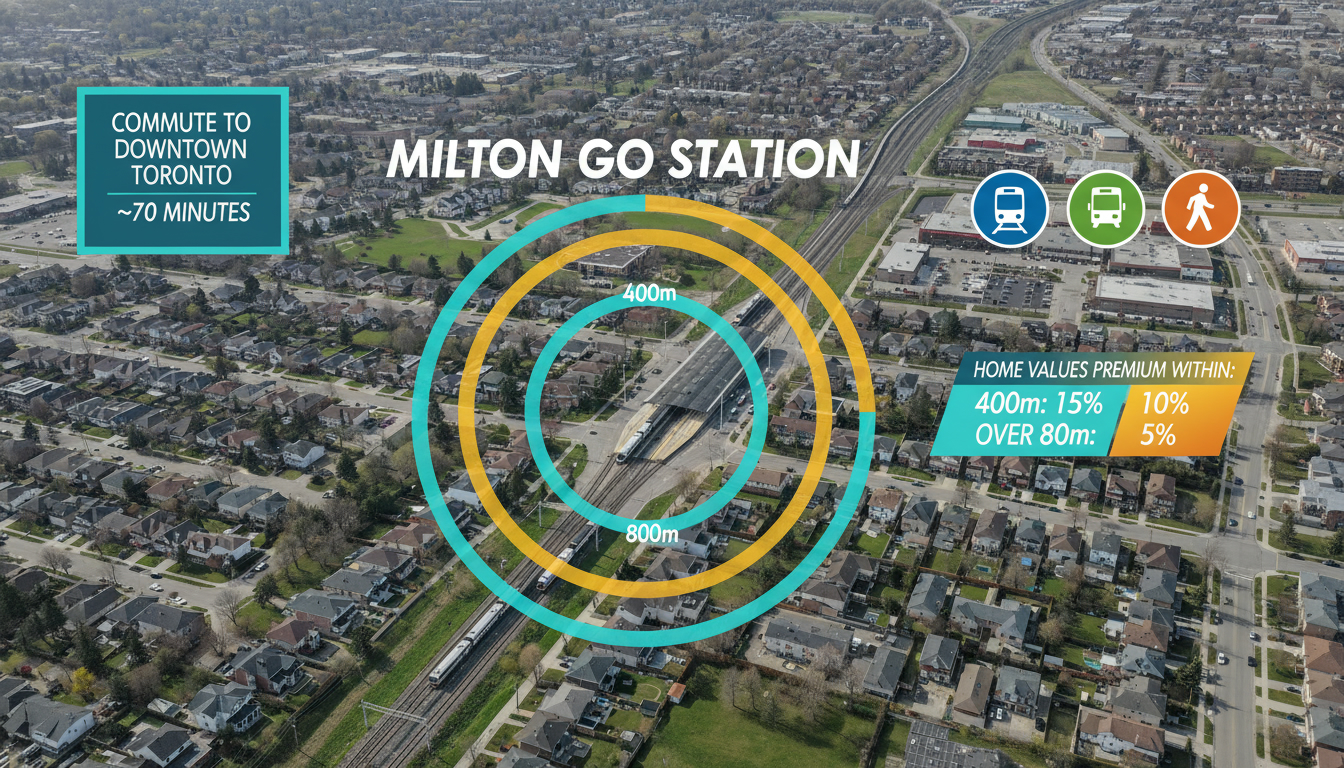
How does proximity to transit affect value?
Can being a 5‑minute walk from Milton GO station add tens of thousands to your home? Yes — and here’s how to make it work for you.
Why this matters to Milton home sellers
Buyers in Milton aren’t just buying a house. They’re buying time and access. Proximity to transit — especially Milton GO and major bus corridors — changes who can buy your home and how much they’ll pay. If you’re selling in Milton, ON, this can be the difference between a fast, over‑asking sale and months on market with price cuts.
This post will give you a clear, no‑fluff breakdown of how transit proximity affects investment and resale value in Milton, what numbers to expect, and practical steps to maximize your sale price.
Quick bottom line
- Homes within a 5–10 minute walk (≈400–800m) of Milton GO or major transit stops typically attract more buyers and sell faster. Expect a price premium in the range of 5–15% compared with comparable homes farther away.
- Properties immediately adjacent to noisy corridors can see a discount unless mitigated by design, landscaping, or pricing strategy.
- Future transit improvements (service frequency, GO Expansion) will push values up further. If you sell now you benefit from current demand; if you hold, expect long‑term upside as transit projects complete.

How proximity to transit changes demand (and price)
-
Larger buyer pool: Commuters to Toronto and Oakville want Milton homes that cut commute time. That means people who might otherwise buy closer to the city now consider Milton — increasing competition.
-
Higher rental demand: Investors target homes near transit for reliable rental income. Strong rental demand supports higher sale prices and quicker exits for investors.
-
Future proofing: Transit projects bring long‑term infrastructure investment. Buyers pay a premium today for easier access tomorrow.
-
Price transparency: Transit proximity is an easy selling point in listings and ads. It’s measurable. That clarity converts browsers into buyers faster.
The Milton context — what makes it different
Milton is not a suburb in name only. It’s one of Canada’s fastest‑growing communities. Here’s how local factors amplify the value of transit proximity:
- Milton GO Station connects the town to Toronto via the Milton Line, drawing daily commuters.
- Highway access (401/407) helps, but parking and congestion are getting worse; more buyers prefer to ride the train.
- New residential developments are clustered around transit nodes, creating transit‑oriented neighborhoods that command premium pricing.
- Milton’s population growth increases competition for entry‑level and family homes — transit access becomes a tiebreaker.
Numbers that matter for buyers and sellers in Milton
Data varies by street and property type, but here are practical ranges you can use immediately when evaluating a listing or preparing to sell:
- Walkable premium: 5–15% higher sale price for homes within a 5–10 minute walk of Milton GO or major bus hubs.
- Immediate adjacency risk: Homes backing directly onto rail lines or busy transit corridors can be priced 3–8% lower unless noise and privacy are addressed.
- Days on market: Properties near transit sell up to 30–50% faster in commuter markets during active demand cycles.
These ranges reflect market behavior in commuter towns similar to Milton. Your exact number depends on home condition, lot size, and local comparables — which is where a local expert matters.
What buyers pay extra for
Buyers aren’t paying for transit alone. They’re paying for three things transit gives them:
- Time saved: Shorter, reliable commutes. Time is the real currency.
- Lower car costs: Less wear, less fuel, lower insurance if commuting by GO or bus.
- Flexibility: Access to jobs, education, and urban amenities without daily driving.
When these benefits are clear in your listing and marketing, buyers justify higher bids.

Downsides and how to neutralize them
Transit proximity isn’t all upside. Savvy sellers address negatives before they become objections:
- Noise and vibration: Add landscaping, sound‑proofing tips in disclosures, and highlight renovations that mitigate noise (insulated windows, fencing).
- Privacy concerns: Use staging and photos that show privacy features: mature hedges, private yards, and fencing.
- Safety perceptions: Provide crime statistics where appropriate, emphasize active, well‑lit station areas and local community programs.
Price competitively if your property has unavoidable negatives. Buyers will pay for convenience — but not for obvious, unaddressed downsides.
How to market proximity to transit — concrete steps that sell
- Lead with commute times: Use “20‑minute door‑to‑door to downtown Toronto” rather than vague claims. Buyers react to specific time savings.
- Visual proof: Include maps showing walking radius, transit lines, and travel times in every online listing and flyer.
- Highlight lifestyle benefits: Show nearby coffee shops, schools, parks, and future development plans. Transit buyers care about walkability.
- Stage for transit buyers: Set up spaces for work‑from‑home buyers and commuters — a mudroom for commuters, a secure bike storage area.
- Price to capture competition: Price your home to get multiple offers if the comps support it. Transit‑proximate homes draw more interest; pricing is the lever.
Investment vs resale — what Milton sellers must know
Investment value and resale value align but are not identical. Investors focus on yield; homeowners focus on resale and liveability. Here’s how to balance both:
- Investors: Look for rental yield, low vacancy risk, and appreciation potential from transit upgrades. Near the station is usually safer for yields.
- Homeowners/sellers: Emphasize lifestyle and future resale. Small upgrades that improve noise reduction and curb appeal deliver outsized returns.
If you’re selling an investor property, show historical rents and occupancy rates. If you’re selling a family home, lead with commute times and school access.
Case study (hypothetical, practical)
Scenario: Two semi‑detached homes built same year, same layout. One is a 7‑minute walk to Milton GO, the other a 20‑minute drive.
- Seller A (near GO) lists at market with strong marketing. Gets 10% over MLS comps after three competing offers.
- Seller B (farther away) lowers price after 60 days and sells at market minus 3%.
The difference: buyer pool size, commute convenience, and perceived flexibility. That swing equals tens of thousands on a typical Milton price point.

Timing: sell now or wait for GO Expansion? Practical advice
GO Expansion and regional transit improvements are long‑term positives. But markets price expected improvements well before completion. If you need to sell within 6–12 months, you benefit from current commuter demand now. If you can hold for 3–7 years, expect appreciation as service improves — but you also take market risk.
If your goal is to maximize resale price quickly: prepare your home, market the transit advantage, and price to create competition.
If you can hold: quantify the upside with your Realtor and tax advisor. Long‑term ownership around transit typically outperforms peripheral locations in the same municipality.
Why local expertise matters: what a Milton specialist does differently
A generalist lists a property. A Milton specialist positions transit proximity correctly.
- They know which streets buyers prefer near Milton GO.
- They understand the buyer demographics: young professionals, families, investors — and how to reach them.
- They price to trigger multiple offers when the market supports it, not just to sell quickly.
That difference translates to real dollars. Don’t let a non‑local agent guess on your biggest asset.
Next steps if you’re selling in Milton
- Get a localized market assessment focused on transit impact. Ask for recent sale comparables within a 10‑minute walk radius.
- Fix obvious negatives: windows, landscaping, and minor noise mitigation improvements pay off.
- Build a transit‑first marketing package: commute times, maps, and lifestyle shots.
- Talk to a Milton specialist who can price to create competition.
Contact Tony Sousa to get a no‑nonsense, data‑driven valuation for your Milton property: tony@sousasells.ca | 416‑477‑2620 | https://www.sousasells.ca
FAQ — Transit proximity, investment & resale value in Milton, ON
Q: How much more can I expect to sell for if my Milton home is near Milton GO?
A: Expect a premium commonly between 5–15% for homes within a 5–10 minute walk. The exact premium depends on condition, lot, and comparables in your neighborhood.
Q: Does being next to the rail line reduce value?
A: It can. Immediate adjacency may apply a 3–8% discount without mitigation. Improvements like sound‑rated windows, mature screening, and smart landscaping often remove that discount.
Q: Will GO Expansion increase my home value?
A: Yes, better service and frequency increase demand. Much of the benefit is priced in early, but tangible gains typically follow completion of service upgrades.
Q: Should an investor or homeowner prioritize transit proximity in Milton?
A: Both benefit. Investors get lower vacancy risk and stronger rent growth. Homeowners get resale upside and better commute options. Prioritize it if your budget and lifestyle align.
Q: How should I market my Milton home’s transit access?
A: Use specific commute times, maps, and lifestyle images. Lead with “XX minutes to downtown Toronto via Milton GO” and show a walking radius on your listing.
Q: Who can help me value and market my transit‑proximate property in Milton?
A: Work with a Milton real estate specialist who understands local buyer profiles and transit impacts. Contact Tony Sousa: tony@sousasells.ca | 416‑477‑2620.
If you want a tailored analysis for your address, including a comparable market report focused on transit proximity, email Tony now and get numbers, not opinions.