How do I calculate affordability for a
mortgage?
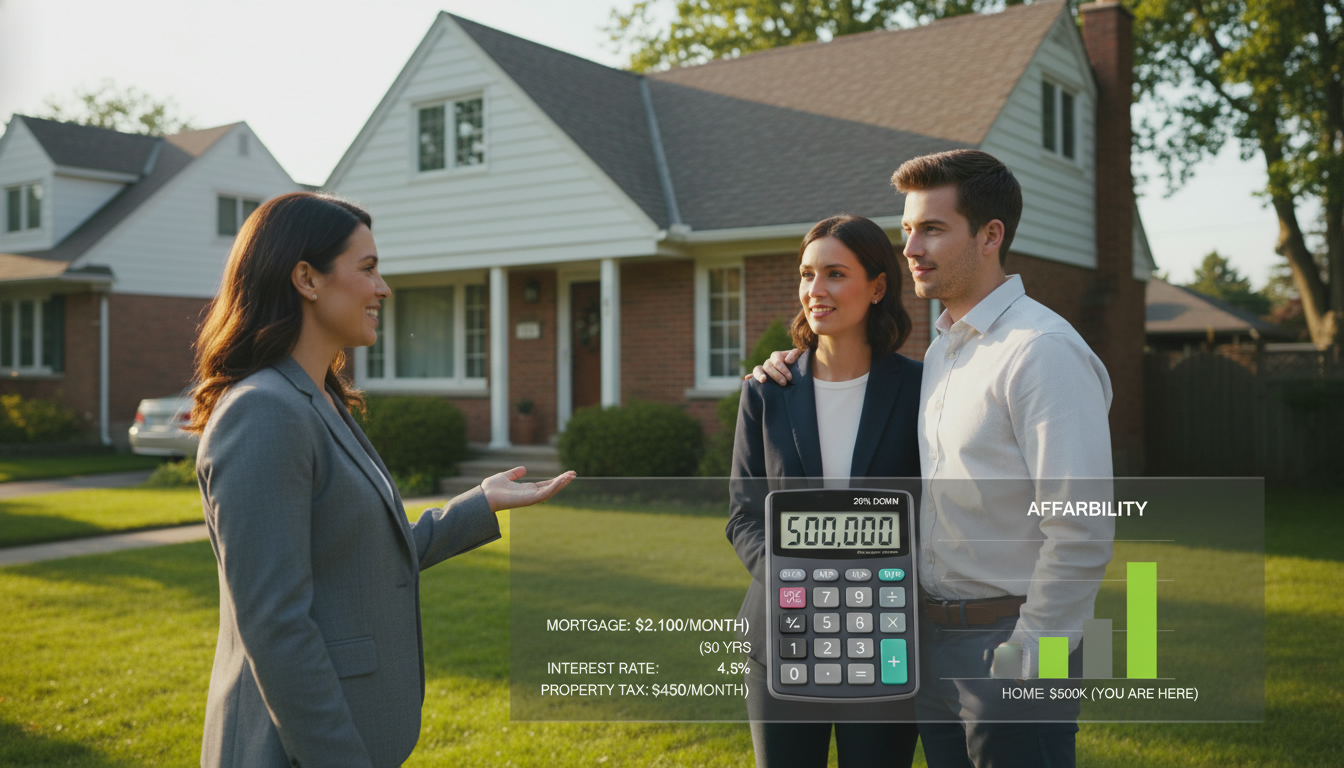
Want to know exactly how much house you can afford in Georgetown — in 5 minutes? Read this now and stop guessing.
Why affordability matters in Georgetown, ON
Georgetown is hot. Good schools, quick GO Transit access, and ownership demand from Toronto commuters push prices. That means guessing what you can afford kills deals. Lenders don’t guess. You should not either.
This guide gives a step-by-step affordability calculation you can do today. No fluff. Clear math. Local context for Georgetown, Ontario. Use it to get pre-approved faster and make stronger offers.
The three numbers every buyer must know
- Gross monthly income (before tax).
- Your existing monthly debt payments (car, lines of credit, credit cards).
- Down payment and cash available for closing costs.
Add local factors: property taxes, heating costs, condo fees (if applicable). Those feed into the final affordability number.
Lender rules that shape affordability (Canada basics)
Lenders use ratios to decide how much house you qualify for:
- GDS (Gross Debt Service) ratio: typically no more than 39% of gross monthly income. GDS includes mortgage principal + interest, property taxes, heating, and 50% of condo fees where applicable.
- TDS (Total Debt Service) ratio: typically no more than 44% of gross monthly income. TDS includes GDS plus all other monthly debt obligations.
Lenders also require qualifying at a stress-test rate (the greater of a published benchmark or your contract rate + 2%). That means your affordability is calculated using a higher rate than the rate you might actually get.
These rules are national, but their impact is amplified in Georgetown because prices trend above national averages for the region. That makes accurate calculation critical.

Step-by-step: Calculate your mortgage affordability (simple math)
Step 1 — Convert annual income to gross monthly income:
- Annual income $100,000 -> monthly gross = $100,000 / 12 = $8,333.
Step 2 — Calculate your GDS ceiling (use 39% if you want lender-friendly numbers):
- 0.39 x $8,333 = $3,250. This is the maximum monthly housing cost lenders will typically allow.
Step 3 — Subtract estimated non-mortgage housing costs:
- Estimate monthly property taxes (check the listing or Halton Region tax rates).
- Estimate monthly heating/utility costs and any condo fees.
Example (Georgetown estimate):
- Property taxes: $350/month (example — verify for each house).
- Heating + utilities: $150/month.
- Condo fees: $0 for a detached house.
- Total non-mortgage housing costs = $500.
So maximum monthly mortgage payment = $3,250 – $500 = $2,750.
Step 4 — Convert that monthly mortgage payment into principal (the mortgage amount) using the mortgage payment formula or an online calculator.
Use this formula if you want the math: P = M * (1 – (1 + r)^-n) / r
- P = mortgage principal
- M = monthly mortgage payment ($2,750 in the example)
- r = monthly interest rate (annual rate / 12)
- n = number of monthly payments (amortization years x 12)
Example with numbers (illustrative):
- Assume qualifying (stress-test) rate = 5.00% annually, so r = 0.05 / 12 = 0.0041667.
- Amortization = 25 years -> n = 300.
- The factor (1 – (1 + r)^-n) / r ≈ 171.0.
- P = $2,750 x 171.0 ≈ $470,250 mortgage principal.
Step 5 — Add your down payment to get the maximum purchase price:
- If you have a 20% down payment, Purchase Price ≈ Mortgage / (1 – 0.20) = $470,250 / 0.80 ≈ $587,813.
- If you have 10% down, remember you’ll pay CMHC mortgage default insurance which increases monthly costs and reduces the purchase power.
That’s the math. Replace the sample numbers with your income, debts, and current qualifying rate. Use the same steps and you’ll get your true affordability.
Quick calculator cheat-sheet (use this mentally)
- Monthly gross income x 0.39 = max housing cost (GDS ceiling).
- Subtract taxes, heat, condo fees = max mortgage payment.
- Multiply monthly mortgage payment by ~171 (for 25 years at ~5%) to estimate principal. Adjust multiplier for different rates/amortizations: higher rate = lower multiplier.
If you want exact numbers for today’s rates in Georgetown, run this through a lender or an up-to-date mortgage calculator. The method stays the same.
Local adjustments for Georgetown buyers
- Property taxes: Georgetown sits in Halton Hills. Property tax rates and assessments vary. Ask for last year’s property tax bill from the listing or agent; it directly reduces your borrowing power.
- Commute premium: Proximity to Georgetown GO station adds value. You can often pay a small premium and still get better resale. Factor in savings on commuting when comparing properties.
- Older homes: Many Georgetown properties are older and may need upgrades. Budget an inspection contingency and home improvement funds — these reduce down payment available.
- Multiples offers: In competitive listings, pre-approval backed by clear affordability calculations wins. Sellers and lawyers will look for a lender-ready buyer.
How down payment size and mortgage insurance affect affordability
- 20%+ down -> conventional mortgage, typically lower interest and no CMHC insurance.
- 5–19.99% down -> high-ratio insured mortgage; CMHC or private insurer charges apply. Insurance premiums are capitalized into your mortgage and increase your monthly payment, reducing purchase power.
Always model both scenarios. A smaller down payment might lower your immediate cash need but shrink the house you can afford once insurance and higher rates are included.

Common mistakes that kill buying power in Georgetown
- Ignoring the stress test. Lenders qualify you at a higher rate. If you only budget at your offered rate, you’ll be short.
- Forgetting closing costs. Land transfer taxes, legal fees, title insurance, and adjustments can cost 1.5–4% of purchase price.
- Using net income instead of gross. Lenders use gross income.
- Overcounting potential rental or bonus income without documented proof. Lenders usually require history and documentation.
How a local expert helps you win in Georgetown
A local mortgage-savvy realtor who understands Halton Region tax assessments, current seller expectations, and which lenders approve faster will save you real money and time.
I work with local mortgage brokers and lenders to prepare airtight affordability packages: verified income, documented debts, and pre-qualification at the right stress-tested rate. That turns your offer from hopeful to credible.
If you want this done for you, get a clear affordability number and a lender-ready pre-approval for Georgetown listings today. Contact the team below for a direct evaluation.
Call to action
Ready to stop guessing and buy with confidence in Georgetown? Email tony@sousasells.ca or call 416-477-2620. Visit https://www.sousasells.ca for immediate help and up-to-date listings in Georgetown, ON.
FAQ — Mortgage affordability and financing in Georgetown, ON
Q: What is the quickest way to know how much mortgage I can afford?
A: Calculate gross monthly income, apply a 39% GDS cap, subtract property taxes/heating/condo fees, then convert the remaining monthly budget to principal using a mortgage payment factor or an online calculator. Get a pre-approval from a lender to confirm.
Q: Do lenders use gross or net income?
A: Gross income. Use documented income only (T4s, pay stubs, CRA notices for self-employed).
Q: How does the stress test affect my affordability?
A: You must qualify at a higher rate (either a published benchmark or contract rate + 2%). That reduces the mortgage you qualify for compared to calculating affordability at your real negotiated rate.
Q: How much should I budget for closing costs in Georgetown?
A: Typically 1.5–4% of purchase price. That covers legal fees, land transfer taxes (Ontario + possibly municipal), title insurance, and adjustments.
Q: Will mortgage insurance (CMHC) reduce my purchase power?
A: Yes. The insurance premium increases your mortgage amount and monthly payments, so your qualified purchase price will be lower than with a 20%+ down payment.
Q: How do property taxes in Halton Hills affect my calculation?
A: Property taxes reduce your available monthly housing budget under GDS. Always check the actual tax amount for the property.
Q: Can I include bonus income or overtime when calculating affordability?
A: Only if you can document it consistently (T4s and employer confirmations). Lenders require proof of recurring income.
Q: What about amortization — longer amortization increases affordability, right?
A: Yes — longer amortization (e.g., 30 vs 25 years) reduces monthly payments and increases the mortgage principal you can afford, but it increases total interest paid over time.
Q: Are there local lender programs for Georgetown buyers?
A: Some local credit unions and banks in Halton offer competitive products for buyers in Georgetown. A local broker can point you to lenders that favor the Halton market.
Q: Who should I contact to get a precise affordability calculation and pre-approval?
A: For a local, accurate assessment and fast pre-approval for Georgetown listings, contact Tony Sousa: tony@sousasells.ca | 416-477-2620 | https://www.sousasells.ca
Contact for a free affordability check and step-by-step pre-approval support. Make your offer airtight. Own in Georgetown with clarity and confidence.