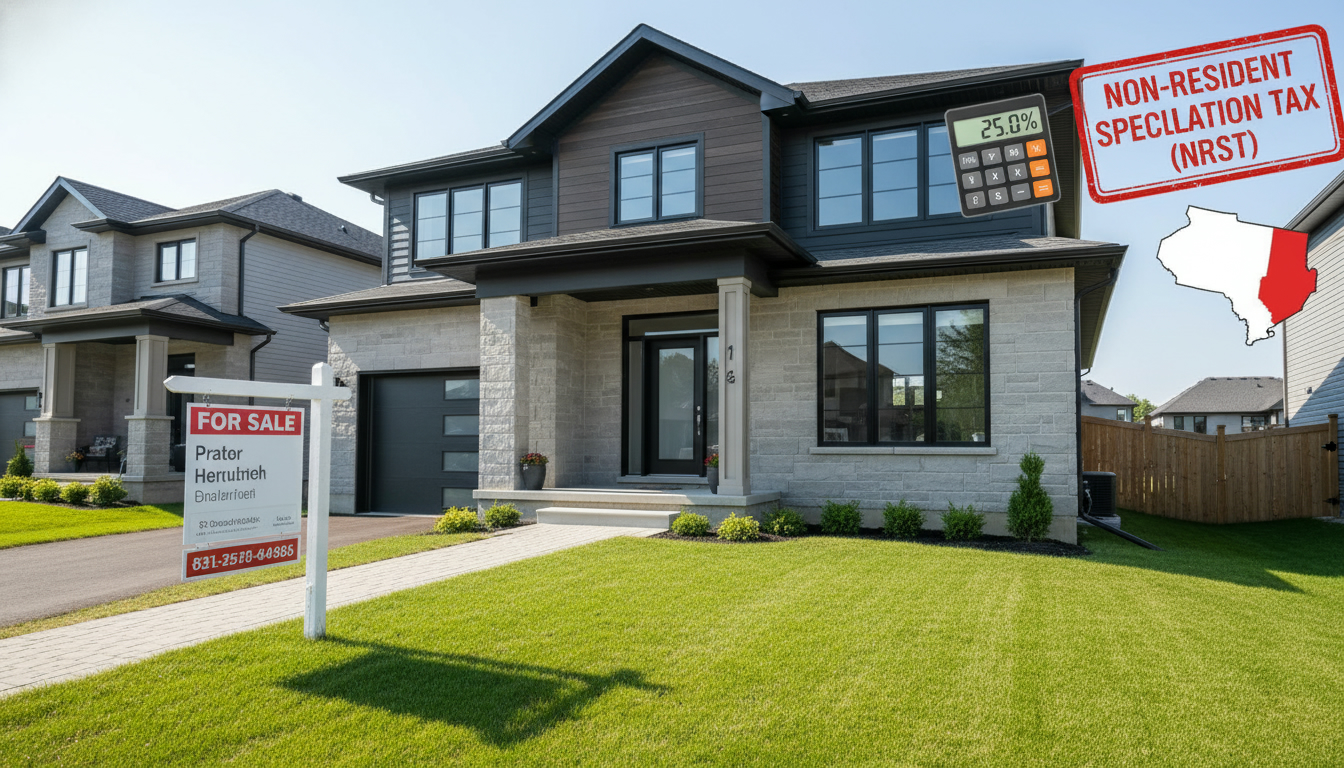
What’s the Non-Resident Speculation Tax?
“What’s the Non-Resident Speculation Tax?” — The Milton home seller alert that makes buyers rethink offers and can stall your closing.
Quick, blunt answer
The Non-Resident Speculation Tax (NRST) is a provincial tax aimed at purchasers who are not Canadian citizens or permanent residents. It’s charged on top of the purchase price when a non-resident buyer buys residential property in the Greater Golden Horseshoe — which includes Milton. Sellers don’t usually pay the NRST. But the tax affects sales, buyer qualification, timing, and closing risk. If you’re selling a home in Milton, you need to know how NRST changes negotiations and what to add to your sale documents to protect your closing.
What the NRST is and why it matters to Milton sellers
The NRST is a one-time tax applied at the time of purchase. Its purpose is to discourage non-resident speculation in Ontario’s hottest markets. Milton sits inside the Greater Golden Horseshoe, so properties here fall under NRST rules.
Why sellers should care:
- Buyers who must pay NRST may struggle to close if they didn’t budget for it. That can kill your sale or force last-minute price concessions.
- Offers can look stronger than they are. A buyer can sign an agreement but fail to fund the NRST, leaving you with a failed deal.
- Timing gets messy. NRST paperwork or refund applications can delay closing.
In short: you don’t pay the NRST, but it can cost you time, certainty, and negotiating leverage unless you plan ahead.
How NRST actually applies — the essentials
- Who pays: The purchaser, if they are not a Canadian citizen or permanent resident at the time of purchase and the property is in the designated area.
- When it applies: At the time of transfer/closing. The tax is calculated as a percentage of the purchase price.
- Where it applies: The Greater Golden Horseshoe — Milton is inside this area.
Sellers: the tax is a buyer-side cost. But it affects the deal. Expect buyers to ask for participation, concessions, or extra closing time. Expect lawyers and lenders to require proof of payment or exemption before finalizing financing.
Common buyer exemptions — and why you need proof
Exemptions exist for certain buyers: Canadian citizens, permanent residents, and others who meet defined residency or work/study criteria. There are also limited exemptions for certain corporate purchases or transfers.
As a seller, don’t take a buyer’s word for it. Require documentation in the Agreement of Purchase and Sale or ask your salesperson to include clear conditions:
- Proof of citizenship or permanent residency at time of offer
- Evidence of exemption status or completed NRST payment
- A financing condition that specifically accounts for NRST payment
This protects you from offers that appear solid but fall apart when the buyer can’t prove exemption or can’t pay the extra tax.
Real-world Milton scenarios you’ll see
1) The buyer signs at price X but hasn’t counted NRST in their cash-out. At closing, they short-fund the deal. Result: closing delay or collapsed deal.
2) The buyer claims an exemption (PR, citizen, etc.) but can’t prove it in time. Lawyer refuses to close. Result: renegotiation, extension costs, or cancelled sale.
3) Buyer pays NRST and later applies for a refund and wins. The seller is unaffected, but the buyer’s financing and timing were impacted during the refund process.
These scenarios show that NRST affects risk, not the legal tax obligation of the seller.
How to protect your sale — actionable checklist for Milton sellers
-
Include NRST clauses in the Agreement of Purchase and Sale. Require buyer to declare residency status and provide documents at time of deposit or condition removal.
-
Add a funding condition that expressly includes NRST payment as a permitted closing cost. That way lenders and lawyers treat it as part of the buyer’s obligations.
-
Ask for proof of funds that covers NRST. Don’t accept a pre-approval that ignores extra tax exposure.
-
Use an experienced real estate lawyer who knows NRST paperwork and refund mechanics.
-
Keep a backup offer active if your buyer’s NRST status looks uncertain.
-
Add a sunset clause or short conditional extension for NRST documentation only if you’re willing to accept the delay.
Follow these steps and you’ll protect closing certainty and keep leverage in negotiation.

What happens if the buyer didn’t pay NRST at closing?
If a buyer fails to pay when required, the transfer may not be registered, or it’s registered but the buyer faces penalties and interest. For you as the seller, the immediate concern is the failed closing. That means lost time, possible market exposure, and carrying costs. In extreme cases, buyers may try to renegotiate price to cover the tax shortfall. Don’t let that happen without legal counsel.
Refunds and disputes: a seller-focused summary
Buyers can apply for a refund if they qualify for exemption after purchase. Refund rules and timelines are set by provincial authorities. As a seller, be aware:
- A refund process is a buyer matter — it doesn’t shift tax liability to you.
- Refund applications can take months. That can affect post-closing disputes if the sale included special conditions tied to tax status.
- If the buyer financed and their loan assumed no refund, a delayed refund won’t change your proceeds but could affect their finances.
For clarity, instruct your lawyer to document explicitly who is responsible for tax-related delays or consequences.
Pricing and negotiation strategy when NRST is in play
If you’re selling in Milton, price your home based on market demand and comparable sales — not on NRST calculations. But during negotiation:
- Reinforce that the NRST is the buyer’s cost. Use your contract to make it unambiguous.
- If a non-resident buyer insists, ask for stronger deposit or proof of funds to offset risk.
- If you get multiple offers, prefer buyers who provide exemption proof or NRST-paid confirmation.
That’s how you maintain price integrity while managing closing risk.
Local market context — Milton and the Greater Golden Horseshoe
Milton remains attractive to buyers for commuter access, schools, and new developments. That draws both local and non-resident interest. Because Milton sits in the Greater Golden Horseshoe, NRST rules are relevant for many transactions here.
Understand local buyer profiles. A foreign buyer who planned for NRST will close cleanly. A buyer who didn’t budget for it will create problems. Your job as the seller is to filter offers so you aren’t left holding the bag.

Simple legal protections to add right now
- Proof-of-Residency clause: Buyer must deliver citizenship/PR or official exemption evidence before removing conditions.
- NRST Payment Clause: Buyer acknowledges payment obligation and will provide proof, or the buyer permits a 3-day extension to cure.
- Deposit Protection: Larger deposit or trust hold in cases of NRST uncertainty.
These are standard, enforceable contract tools when written by an experienced real estate lawyer.
Final direct advice
You won’t pay the NRST. But as a seller in Milton, NRST changes how deals close. Use contract language, demand documentation, and work with an agent and lawyer who know NRST mechanics. Treat NRST like any other closing risk — plan for it, don’t react to it.
If you want a market-specific action plan for your home in Milton — including contract language and negotiation strategy tailored to NRST risk — contact a local expert who handles these issues every day.
Contact for a fast, no-nonsense consult: tony@sousasells.ca | 416-477-2620 | https://www.sousasells.ca
FAQ — Non-Resident Speculation Tax and Milton home sellers
Q: Who actually pays the NRST?
A: The buyer pays the NRST. Sellers are not liable for the tax itself. The seller’s risk is transactional: failed closings, delays, or renegotiations.
Q: Does NRST apply to Milton properties?
A: Yes. Milton is inside the Greater Golden Horseshoe and NRST rules apply. Confirm boundaries and updates with your lawyer.
Q: What percent is NRST?
A: Provincial governments set the rate and it has changed since introduction. Always confirm the current rate with official sources or your lawyer before negotiating. (If you want immediate confirmation for your sale, contact a local expert.)
Q: Can a buyer get a refund of NRST?
A: Yes — buyers who were exempt at the time of purchase may apply for a refund. Refund timelines and documentation requirements are set by provincial authorities.
Q: What exemptions exist?
A: Exemptions commonly include Canadian citizens, permanent residents, and some residents with valid work permits or other qualifying circumstances. Exact rules and documentation vary; don’t accept verbal claims — get proof.
Q: How should I protect my sale contractually?
A: Include clauses requiring residency proof, NRST payment proof (or exemption documents), and appropriate funding conditions. Ask for stronger deposit or proof-of-funds when a buyer’s NRST status is uncertain.
Q: Will NRST affect my sale price?
A: Not directly. NRST is a buyer-side cost. But if buyers can’t close, you may face market exposure that could affect net proceeds. Use contract protections to avoid forced price concessions.
Q: What happens if a buyer can’t pay NRST at closing?
A: The closing can fail or be delayed. Your lawyer can cancel the deal or enforce remedies in the contract. That’s why you should require proof early.
Q: Who should I call for support in Milton?
A: Use a local real estate agent and a real estate lawyer experienced with NRST. For an experienced Milton perspective and tactical help, contact Tony: tony@sousasells.ca | 416-477-2620 | https://www.sousasells.ca
If you want contract language examples, a seller checklist tailored to your property, or a quick review of an offer that looks risky because of NRST, reach out. I’ll show you what to demand so the sale closes on your terms.