How do property taxes vary across Ontario?
Is Georgetown’s property tax secretly killing your sale — and what to do about it now?
Quick, blunt answer
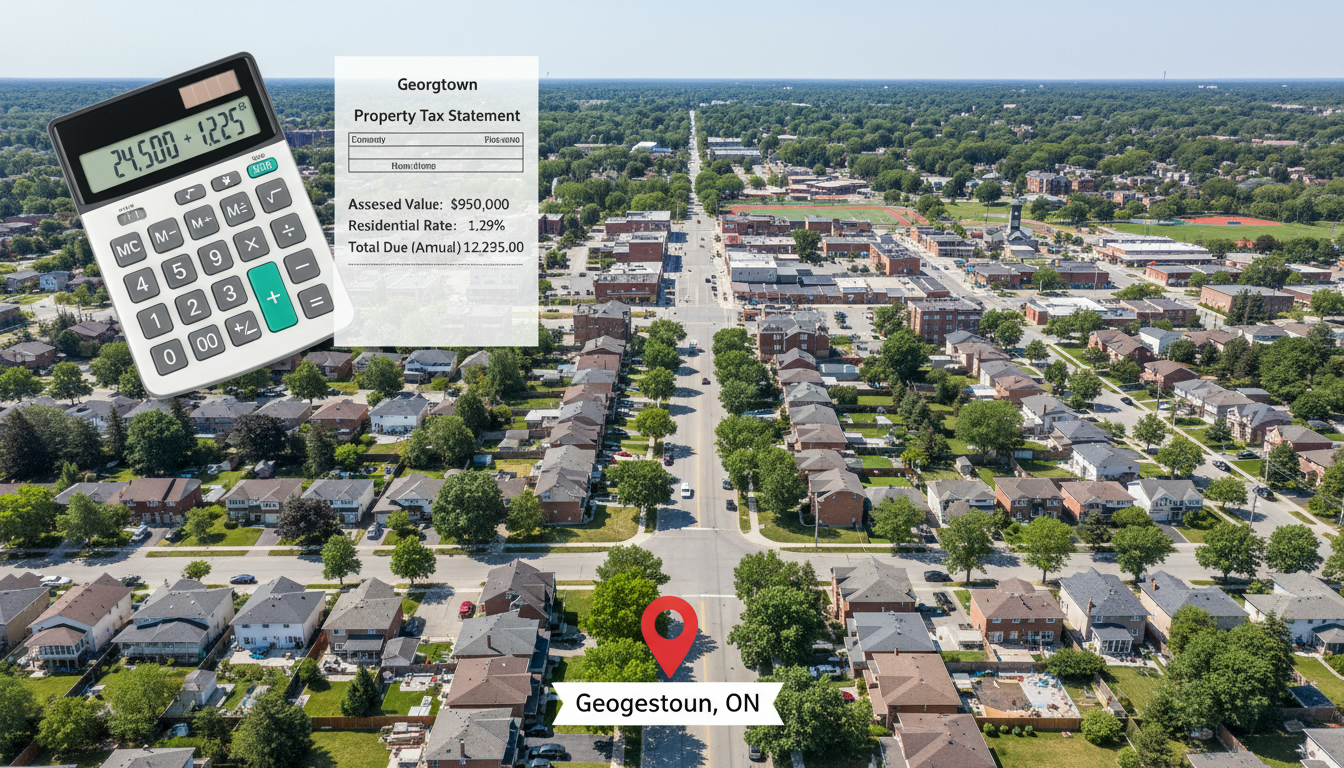
Property taxes in Ontario vary because assessed values, municipal tax rates, and local levies differ from place to place. For Georgetown (Town of Halton Hills) that means your tax bill depends on your MPAC assessment, Halton Hills’ municipal budget decisions, Halton Region charges, and provincial education taxes. In short: two houses with the same value in different Ontario towns often pay very different taxes. Understand this, use it in your pricing, and you can protect your sale and your profit.
Why this matters for Georgetown home sellers
If you’re selling in Georgetown, ON, buyers will compare total carrying costs — mortgage + property taxes + utilities. Higher perceived taxes lower buyer demand unless you explain the value (schools, transit, parks, proximity to GTA). Knowing local tax drivers lets you justify price, avoid surprises at closing, and convert hesitant buyers into offers.

How property taxes are calculated in Ontario (simple formula)
- MPAC gives each property a Current Value Assessment (CVA).
- Your municipal tax rate (set by Town, Region + provincial education portion) is applied to that CVA.
- Annual tax = CVA × combined tax rate.
Tax bill components: municipal tax (Town of Halton Hills), regional tax (Halton Region services), provincial education tax, and any special charges (e.g., local improvement levies, business improvement areas).
Why property tax rates vary across Ontario — the exact drivers
- Assessment levels (MPAC): Higher assessed values mean higher dollar taxes at the same rate.
- Municipal budgets and priorities: More spending on local services = higher municipal tax rates.
- Regional responsibilities: Regions like Halton collect for policing, transit, waste; that affects your portion.
- Property class mix: Residential, multi-residential, commercial — classes have different rates.
- Growth and development: Fast-growing areas may levy more to fund new infrastructure.
- Local levies and special charges: Waterfronts, conservation areas, or BIA fees add costs.
- Provincial education tax: Applied uniformly per property class, but it changes with provincial budgets.
- Reassessment timing: When MPAC updates values, relative taxes shift between neighborhoods.
What this means in practice — Ontario comparisons
- Big city vs small town: Toronto may have a lower tax rate but a much higher assessed value. A suburban town can have a higher tax rate but lower assessed values.
- GTA suburbs (like Halton Hills): Higher market values but often efficient municipal services. That combination can feel expensive in dollars but competitive in tax rate percentage.
Georgetown-specific realities sellers must know
- Georgetown is part of Halton Hills in the Region of Halton. Your tax bill includes Town of Halton Hills and Halton Region portions, plus the provincial education portion.
- MPAC’s CVA is the baseline. Recent market appreciation in Georgetown pushes CVAs up — that raises taxes even if the tax rate stays the same.
- Halton Region’s rapid growth and infrastructure needs (roads, transit links to GTA, parks) influence regional tax components.
- Georgetown’s appeal (commuting access, schools, green space) lets you justify pricing despite rising taxes. Use that narrative.

Actionable pre-listing checklist for Georgetown sellers (do these now)
- Pull your last 3 years of property tax bills and MPAC notice. Know the trend.
- Confirm your property class with MPAC (residential or other). Misclassification can cost you.
- Get a pre-listing tax estimate: multiply MPAC’s assessed value by current municipal + regional + education rates.
- Consider an assessment appeal if your CVA is clearly out of step with comparables. Appeals are time-sensitive.
- Factor prorated taxes into your sale contract. Buyers expect a clean closing — plan for it.
- Build a buyer-facing tax summary: show recent bills and explain what buyers get for those taxes (schools, transit, parks).
- Compare neighborhood tax history in Georgetown vs nearby towns — use this in your negotiation pitch.
- Price with tax context: if taxes rose because of improvements buyers value, you can insist on a stronger asking price.
- Work with a listing agent who knows Halton Hills— they sell the neighborhood value, not just the house.
- Put Tony Sousa on speed-dial: Tony knows Georgetown comps, MPAC patterns, and how to neutralize tax objections in offers.
How to turn property taxes into a selling advantage
- Translate taxes to service: “Your $X/month funds top-rated schools, commuter bus, and park maintenance.”
- Show the tax trend alongside neighborhood upgrades (new schools, road repairs). Demonstrate ROI.
- Offer a transparent tax history in your listing packet. Transparency builds buyer trust and reduces low-ball offers.
Common tax pitfalls that kill deals — avoid these
- Surprise MPAC reassessments during a sale. If values spike mid-listing, buyers panic.
- Leaving tax class errors uncorrected. That invites renegotiation after inspection or lawyer review.
- Ignoring special local levies or development charge notices attached to your property.
- Weak comparables that don’t reflect Georgetown’s costs and advantages.
Where to get exact numbers for Georgetown property taxes
- MPAC (mpac.ca) — current value assessment and property class.
- Town of Halton Hills finance/tax pages — municipal tax rates and budgets.
- Halton Region website — regional tax levies and services.
- Ontario government — education tax rates and provincial notices.
Pricing strategy templates — use these phrases when negotiating
- “Total carrying cost for this home, based on current taxes, is $X/month. That includes municipal services and regional transit access — a value add compared to lower-tax towns where services lag.”
- “MPAC assessed this property at $Y. That assessment funds high-quality local services which preserve resale value.”
- “We’ve provided three years of tax history in the disclosure package. These numbers are baked into our competitive pricing.”
Short case study (realistic scenario you can use)
A three-bedroom in Georgetown had a CVA jump after market gains. The seller clarified the increase with MPAC, pulled three years of tax bills, and explained to buyers that the higher tax dollars funded new transit links and school improvements. Instead of cutting price, the seller emphasized neighborhood value, received two offers, and closed at asking. The difference came from controlling the tax narrative — not lowering the price.
Final selling play: don’t let taxes be the scapegoat
Buyers who focus only on taxes miss the net value: location, schools, commute time, and future resale. Position your Georgetown home as the solution to a buyer’s needs, with taxes framed as the cost of top-tier services and growth.
Contact for Georgetown sellers
Need a local expert who converts tax headaches into selling power? Tony Sousa is a Georgetown realtor who handles MPAC issues, tax appeals, and neighborhood positioning every day. Email: tony@sousasells.ca | Phone: 416-477-2620 | Website: https://www.sousasells.ca

FAQ — Georgetown property taxes and neighborhood questions (quick answers)
1) How do I find my current property tax rate in Georgetown?
Check the Town of Halton Hills tax page for municipal rates and the Halton Region site for the regional portion. Multiply your MPAC assessment by the combined rates for an annual estimate.
2) Can I appeal my MPAC assessment before selling?
Yes. If your assessed value significantly exceeds comparable properties, file a Request for Reconsideration (RfR) with MPAC. Appeals have deadlines — start early.
3) Will property taxes be prorated at closing?
Yes. In Ontario, property taxes are usually prorated between buyer and seller based on closing date. Confirm details with your lawyer.
4) Do Georgetown taxes affect buyer mortgage approval?
Lenders consider total carrying costs. Higher taxes can reduce a buyer’s borrowing capacity, so present clear monthly cost estimates.
5) Are there neighbourhood differences inside Georgetown?
Yes. Older cores, new subdivisions, and conservation-adjacent areas can have different assessed values and sometimes different local levies. Always compare like-for-like.
6) Do school rankings influence property taxes?
Not directly. School quality doesn’t change tax rates, but it affects demand—higher demand pushes up assessed values, which raises taxes in dollars.
7) What if a buyer says taxes are too high — should I cut price?
Not automatically. Use the tax history and neighborhood benefits to justify price. Offer incentives if necessary, but defend value when services and location justify it.
8) Who pays for arrears or outstanding local charges?
Outstanding municipal arrears are typically the seller’s responsibility to clear before closing. Your lawyer will confirm this during title search.
9) How often does MPAC reassess properties?
MPAC issues notices after market-wide re-assessments. Reassessment frequency can vary; monitor notices and appeal promptly if needed.
10) How can an agent help with tax-related objections?
A skilled local agent explains the tax breakdown, shows comparable tax histories, and positions neighborhood value. They can also coordinate MPAC appeals and communicate with solicitors.
Sell smarter. Control the tax story. Convert objections into offers.
Contact Tony Sousa for a property tax review and a Georgetown listing strategy: tony@sousasells.ca | 416-477-2620 | https://www.sousasells.ca