How do I protect my home against floods and
natural disasters?
Want to shield your Milton home from floods and natural disasters — a no-BS plan that actually works?
Why Milton homeowners must act now
Milton sits at the edge of the Niagara Escarpment and is crossed by waterways like Sixteen Mile Creek. Rapid growth (approx. 132,000 residents in 2021) and more paved surfaces mean more stormwater runoff and faster rivers after heavy rain. Southern Ontario has seen more intense rainfall events in recent years. That combination makes Milton homes more likely to face basement flooding, sewer backup, and storm damage.
This isn’t scare talk. It’s a clear, tactical playbook you can use today to reduce risk, protect your assets, and negotiate better insurance terms.
Quick reality check: what insurance actually covers in Milton
- Standard homeowner policies often cover damage from sudden events like a windstorm or lightning, but many do NOT cover overland flooding (water that comes in from surface runoff).
- Sewer backup and groundwater seepage usually require specific endorsements.
- Overland flood coverage is available through some insurers or as a separate policy — but terms, limits, and deductibles vary.
If you don’t verify your policy, you’ll discover gaps after the water’s already in the basement. That’s not a mistake — it’s an expensive oversight.
The step-by-step protection plan (Immediate • Short-term • Long-term)
Follow these steps in order. Each step reduces damage and lowers long-term insurance costs.
Immediate actions (do these in the next 24–72 hours)
- Move valuables off the floor and put important documents in waterproof containers or scan them.
- Install a battery backup for your sump pump or add a secondary pump (dual pump system). Sump pumps fail most often during power outages.
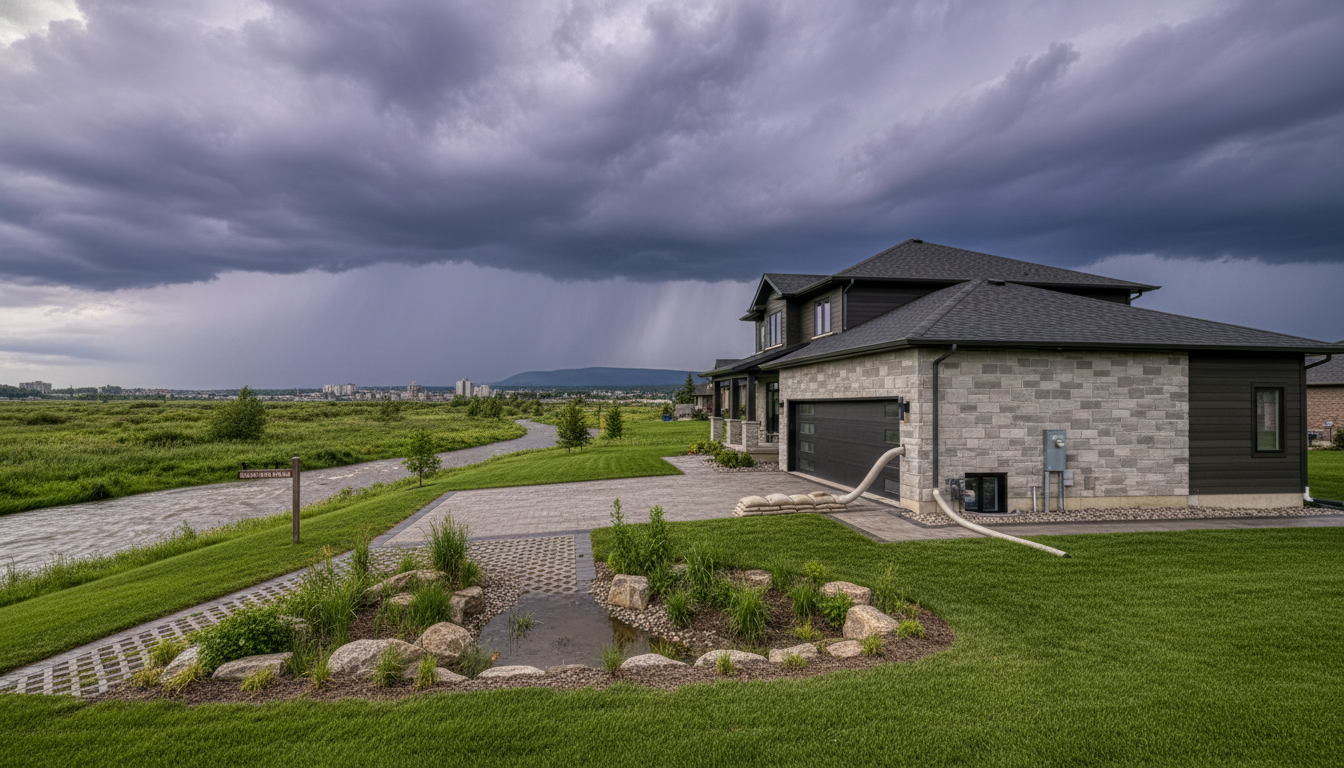
- Clear gutters and downspouts; aim downspouts at least 2–3 metres away from the foundation or into a storm sewer if local bylaws allow.
- Sandbags or portable flood barriers at door sills and low windows provide short-term defense.
Estimated costs: $0–$200 for materials, $200–$700 for a battery backup.
Short-term fixes (weeks to months)
- Fit a backwater valve/sewer backup valve on home sewer lines. This prevents municipal sewer water from flowing back into your basement.
- Seal foundation cracks with hydraulic cement and apply a water-resistant sealant on interior walls. This is a stop-gap until full waterproofing.
- Improve grading so soil slopes away from your foundation (minimum 6 inches drop over first 1 metre recommended).
Estimated costs: $800–$3,000 for backwater valve; $300–$1,500 for basic sealing and grading.
Long-term mitigation (months to years)
- Install an interior drain system and sump with high-capacity pump and alarm.
- Consider exterior waterproofing and excavation if recurring flooding occurs. It’s costly but effective.
- Hardscape for resilience: permeable paving, rain gardens, swales, and retention beds reduce runoff to your foundation.
- Elevate utilities (electrical panels, furnace, water heater) above expected flood level or move them to upper floors.
Estimated costs: interior drain + sump $4,000–$10,000; exterior waterproofing $5,000–$20,000 depending on scope; elevating utilities varies based on home.

Smart property changes that save you money on insurance
Insurance companies reward risk reduction. Take these steps to lower premiums and improve claims outcomes:
- Install backwater valves and sump pump backups.
- Document improvements and provide receipts to your insurer or broker.
- Join a community mitigation program or request a risk assessment from Halton Region.
Keep detailed before/after photos, invoices, and a simple maintenance log. When you negotiate with carriers, this paperwork proves you’re a lower-risk homeowner.
Insurance & risk: what to ask your broker right now
Ask these exact questions — don’t settle for vague answers:
- Does my standard homeowner policy include overland flood? If not, can I buy it as an endorsement or separate policy?
- Is sewer backup covered? If not, what endorsement covers it and what’s the deductible?
- Are there discounts or credits for mitigation measures (backwater valve, sump pump with battery backup)?
- What is my deductible for flood-related claims and how is “flood” legally defined in my policy?
Write answers down and get them in email. Verbal promises vanish when you need them.
Local resources every Milton homeowner must use
- Conservation Halton: floodplain maps and creek data. Check where your property sits relative to mapped floodplains.
- Halton Region Emergency Management: local alerts, flood response, and public guidance.
- Insurance Bureau of Canada (IBC): national flood insurance guidance and resources.
- Local licensed contractors experienced with basement waterproofing, backflow prevention, and landscape drainage.
Call them. Get maps, permits, and official advice before spending big money.
Real Milton examples (how this plays out locally)
- Houses near Sixteen Mile Creek and low-lying subdivisions are more prone to overland flooding after intense summer storms.
- New developments on tighter lots see faster runoff; older homes with mature yards often absorb water better.
This matters when you buy, renovate, or price insurance. Knowing local micro-topography and stormwater infrastructure decides whether you need perimeter drains or just gutter work.

Emergency checklist: the 15-minute survival prep
- Turn off electrical power if water is rising near electrical outlets.
- Locate main water shutoff, gas shutoff, and circuit breaker box.
- Grab the emergency kit: flashlight, phone chargers, water, first aid, essential meds, insurance papers, and some cash.
- Photograph damage for claims.
Cost vs. value — what you should expect
Mitigation saves money over time. A $1,500 backwater valve and $600 battery backup can avoid a $25,000 basement loss. Exterior waterproofing is expensive, but it increases resale value and reduces recurring claim risk — essential in a growing market like Milton.
How to prioritize spending
- If you’ve had a flood: interior drain + sump, backwater valve, and electrical elevation are priorities.
- If you’ve never flooded but live near creeks or low spots: invest in grading, gutters, and a battery-backed sump.
- If you’re buying or selling: get a pre-sale inspection that includes flood and drainage risk. That protects sale value and disclosure obligations.
Positioning you can use when negotiating with insurers or buyers
Documented mitigation + local risk awareness = negotiation power. When you show an insurer receipts for a backwater valve, sump battery and perimeter drainage, your risk profile drops. When selling, disclose mitigation measures and provide documentation to buyers to justify higher asking price.

FAQ — Milton flood and natural disaster protection (clear answers)
Q: Does my standard homeowner insurance cover flooding from heavy rain?
A: Usually no. Standard policies often exclude overland flooding. Get written confirmation from your broker and consider an overland flood policy.
Q: Is sewer backup covered?
A: Not always. Many policies require a sewer backup endorsement. Add it if you have a basement or live in a low area.
Q: Where can I check if my property is in a floodplain?
A: Start with Conservation Halton’s floodplain maps and Halton Region planning. They show regulated floodplain zones and permit requirements.
Q: How much does installing a backwater valve cost in Milton?
A: Typical range: $800–$3,000 depending on access and whether the line runs under a basement slab.
Q: Are there local grants or rebates for flood mitigation?
A: Programs change. Contact Halton Region and Conservation Halton to ask about current rebates or residential mitigation programs. Keep in mind most major retrofit costs are homeowner-funded.
Q: What’s the single best investment for a Milton homeowner?
A: A battery-backed sump pump and a properly installed backwater valve offer the biggest protection per dollar spent.
Q: Will mitigation lower my insurance premium?
A: Possibly. Insurers reward demonstrable risk reduction. Provide documentation and ask for re-evaluation.
Final word — a direct call to action
Protecting your Milton home isn’t complicated — it’s systematic. Start with the checklist: clear gutters, install a sump backup, add a backwater valve, and verify insurance coverage in writing. Then move to larger investments only after a targeted risk assessment.
If you want local, tactical help — someone who understands Milton’s flood risks, municipal systems, insurance nuances, and property values — reach out. You’ll get straightforward answers and a concrete action plan, not fluff.
Contact: tony@sousasells.ca | 416-477-2620 | https://www.sousasells.ca
If you want a prioritized mitigation checklist for your exact Milton property, email the address above and ask for a one-page risk assessment checklist.