
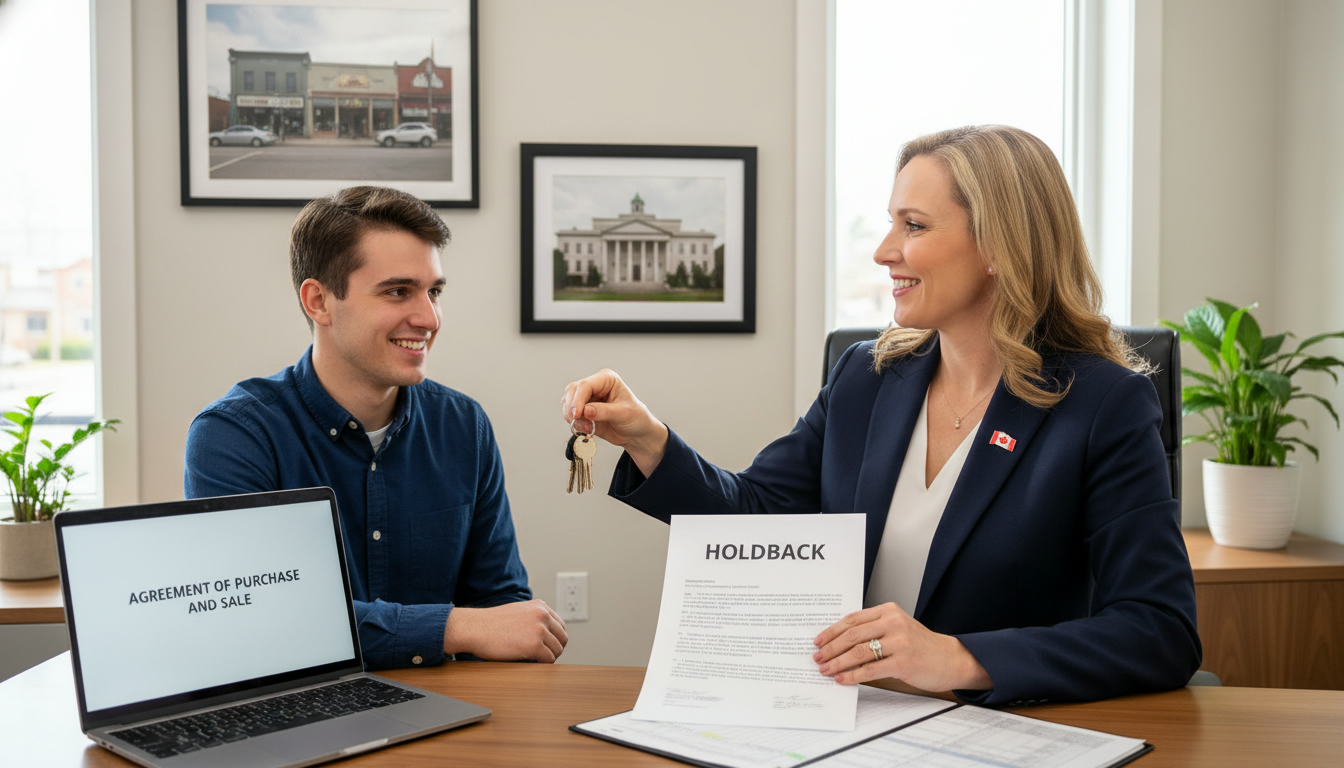
What’s a holdback?
What’s a holdback? — The single line that can cost you thousands if you ignore it
If you’re selling a home in Georgetown, ON, you need to know what a holdback is, how it works, and how to avoid getting your proceeds frozen at closing. This is clear, practical advice for sellers who want to walk away with full payment on closing day — no surprises, no delays.
Quick answer: What is a holdback?
A holdback is money agreed in the purchase contract that the buyer’s lawyer or the seller’s lawyer keeps in trust instead of paying to the seller at closing. The funds are held until a specific problem is fixed or a condition is met. Think of it as escrow for a known issue — a guarantee that work will be completed or a problem will be cleared after closing.
Why holdbacks happen in Georgetown, Ontario
In Georgetown and the wider Halton Hills area, holdbacks appear for the same reasons they do across Ontario — but local municipal rules and small-town construction records make a few holdback types more common here:
- Municipal compliance and property standards orders: unfinished permits or outstanding town work orders can trigger a holdback until the town signs off.
- Title defects or liens: unresolved builder liens, contractor claims, or encumbrances found in a title search.
- Incomplete agreed repairs: buyer asks for repairs after inspection; seller agrees but buyer wants cash held until verified.
- Missing documents: condo status certificates, compliance letters, or warranties not provided by closing.
- Unpermitted renovations: municipalities in Halton are strict — buyers often insist on funds held until permits are produced.

How a holdback is written into the Agreement of Purchase and Sale
The Agreement of Purchase and Sale (APS) is where the holdback lives. Common language includes:
- Holdback amount — either a fixed dollar amount (e.g., $10,000) or a percentage of sale price (commonly 1–3%).
- Conditions for release — what must be provided or corrected for funds to be released.
- Time limit — how long the lawyer will hold money before it is released or returned.
- Interest — whether interest earned while funds are held goes to buyer, seller, or is split.
Sellers in Georgetown must read Schedule A and any special conditions carefully. If an issue is foreseeable, handle it before listing to avoid holdbacks.
Who holds the money and how it’s managed
In Ontario, lawyers hold holdbacks in a trust account. They’re legally obligated to follow the wording of the APS and the release instructions. Typical process:
- Buyer’s lawyer or seller’s lawyer receives the funds at closing.
- Money is placed in trust.
- Release conditions must be satisfied and confirmed in writing (for example, the municipal compliance office issues a clearance).
- Lawyer releases funds according to instructions or court order if disputed.
Never accept a verbal promise. Only written release terms in the APS or signed undertakings by lawyers control the funds.
Typical holdback amounts — what sellers should expect
There is no single rule, but common benchmarks:
- Small issues: $1,000–$5,000 (appliance, missing paperwork, small repairs)
- Medium issues: $5,000–$25,000 (significant repairs, permit problems)
- Big issues/percentage: 1–3% of sale price (title defects, large municipal work orders)
The number must reflect the real cost to fix the issue. Buyers and their lawyers will ask for enough to cover worst-case repair or remediation.
Holdback vs. deposit vs. adjustments — know the difference
- Deposit: part of purchase price paid to seller’s brokerage and credited to buyer at closing.
- Adjustments: prorated expenses (taxes, utilities) calculated on closing statement.
- Holdback: separate amount kept in trust beyond closing for unresolved problems.
Confusing these is costly. Your lawyer and realtor should explain each line on the Statement of Adjustments.

Common holdback triggers specific to Georgetown sellers
- Building permits not closed for renovations.
- Outstanding property standards orders from the Town of Halton Hills.
- Work orders after inspections of older homes in Acton and Georgetown neighborhoods.
- Missing condo documentation for units in downtown Georgetown.
- Unpaid contractor liens for recent landscaping or roofing work.
If you suspect a municipal issue, contact the Town of Halton Hills before listing. Clearance letters or closed permits eliminate many holdback requests.
How to prevent a holdback — proactive seller checklist
Preventing a holdback is cheaper than solving one:
- Order a pre-listing title search and remove known liens.
- Close outstanding building permits and get municipal clearances.
- Get receipts and warranties for recent major work (roof, furnace, electrical).
- Provide a condo status certificate early if selling a condo in Georgetown.
- Consider a pre-listing home inspection and fix any issues buyers will flag.
- Work with a local real estate lawyer experienced with Halton Hills and Georgetown regulations.
The goal: remove the buyer’s reasons to hold money back.
When a holdback is reasonable — and when it’s a negotiation tactic
Buyers are entitled to protect themselves. A properly drafted holdback is reasonable when there is a real, verifiable issue. But sometimes buyers or their agents use inflated holdbacks as leverage in negotiation.
How to respond:
- Demand an itemized estimate for repairs or remediation.
- Offer a realistic amount in trust instead of stretching negotiations.
- Set a clear timeline and release conditions in writing.
- If negotiation stalls, let your lawyer mediate or seek a quick court order.
A solid local realtor and a skilled real estate lawyer stop aggressive holdback tactics fast.
Release and dispute — what usually happens after closing
Once the condition is met, the buyer’s lawyer must provide a written release or the seller’s lawyer can request the court to order release. If there’s a dispute:
- Lawyers exchange affidavits and invoices.
- The trust funds stay frozen until settlement or court order.
- In many cases, the parties agree to jointly instruct release upon completion of a final inspection.
Timeframes matter. The APS should include a cut-off date when the holdback expires or converts to a claim.

The legal paperwork every seller must have ready in Georgetown
- Agreement of Purchase and Sale: clearly state holdback terms.
- Title search and certificate: disclose liens and encumbrances early.
- Municipal compliance documentation: closed permits, clearance letters.
- Warranties and receipts: for major repairs and recent work.
- Condo status certificate (if applicable) and common element documents.
- Payoff statements for outstanding mortgages or second charges.
Bring these to your realtor and lawyer during listing. It keeps the closing clean.
Why local expertise matters
Georgetown and Halton Hills have specific municipal rules and common local contractors. A real estate lawyer familiar with the Town of Halton Hills will move faster on municipal clearances and lien searches. A local realtor knows which buyers will insist on a holdback and how to structure the APS to avoid it.
If you want to sell without drama, use a local team that knows Georgetown paperwork and how to get funds released quickly.
Final words — don’t let a holdback catch you off guard
A holdback is not a trap — it’s a tool. Used correctly it protects both buyer and seller. Ignored, it can delay your closing and reduce your proceeds.
Do the prep work. Disclose clearly. Use a local realtor and lawyer who will write smart holdback language and push for clean, fast releases.
For fast answers tailored to Georgetown sellers, contact a local expert who handles the legal paperwork and closings every week: Tony Sousa, Local Realtor — tony@sousasells.ca | 416-477-2620 | https://www.sousasells.ca
FAQ — Common seller questions about holdbacks in Georgetown, ON
Q: How long will funds be held?
A: It depends on the APS. Typical holdbacks have a fixed time (30–90 days). If not specified, funds remain in trust until release instructions or court order.
Q: Who decides the holdback amount?
A: It’s negotiated between buyer and seller and written in the APS. Lawyers usually recommend an amount based on repair estimates.
Q: Is a holdback interest-bearing?
A: Trust accounts may earn interest. The APS should state who receives interest. If not specified, lawyers follow professional rules — ask your lawyer.
Q: Can I avoid a holdback if a buyer demands one?
A: Often yes. Provide the missing document, close permits, or offer a short-term, smaller holdback while you obtain clearance.
Q: What if the buyer never does the work they promised after release?
A: Release conditions should require documentation (receipts, municipal sign-off). Don’t release funds on a handshake; require proof.
Q: Will a holdback affect my mortgage payoff?
A: The lender’s mortgage is paid at closing from the non-held proceeds. The holdback reduces your immediate payout but doesn’t stop mortgage discharge if the lender is paid.
Q: Who should I call in Georgetown for help with holdbacks and closing paperwork?
A: A local real estate lawyer and an experienced Georgetown realtor. For local help, contact Tony Sousa — tony@sousasells.ca | 416-477-2620 | https://www.sousasells.ca
Sell clean. Close fast. Don’t let paperwork steal your profits.